


Showing posts with label Elder Ephraim of Vatopaidi. Show all posts
Showing posts with label Elder Ephraim of Vatopaidi. Show all posts
Tuesday, February 3, 2015


Tuesday, January 14, 2014
10.000 Euros Compensation to Vatopedi Monastery
Father Ephraim of the Holy and Great Monastery of Vatopedi, was suing Greek journalist, Kostas Vaxevanis for two of his articles published on the Internet and in print, concerning exchanges between the monastery and the state.
Monday, October 7, 2013
Vatopedi monk, 13 others to stand trial over land swap deal

Sunday, December 30, 2012
Elder Joseph of Vatopaidi intervenes through the Radio and during the Holy Liturgy
The following incident refers to a friendly family of mine, and it took place on the 2nd of July 2009, a day after the blessed repose of Elder Joseph of Vatopaidi.
A. and her husband were going through some very tough times for the last few years and particularly since last May. It has to do with how her parents in law view her and how they behave towards their own son. In effect they are trying to separate the couple, who already have four kids, one newly-born- through quarrels, slurs, and malicious behaviour with appalling letters full of vile and slurs. They even managed to turn other relatives against the couple. However, being the spiritual children of Elder Efrem of Vatopaidi, the couple does not return the fire but shows patience and perseverance in trying to protect their family.
Nevertheless, being human, they are suffering. The wife reached the point where she thought that it is all her fault since everybody had turned against her and was desperate. Elder Efrem told her to forget about it and that it is not her fault. However, she cannot get rid of this thought.
The day after Elder Joseph reposed to the Lord, while she was driving her children to school with her husband’s car, she heard on the radio a faint, husky voice saying quickly: ‘Do not allow Satan enter your house. You must get rid of him. He particularly likes to dissolve marriages and families. What is happening is not your fault. It is Satan who makes you believe it is your fault and gives you a hard time unnecessarily’. When she returned home she told her husband that she had listened to a wonderful speech by an elder with a faint, husky voice, talking about their specific problem. When the husband got into the car, he listened to an interview which Elder Joseph of Vatopaidi gave to the reporter of the Metropolis of Limassol Radio, Mr Louka Louka. It was a very good interview but it was referring to irrelevant to their problem issues.
He thought to ask for the CD to listen to it with his wife. They made a copy of Elder Joseph’s interview, broadcasted on the 2nd of July 2009. The following night he drove to the Machaira monastery to attend an all night vigil. He turned the CD on but at no time did the Elder talk about Satan and the need to drive him out of our homes. The husband thought it was weird. Then he remembered that the radio station broadcasts the Holy Liturgy live from the Holy Monastery of Asomaton Petraki at 7.30am everyday. He confirmed this with those working at the radio station. Indeed, the previous day the radio was broadcasting the Holy Liturgy at 7.30 and not anything with Elder Joseph speaking. What had happened was inconceivable in our logic. Elder Joseph spoke to his wife during the Holy Liturgy!
This proved without any doubt that Elder Joseph, having found favour in the face of our Lord, intervened miraculously to calm down a devout soul which was unjustly suffering from slanders and slurs.
This event astounded us very much and proved that not only Elder Joseph had gained favour in the face of the Lord but also the fact that there is life after death and that Our Lord is a Living God. Our Lord is neither a theory nor some man-made fiction. However, we, His creations, doubt Him.
I mentioned this event to the Abbot of Vatopaidi, Elder Efrem. He was not surprised since he knew very well how his elder lived. The Metropolitan of Limassol Athanasios was also informed and confirmed again that at 7.30 every morning the station broadcasts the Holy Liturgy.
I have received the permission of the couple to reveal this astonishing ‘intervention through the radio waves’ by Elder Joseph, without mentioning their names.
NEARCHOS PANAGI
Dentist
Friday, March 16, 2012
Ephraim, Abbot of the Vatopaidi - The theologian view on sudden death
Nowadays
when science and technology are flying, when cultures converge and
there is a crisis in values, even the word ‘death’ is avoided and
anything reminiscent of it is ignored and discarded. Modern man views
death as something negative and as a loss; we usually say for the
departed: ‘We’ve lost him’. Whoever does not have the proper knowledge
about this issue of death, he is trying to ignore it. Thus he lives an
essentially neurotic life, drained of its true meaning.
The arrest of cardiac function and or the death of the brain -namely the biological, clinical death- is not a natural state for man and it is not a condition which is in accordance with God’s pleasure. “God made not death” (Wisdom of Solomon 1, 13). Death intruded into human nature and acts as a parasite. Death entered the world through the forefathers’ sin. It is not possible that evil originated from God, since God is good.
When He created man, He did not make him mortal. Death appeared after the sin was committed. “For in the day that you eat of it (of the fruit from the tree) you shall surely die” (Gen. 2, 17) Indeed, says Paul the Apostle: “just as sin came into the world through one man, and death through sin, and so death spread to all men because all sinned” (Romans 5, 12). That is, death as the result of the forefathers’ sin encroached into human nature and thereafter to the rest of the creation.
The Lord through His ineffable
providence fended so that man’s time of death remains unknown to him.
According to Orthodox Theology, if man knew the time he was going to die
he would not stop sinning, disregarding virtue. The fact that the time
of one’s death is unknown keeps him vigilant and ready. “Therefore, stay
awake, for you do not know on what day your Lord is coming” (Matthew
24, 42), namely either during your death or during His Second Coming.
However, this does not mean that the
Lord takes pleasure when sudden death occurs. There is a prayer used
during our Church services in which we beg the Lord to protect us from
sudden death among other perils. “Again we pray that this sacred church
and every church, city, town, and every country may be preserved from
famine, pestilence, earthquake, flood, fire, the sword, the invasion of
aliens, civil war and sudden death” (prayer from Midnight Office).
The Church prays not only for its active
members, the faithful, but for the entire world and its prospective
members. As a loving mother, she turns its attention and her affection
to all her children throughout the world in order to protect them from
all evil and grant them every goodness and blessing. For this reason the
Church prays not just for all orthodox but also for “peace throughout
the world…for those who travel by land, by sea, and by air, the sick,
the sufferin, the captives, and their salvation”.
Sudden death for the non-believer, the
atheist and the one who does not repent, becomes a horrid event with
terrible consequences since the time gifted to him by the Lord was not
utilized. He did not adopt a positive stance in face of the Lord,
against his own self and the world. This is attested by the fact that he
did not repent and did not live a life, mindful of the Lord. Thus, his
communion with the Lord, his participation in the eternal, divine bliss
becomes questionable after his death. The previously mentioned
supplication to the Lord to protect us from sudden death refers
precisely to such a person.
However, the faithful, the one who
practices a true, orthodox spiritual life, cannot be spiritually harmed
by sudden death, since it becomes irrelevant to him. The higher his
spiritual state the less afraid of death he is; we would even say that
such a person rather desires the advent of death.
This is not because he hates this life or views his body as a prison and wishes to be rid of it like the Platonist philosophers believed, but because the Christian loves life and desires his communion with the true Life, who is Christ Himself. Thus he professes along with Paul the Apostle: “to me to live is Christ, and to die is gain. If I am to live in the flesh, that means fruitful labor for me. Yet which I shall choose I cannot tell. I am hard pressed between the two. My desire is to depart and be with Christ, for that is far better” (Philippians 1, 21-23).
This is not because he hates this life or views his body as a prison and wishes to be rid of it like the Platonist philosophers believed, but because the Christian loves life and desires his communion with the true Life, who is Christ Himself. Thus he professes along with Paul the Apostle: “to me to live is Christ, and to die is gain. If I am to live in the flesh, that means fruitful labor for me. Yet which I shall choose I cannot tell. I am hard pressed between the two. My desire is to depart and be with Christ, for that is far better” (Philippians 1, 21-23).
Similarly, blessed Elder Joseph, the
Hesychast, exhibiting this fervor, this divine Eros for Christ, this
desire to enjoy the true life, used to say: “Death is a mighty, terrible
thing for many people; for me death is a repose, something very sweet” (
Elder Joseph the Hesychast: An expression of monastic experience). Thus
he used to advocate: “Blessed is he who remembers death day and night
and prepares to greet him. Death becomes a pleasurable event to those
who expect him but it becomes bitter and tough (as sudden death) to
those who do not expect him”.
St Silouan the Athonite presents a very
nice instance of sudden death. Let us suppose, he says, that there is a
King who lives in sin, in opulence and has acquired all the riches of
the earth. If somebody were to tell him that he was going to die while
sitting on his throne surrounded by princes and all his escorts,
enjoying a feast in all his glorious might, he would become upset and
tremble in fear. If however, one were to tell the same thing to a
pauper, who was loaded with God’s love, he would peacefully say: “Let
the Lord’s will be done. Praise be to the Lord for remembering me and
for wishing to take me to the place where the robber entered first”.
Nevertheless, it is best if man knew the
hour of his death so that he could pray and hand his soul over while
praying, as it happens with the righteous, pious Elders. Thus blessed
Elder Joseph, the Hesychast, knew beforehand- had been informed by the
Most Holy Lady- that he would repose on the day of her Dormition, on the
15th of August. But also many saints of our Church had been informed of
this event, like St Simon, the pole dweller, St Gregory Palamas and
others. St Theognostos says that no matter how many virtues or charismas
one has acquired “he must not pray to be absolved of his flesh without
being previously informed about his death; but indeed he must pray
extensively for this” (St Theognostos: Filokalia, vol. 2).
“The Lord’s designs are like the deep
abyss” (Psalms 35, 7) and “who has known the mind of the Lord” (Romans
11, 34). In His unfathomable designs and decisions, the Lord always
weaves the deliverance and the spiritual perfection of man, even if to
his finite mind it seems that he is harmed and suffers injustice. Thus
the Lord has permitted that many saints die a sudden death, like Jacob
the brother of the Lord and Apostle, St Moses, Ethiopas, St Stefan, the
New, the 38 elders killed at Sinai and the 33 elders killed at Rietho,
even the great reformer of hagiorite monasticism St Athanasius, the
Athonite, and others. These people, as spiritual fathers, have taken
upon themselves the sins of the people and have been sacrificed like
Christ for the deliverance of the world. They have also become the cause
for the awakening and revival of their generation. As St Anastasios of
Sinai says: people ought to marvel on the sudden death of a righteous
person and wonder: “If such a thing happened to a saint what is going to
happen to us, sinners?”
Sometimes the Lord allows the onslaught
of sudden death to wipe out numerous sins. In the book of Gerontinko it
is said that when a monk committed fornication, two of his former
co-ascetics, who had already died, begged the Lord to allow a lion to
devour him in order to wipe out his sin in such a painful way and have
him ranked among them and those saved. The prescient, blessed Elder
Porfyrios used to say that scientists have come very close to the
discovery of the cure for cancer, but the Lord does not give His
permission since Paradise is filled with cancer-patients.
Pain is intertwined with living.
Occasionally, we find ourselves cracking from the many, fierce hardships
that befall us, especially if we do not have enough faith. For
instance, if we know that somebody will die soon from an incurable
disease we find it hard to accept it, despite having prepared for it
psychologically. How much more difficult would it be to remain calm and
peaceful in the event of a young person suddenly dying?
Death is an unnatural, perverted and
abhorrent event. It will always be man’s last enemy. From ancient times
until recently, man would scrutinize death with intense existential
interest. Nowadays however, despite everyday viewing through the media
many collective or violent deaths in wars, accidents or crimes, man has
lost his existential attitude towards death and thinks it is something
natural.
When a Christian speaks about death, he
is not being pessimistic or compromises in a fatalistic way; neither
does he regard it as something natural; He considers death as an enemy
he must win over through Christ. “The last enemy that shall be destroyed
is death” (A Corinthians 15, 26). “The Word was made flesh” (John 1,
14) “that through death he might destroy the one who has the power of
death, that is, the devil” (Hebrews 2, 14). God was incarnated to
abolish death and sin and to beat the devil. Christ took over a mortal
flesh subjected to passions in order to win over death with His own
flesh.
Through His crucifixion and His Resurrection He beat death and gave man the ability to also thrash it, after being united with Him. Thus, after the incarnation of Word God, death has changed its name and its direction. It is no longer called ‘death’ but ‘repose’ and becomes the bridge towards eternal life. The righteous one “passes from death to life” (John 5, 24).
Through His crucifixion and His Resurrection He beat death and gave man the ability to also thrash it, after being united with Him. Thus, after the incarnation of Word God, death has changed its name and its direction. It is no longer called ‘death’ but ‘repose’ and becomes the bridge towards eternal life. The righteous one “passes from death to life” (John 5, 24).
St Nicodemus the Hagiorite advises us
not to forget that “death shows up like an unexpected thief and we do
not know how or when he will visit us. He may appear today, at this
hour, at this very moment and you, who woke up feeling fine, will not
last until the evening, while you, who have reached the evening, may not
wake up…Therefore, my brother, take heed and tell yourself: “If I die
suddenly, what will become of the wretched old me? What would be my
benefit even if I enjoy all the pleasures of the world?…. ‘Get thee
behind me, Satan and evil thought! I do not wish to obey you and commit a
sin’” (St Nicodemus, the Hagiorite: Exomologitarion).
According to the Fathers and the
experience of our Church our reposed brothers- especially those who have
departed suddenly- benefit a great deal from the memorial services and
the customary forty- liturgies we offer them, as well as from our
prayers, almsgiving and our own righteous way of living which is
reflected on their souls as light.
In concluding our short presentation in
which we have briefly touched upon some aspects of the issue of sudden
death from a theologian point of view, we would also like to stress that
death, namely the separation of the soul from the body, constitutes a
mystery on which only the Ruler of life and death has a say. It is up to
the Lord’s unanswered judgments whether we will die a sudden death or
not; but we must firmly believe and totally assimilate with all our
might the fact that through the Resurrected Christ, “death has no more
dominion” (Romans 6, 9) and that “the gift of God is eternal life”
(Romans 6, 23).
Monday, February 13, 2012
Ephraim, Abbot of the Vatopaidi Monastery - The theologian view on sudden death

Nowadays
when science and technology are flying, when cultures converge and
there is a crisis in values, even the word ‘death’ is avoided and
anything reminiscent of it is ignored and discarded. Modern man views
death as something negative and as a loss; we usually say for the
departed: ‘We’ve lost him’. Whoever does not have the proper knowledge
about this issue of death, he is trying to ignore it. Thus he lives an
essentially neurotic life, drained of its true meaning.
The arrest of cardiac function and or
the death of the brain -namely the biological, clinical death- is not a
natural state for man and it is not a condition which is in accordance
with God’s pleasure. “God made not death” (Wisdom of Solomon 1, 13).
Death intruded into human nature and acts as a parasite. Death entered
the world through the forefathers’ sin. It is not possible that evil
originated from God, since God is good. When He created man, He did not
make him mortal. Death appeared after the sin was committed. “For in the
day that you eat of it (of the fruit from the tree) you shall surely
die” (Gen. 2, 17) Indeed, says Paul the Apostle: “just as sin came into
the world through one man, and death through sin, and so death spread to
all men because all sinned” (Romans 5, 12). That is, death as the
result of the forefathers’ sin encroached into human nature and
thereafter to the rest of the creation.
The Lord through His ineffable
providence fended so that man’s time of death remains unknown to him.
According to Orthodox Theology, if man knew the time he was going to die
he would not stop sinning, disregarding virtue. The fact that the time
of one’s death is unknown keeps him vigilant and ready. “Therefore, stay
awake, for you do not know on what day your Lord is coming” (Matthew
24, 42), namely either during your death or during His Second Coming.
However, this does not mean that the
Lord takes pleasure when sudden death occurs. There is a prayer used
during our Church services in which we beg the Lord to protect us from
sudden death among other perils. “Again we pray that this sacred church
and every church, city, town, and every country may be preserved from
famine, pestilence, earthquake, flood, fire, the sword, the invasion of
aliens, civil war and sudden death” (prayer from Midnight Office ).
The Church prays not only for its active
members, the faithful, but for the entire world and its prospective
members. As a loving mother, she turns its attention and her affection
to all her children throughout the world in order to protect them from
all evil and grant them every goodness and blessing. For this reason the
Church prays not just for all orthodox but also for “peace throughout
the world…for those who travel by land, by sea, and by air, the sick,
the sufferin, the captives, and their salvation”.
Sudden death for the non-believer, the
atheist and the one who does not repent, becomes a horrid event with
terrible consequences since the time gifted to him by the Lord was not
utilized. He did not adopt a positive stance in face of the Lord,
against his own self and the world. This is attested by the fact that he
did not repent and did not live a life, mindful of the Lord. Thus, his
communion with the Lord, his participation in the eternal, divine bliss
becomes questionable after his death. The previously mentioned
supplication to the Lord to protect us from sudden death refers
precisely to such a person.
However, the faithful, the one who
practices a true, orthodox spiritual life, cannot be spiritually harmed
by sudden death, since it becomes irrelevant to him. The higher his
spiritual state the less afraid of death he is; we would even say that
such a person rather desires the advent of death. This is not because he
hates this life or views his body as a prison and wishes to be rid of
it like the Platonist philosophers believed, but because the Christian
loves life and desires his communion with the true Life, who is Christ
Himself. Thus he professes along with Paul the Apostle: “to me to live
is Christ, and to die is gain. If I am to live in the flesh, that means
fruitful labor for me. Yet which I shall choose I cannot tell. I am hard
pressed between the two. My desire is to depart and be with Christ, for
that is far better” (Philippians 1, 21-23).
Similarly, blessed Elder Joseph, the
Hesychast, exhibiting this fervor, this divine Eros for Christ, this
desire to enjoy the true life, used to say: “Death is a mighty, terrible
thing for many people; for me death is a repose, something very sweet” (
Elder Joseph the Hesychast: An expression of monastic experience). Thus
he used to advocate: “Blessed is he who remembers death day and night
and prepares to greet him. Death becomes a pleasurable event to those
who expect him but it becomes bitter and tough (as sudden death) to
those who do not expect him”.
St Silouan the Athonite presents a very
nice instance of sudden death. Let us suppose, he says, that there is a
King who lives in sin, in opulence and has acquired all the riches of
the earth. If somebody were to tell him that he was going to die while
sitting on his throne surrounded by princes and all his escorts,
enjoying a feast in all his glorious might, he would become upset and
tremble in fear. If however, one were to tell the same thing to a
pauper, who was loaded with God’s love, he would peacefully say: “Let
the Lord’s will be done. Praise be to the Lord for remembering me and
for wishing to take me to the place where the robber entered first”.
Nevertheless, it is best if man knew the
hour of his death so that he could pray and hand his soul over while
praying, as it happens with the righteous, pious Elders. Thus blessed
Elder Joseph, the Hesychast, knew beforehand- had been informed by the
Most Holy Lady- that he would repose on the day of her Dormition, on the
15th of August. But also many saints of our Church had been informed of
this event, like St Simon, the pole dweller, St Gregory Palamas and
others. St Theognostos says that no matter how many virtues or charismas
one has acquired “he must not pray to be absolved of his flesh without
being previously informed about his death; but indeed he must pray
extensively for this” (St Theognostos: Filokalia, vol. 2).
“The Lord’s designs are like the deep
abyss” (Psalms 35, 7) and “who has known the mind of the Lord” (Romans
11, 34). In His unfathomable designs and decisions, the Lord always
weaves the deliverance and the spiritual perfection of man, even if to
his finite mind it seems that he is harmed and suffers injustice. Thus
the Lord has permitted that many saints die a sudden death, like Jacob
the brother of the Lord and Apostle, St Moses, Ethiopas, St Stefan, the
New, the 38 elders killed at Sinai and the 33 elders killed at Rietho,
even the great reformer of hagiorite monasticism St Athanasius, the
Athonite, and others. These people, as spiritual fathers, have taken
upon themselves the sins of the people and have been sacrificed like
Christ for the deliverance of the world. They have also become the cause
for the awakening and revival of their generation. As St Anastasios of
Sinai says: people ought to marvel on the sudden death of a righteous
person and wonder: “If such a thing happened to a saint what is going to
happen to us, sinners?”
Sometimes the Lord allows the onslaught
of sudden death to wipe out numerous sins. In the book of Gerontinko it
is said that when a monk committed fornication, two of his former
co-ascetics, who had already died, begged the Lord to allow a lion to
devour him in order to wipe out his sin in such a painful way and have
him ranked among them and those saved. The prescient, blessed Elder
Porfyrios used to say that scientists have come very close to the
discovery of the cure for cancer, but the Lord does not give His
permission since Paradise is filled with cancer-patients.
Pain is intertwined with living.
Occasionally, we find ourselves cracking from the many, fierce hardships
that befall us, especially if we do not have enough faith. For
instance, if we know that somebody will die soon from an incurable
disease we find it hard to accept it, despite having prepared for it
psychologically. How much more difficult would it be to remain calm and
peaceful in the event of a young person suddenly dying?
Death is an unnatural, perverted and
abhorrent event. It will always be man’s last enemy. From ancient times
until recently, man would scrutinize death with intense existential
interest. Nowadays however, despite everyday viewing through the media
many collective or violent deaths in wars, accidents or crimes, man has
lost his existential attitude towards death and thinks it is something
natural.
When a Christian speaks about death, he
is not being pessimistic or compromises in a fatalistic way; neither
does he regard it as something natural; He considers death as an enemy
he must win over through Christ. “The last enemy that shall be destroyed
is death” (A Corinthians 15, 26). “The Word was made flesh” (John 1,
14) “that through death he might destroy the one who has the power of
death, that is, the devil” (Hebrews 2, 14). God was incarnated to
abolish death and sin and to beat the devil. Christ took over a mortal
flesh subjected to passions in order to win over death with His own
flesh.
Through His crucifixion and His Resurrection He beat death and gave man the ability to also thrash it, after being united with Him. Thus, after the incarnation of Word God, death has changed its name and its direction. It is no longer called ‘death’ but ‘repose’ and becomes the bridge towards eternal life. The righteous one “passes from death to life” (John 5, 24).
Through His crucifixion and His Resurrection He beat death and gave man the ability to also thrash it, after being united with Him. Thus, after the incarnation of Word God, death has changed its name and its direction. It is no longer called ‘death’ but ‘repose’ and becomes the bridge towards eternal life. The righteous one “passes from death to life” (John 5, 24).
St Nicodemus the Hagiorite advises us
not to forget that “death shows up like an unexpected thief and we do
not know how or when he will visit us. He may appear today, at this
hour, at this very moment and you, who woke up feeling fine, will not
last until the evening, while you, who have reached the evening, may not
wake up…Therefore, my brother, take heed and tell yourself: “If I die
suddenly, what will become of the wretched old me? What would be my
benefit even if I enjoy all the pleasures of the world?…. ‘Get thee
behind me, Satan and evil thought! I do not wish to obey you and commit a
sin’” (St Nicodemus, the Hagiorite: Exomologitarion).
According to the Fathers and the
experience of our Church our reposed brothers- especially those who have
departed suddenly- benefit a great deal from the memorial services and
the customary forty- liturgies we offer them, as well as from our
prayers, almsgiving and our own righteous way of living which is
reflected on their souls as light.
In concluding our short presentation in
which we have briefly touched upon some aspects of the issue of sudden
death from a theologian point of view, we would also like to stress that
death, namely the separation of the soul from the body, constitutes a
mystery on which only the Ruler of life and death has a say. It is up to
the Lord’s unanswered judgments whether we will die a sudden death or
not; but we must firmly believe and totally assimilate with all our
might the fact that through the Resurrected Christ, “death has no more
dominion” (Romans 6, 9) and that “the gift of God is eternal life”
(Romans 6, 23).
Sunday, February 12, 2012
Elder Ephraim: Like Anselm, we must not view the Lord through the prism of legal justice
WHAT manner of justice is that, to give eternal life to one that deserves eternal death?
Whence then, O good God, good both to the good and to the evil,
whence is it that Thou savest the
evil, if to save the evil is not just, and yet Thou doest nothing that is not just? Or is it because Thy goodness is incomprehensible that this lieth hid in that light unapproachable which is Thy dwelling-place?
evil, if to save the evil is not just, and yet Thou doest nothing that is not just? Or is it because Thy goodness is incomprehensible that this lieth hid in that light unapproachable which is Thy dwelling-place?
Verily it is in the most deep and secret abyss of Thy goodness that
there lieth hid the fountain, whence floweth the river of Thy mercy.
Anselm of Canterbury, “Proslogion”, Chapter IX, tr. Clement C. J. Webb (1903).

 |
| Elder Ephraim, Abbot of the Vatopaidi monastery on Mount Athos, greets a fellow monk. |
WE must not view the Lord through the prism of legal justice. [...]God will not inflict punishment. We must abandon the notion of a vindictive God.
“God is love” (1 Jn 4:8). “Word became flesh” (Jn 1:14) so “that through death he might destroy the one who has the power of death, that is, the devil” (Heb 2:14).The purpose and the cause of the divine incarnation, as well as Christ’s emptying Himself on the Cross, was to abolish death, corruption and the Devil, who is the father of deceit and of all sin.
According to Anselm of Canterbury (1033-1109) Christ, through His sacrifice on the Cross, does not gratify divine justice but “saves the sheep that went astray” (Mt 18:11), reconciles man with God and grants him deification.St John Chrysostom says that the Lord was never vindictive but it is us, humans, who are spiteful.The Lord does not need anything. He does not offer salvation in order to gain something. He offers salvation because he loves man; and He loves him because He wants to.
Elder Ephraim of the Vatopaidi, in Αρχιμ. Εφραίμ Βατοπαιδινού Καθηγουμένου Ι. Μ. Μ. Βατοπαιδίου, Αθωνικός Λόγος, Ιερά Μεγίστη Μονή Βατοπαιδίου, Άγιον Όρος 2010, translated here by Olga Konari Kokkinou.
O THOU mercy of God, from how abundant a sweetness, from how sweet an abundance flowest thou forth unto us! O boundless goodness of God, how ought we sinners to be moved by love of Thee!
For Thou savest the just, justice assenting; but deliverest the wicked, when justice condemns them; Thou savest the just by the help of their deserts; Thou deliverest the wicked against their deserts; Thou savest the just, acknowledging in them the good which Thou didst give them; Thou deliverest the wicked, pardoning the evil which Thou hatest.
O immeasurable goodness, passing all understanding, let that mercy be shed upon me, which proceedeth from the great riches of that goodness!Anselm of Canterbury, “Proslogion”, Chapter IX, tr. Clement C. J. Webb (1903).
source
Sunday, January 29, 2012
Εcumenical Patriarchate Denounces Russian Interference in the Ephraim Case
Τhe Ecumenical Patriarchate denounced the interference of the Russian Orthodox Church in the case of Abbot Ephraim of Vatopedi, after the Holy Synod concluded on Tuesday.
 In its official announcement, the Patriarchate points out that Mount
Athos lies within the jurisdiction and borders of the Ecumenical
Patriarchate, and though it may include Orthodox monks of different
national backgrounds, its matters hold no pan-orthodox interests.
Therefore, no other Autocephalous Church is allowed to interfere with
the operation and issues of Mount Athos in any way.
In its official announcement, the Patriarchate points out that Mount
Athos lies within the jurisdiction and borders of the Ecumenical
Patriarchate, and though it may include Orthodox monks of different
national backgrounds, its matters hold no pan-orthodox interests.
Therefore, no other Autocephalous Church is allowed to interfere with
the operation and issues of Mount Athos in any way.
The announcement followed a long discussion on the issue of the
pretrial detention of Abbot Ephraim of Vatopedi. The Ecumenical
Patriarch Bartholomew expressed his regrets over the whole situation
surrounding the case of Abbot Ephraim.
The announcement also emphasizes that the Ecumenical Patriarchate has
always avoided intervening with any judicial matters and
investigations, due to respect of judicial independence, and will
continue its policy, especially as far as this case is concerned, in
which the Patriarchate does not know the content of the relevant papers
in the case.
The Ecumenical Patriarchate had asked Abbot Ephraim to leave his post
until the judicial control of the Monastery’s affairs was over. This
suggestion was followed by Abbot Ephraim at first, but later on a second
decision of the Monastery’s Council allowed him to return to his
duties.
Saturday, January 28, 2012
How the Great and Holy Monastery of Vatopedi is helping people at Porto Lagos (Greece)
Human pain and the numbers of people who
lack even the most basic goods have increased because
of the economic crisis. Many people seek refuge in the
Church. This is what people do in times of hardship. On
the day of the feast of the miraculous icon of
Pantanassa, Fr. T talked with Fr. Nifon, who heads the
Porto Lagos Metohi,
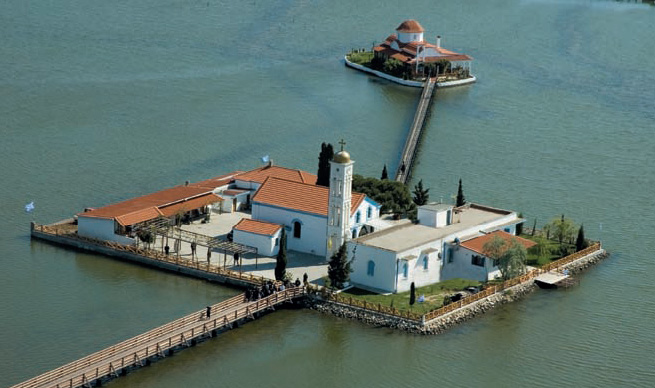
Firstly this discussion gives some historical details and
then it refers to the service which the monastery provides
to ease the hardships of those who seek refuge there.
“Love in real terms”… This is a story
brimming with the presence of the Lord…
Fr T: Let’s start with the history of the Metohi of
St Nicholas
Fr. N: The church of St Nicholas was built in order to
cater for the worshiping needs of the monks since the
place was a metohi. Earlier there was a church dedicated
to the two Saints Theodores and its ruins have been found
outside Porto Lagos. It is for this reason that there is
the icon of the two saints on the Templo (icon stand) in
the church. Tradition has it that St Nicholas appeared in
person and said that from then on “he would be the
patron saint of the metohi, since he was the patron of the
seas”. Thus the church was renamed after him. The
present church was built in 1904 on top of the ruins of
previous churches. This is attested by the fact that the
icons, which we have recently restored, date around 1850.
The monks from Vatopedi would visit the metohi regularly
to attend to its needs since it has been owned by the
monastery since the 11th Century. On this basis
we guess that the metohi was created on the small island
many years ago, but the church is more recent. We have
also recently built the bridge connecting the mainland
with the small island which houses the chapel of the Most
Holy Lady Pantanassa. Earlier people would use small boats
to visit the chapel. Indeed we will need many hours to
describe how many miracles were performed here not only to
Christians but to Muslims too.
FR. T: Is the chapel more recently built?
Fr. N: The chapel was built eighteen years ago. Our Elder,
Blessed Joseph built it and brought over from the Holy
Mountain the miracle performing icon of Pantanassa. This
icon has since become the consolation of the people in
Thrace, not just because of the many miracles the most
Holy Lady performs but because of her perceptible
presence. We will need many hours to account for all those
miracles. Today, a Muslim lady came and crossed the bridge
kneeling instead of walking, carrying two planted pots.
She said that two months ago she had pleaded for her
grandson who had a tumour and now the tumour has
disappeared.
 Fr T: How was the metohi populated over the years?
Fr. N: Occasionally the Vatopedi monastery would send over
somebody as an overseer while the monks would visit on the
feast days. They would also cooperate with the local
fishermen in benefiting from the pond. Many monks, who
served here, like Ignatios hieronmonk, are remembered in
inscriptions seen on the bell tower and the icon stand.
The last fifty years however, because of the peculiar
status of the monastery and the fact that it was sparsely
populated, no fathers resided here. However, there was
always a paid keeper in view of the political situation
which prevailed in the area. During the civil war, a
wonderful incident took place which was described to us by
the couple who was looking after the metohi. Now that they
are old came recently to see me. They stayed at the metohi
as soon as they got married. However, since it was
isolated and remote they had decided to send a letter to
the monastery offering their resignation. They were about
to send the letter the following day. On the same night
they saw a priest walking on the bridge who was covered in
bright light, even though it was already dark. He was
holding the Gospel in one hand and had a white omophorio
on his shoulders. When they went to ask who he was, he
told them not to leave and that he was going to look after
them. “I am the owner of the place. My name is
Nicholas of Myron” he said and disappeared. It was
St Nicholas and thus they took heart and stayed.
We, the brotherhood of Elder Joseph, assumed the
responsibility of the Vatopedi monastery at a time when
only ten elderly monks were living there. We had our hands
full in trying to restore the ruined monastery and as we
were only eighteen monks, had no time to deal with outside
affairs. At the time there was an elderly priest living at
Porto Lagos with his wife, who had subsequently left. Then
another priest was appointed and was guarding the place
with his family. When Vatopedi was re-established as a
coenobium and regained its former glory, more monks joined
the brotherhood and thus the monastery decided to deal
with Porto Lagos. Elder Joseph started coming here and
gained first hand experience of the desolation and poverty
in the area and ached for the hardships that people faced.
He then decided to revive it, since God’s providence
wished to keep our presence in these lands, bordering with
Turkey. Thus he built the chapel to Pantanassa and
fervently wished to populate it and establish it as a tiny
monastery. This happened in 2003 with the blessing of our
Abbot, Elder Efrain. Thus a small brotherhood of three was
sent here, which resumed the liturgical services daily. I
think this is the greatest gift we could offer to people;
namely, to hold the divine service daily. There is no
greater value than that derived from the Divine Liturgy
since the whole place is sanctified and thousands of names
are being read during the paraklisis and the liturgies. We
firmly believe in God’s providence and we do not
lose our hope…

FR. T: We hear that ever since you came here you have been
busy…
Fr N: As soon as we arrived we met with many difficulties
but with God’s help we survived. We have been trying
with our limited abilities and the assistance of the
monastery and the blessing of our Elder Efrem, to stand by
the people who suffer and share in their pain, which is
overflowing.
Everyday, more and more people arrive here, wanting
assistance and we have reached the point where we can not
cope. With God’s help we have also started assisting
people in jail. Every Saturday we hold meetings with
students. On the 24th September we will start
again and Elder Efrem will come and speak. Even though we
are far away, the youngsters visit us every week. Every
Sunday afternoon, we hold meetings open to everyone and
every Wednesday night we hold a night service at the
chapel of St Nektarios. This chapel was miraculously built
despite the strife that was started against its
establishment. They have even imposed a fine on us for
building it. I do not mind that our Muslim brothers build
their own mosques since they live here. But I object to
the double standard imposed by the authorities. They have
withdrawn the 700,000 Euro fine imposed on the Mosque
which was built but they insisted that we paid our own
fine. Nevertheless, we place our faith in the Lord and we
are not overcome by these things. However, it is quite
hard, when one is facing such temptations…
Fr T: A lot of things have been said about the Vatopedi
Monastery. How did you deal with all these?
FR N: This last temptation was substantial and especially
hard for our Abbot. I have been in Greece for almost
thirty years and have never heard such insults thrown
against anyone in so many television shows, in so many
newspaper articles as was done against our Abbot.
Nevertheless, no one speaks about it any more. It has
blown over. If people knew what Vatopedi does for people,
they ought to be grateful. During the military disaster in
Asia Minor, the monastery gifted 35,000 acres in Halkida
to the Greek state, on condition that it will abandon its
claim on the Visthonida pond and the surrounding areas.
The monastery out of sheer love for the refugees gave all
its property at the time. Only 3% of its assets are left
outside the Holy Mountain nowadays. Unfortunately the
authorities wanted to oust the monastery from here. They
wanted us out of here and this was strange. The monastery
did not want to proceed with the land exchanges because it
did not wish to abandon the pond and the surrounding
areas; the state decided to do this. We should be
concerned about the condition imposed that the areas to be
exchanged should be outside the Thrace area. Why? Is it to
obliterate the memory of the monastery from the area? Is
it because they did not want the presence of the
Ecumenical Patriarchate here? Therefore, whom did they
want to leave Thrace to?
The monastery does not belong to Elder Efrem or to Fr
Arsenios or Fr Nifon. It belongs to the people. They said
that we had accepted bribes. However, the monastery is a
public institution and not private. Renowned lawyers like
Konidaris said that the state took money from one pocket
and put it in the other. This is where misinformation and
wickedness lead one. Nevertheless, we take no heed. We
look ahead. Many, friends and foes alike, used to say that
the monastery waw going to be dissolved. I must say that
we are more united than ever and our bond has been
strengthened. We must all bow our heads in front of our
Abbot who lasted for so long under such slanderous
onslaught. He lasted because he is a man of prayer and
humility. Camera crews were camped here permanently. We
made the front pages in the newspapers. All television
programmes would start in the morning and not stop even in
the evening talking about this issue. They even
caricatured him in the carnival. Nevertheless, he lasted
without holding grudges against anyone; he continues to
love them all, and we get on with our jobs. We could just
stay put inside the metohi. But we do not do it. We
continue to fight to save the young and all those who ask
for our help. Occasionally we are upset because we do not
have anything to give to the people who ask for our help.
Fr T: Has the number of those who seek refuge here
increased under the present economic conditions?
FR N: Where else are people going to get assistance if not
from the Church at times of crisis? Our people come here,
at the monasteries, and that’s why it is imperative
that monasteries own property so that they are able to
help our aching brothers. Where else can they go? Even
Muslims come here. The numbers went up dramatically and as
I see it, this trend will continue. Many times we cannot
cope and we are upset. This is what the monastery and
Elder Efrem wanted to do in the area. That’s why
there were companies who wanted to get involved in
developing the place. Even Prince Charles wanted to
contribute in creating bicycle lanes and developing the
pond, even building a byzantine village, but the
authorities could not appreciate it.
Last year, we had to pay 8600 Euros in rents for destitute
students. We also paid for the schooling of needy children
and supported the families of those in jail. This is part
of the welfare aspect of Vatopedi. All these are possible
because the monastery and ordinary people assist us. A lot
of Cypriots contribute to the expenses of various children
and thus we are able to help them. The monastery also
assists us since it is very hard to offer hospitality to
thousands of people. Two days ago a father who was made
redundant told us that he was feeding his small child
water with sugar because he had no money to buy milk. Is
this imaginable in Greece in the 21st Century?
Monasteries and the monks become the recipients of human
suffering.
We are also sending many young drug addicts to the
recovery centre which our own brother, Metropolitan
Athanasios, has built in Cyprus: “Ayia Skepi”.
We have already sent over fifty kids from the area and
there are currently twenty five attending at the centre
and more are outside recovering from their addiction.
These things are only known to the parents who come here
in anguish.
We have also taken over the Institution of Saint
Theodores. When the kids, drug addicts, die, the parents
have nowhere to go. They often are old and they may get
sick. Who is going to look after their child, who is
addicted? The centre owns a plot of land and we are trying
to build it. It is being difficult. I told them that I
will become a beggar for these kids. With God’s help
we managed to collect some money. Unfortunately there is a
delay in the issue of the building permission. We are not
seeking recognition. We do it for love and for our
Lord’s command. But we are facing a lot of
obstacles. “One hand must not know what the other
hand is doing”. However, we have to talk about this
task, which is not ours, but the Church’s, so that
people now that the Church is working quietly and is not
publicizing its work.
Fr T: Who supports this work?
Fr N: It is not carried out solely by us because our means
are limited as a result of the closure of the
monastery’s bank accounts. The love of people
supports us. We will not stop, we go on. It is not right
to talk about such things, but we must fight for the
prevalence of the truth. People in Thrace know about these
issues.
Fr. T: What you are doing with the people in prison is
also well known. What exactly is your mission there?
 Fr N: For the last seven years I have been visiting the
prisons. I also invite imams and muftis to come along to
help their own people. But, I am alone. I do not
discriminate when I go there. There are about 300
prisoners, mostly foreigners. They do not have a shaver,
or soap, or a phone card to call their children. There are
people in prison for the last six years and no one visits
them. There are people who come to me and say: “I do
not need anything. I only want to speak to someone!”
You get really emotional when you meet them. Last year
they were feeling the cold since the prison authorities
were cutting back on costs. Who wants to know what needs
these people have? Christ says: “I was in prison and
you did not visit me.” Of course it is not Christ
who is in prison. They said to Him: “When did we see
you in prison and did not visit you?” Those jailed,
for whatever reason are described by Christ as His
brothers. “Since you did not do it for my brothers,
you did not do it for me either”. Anyone of us can
find himself in this position. Not all of them are
murderers or thieves. There are people who owe monies to
the state, whom we release by paying for their debts. Many
people do not like this. This week a boy of 18.5 is coming
out. He was put in jail for one month for begging. It cost
600 Euros to buy his sentence. This is how Greek justice
is satisfied: to put a youngster 18 years old in prison
because he was selling balloons without permission. His
mother
Fr N: For the last seven years I have been visiting the
prisons. I also invite imams and muftis to come along to
help their own people. But, I am alone. I do not
discriminate when I go there. There are about 300
prisoners, mostly foreigners. They do not have a shaver,
or soap, or a phone card to call their children. There are
people in prison for the last six years and no one visits
them. There are people who come to me and say: “I do
not need anything. I only want to speak to someone!”
You get really emotional when you meet them. Last year
they were feeling the cold since the prison authorities
were cutting back on costs. Who wants to know what needs
these people have? Christ says: “I was in prison and
you did not visit me.” Of course it is not Christ
who is in prison. They said to Him: “When did we see
you in prison and did not visit you?” Those jailed,
for whatever reason are described by Christ as His
brothers. “Since you did not do it for my brothers,
you did not do it for me either”. Anyone of us can
find himself in this position. Not all of them are
murderers or thieves. There are people who owe monies to
the state, whom we release by paying for their debts. Many
people do not like this. This week a boy of 18.5 is coming
out. He was put in jail for one month for begging. It cost
600 Euros to buy his sentence. This is how Greek justice
is satisfied: to put a youngster 18 years old in prison
because he was selling balloons without permission. His
mother
came to us crying. We went and paid off his
sentence.
This is not all we do for the prison system. With the
permission of the prison director we have renovated the
whole institution. When I first went there, the state of
the buildings was abysmal. We managed to take off the iron
bars from the meeting room, since children would visit
their parents in prison and it was not right to have bars
on the windows. We replaced the glazing and tiled the
yard. We had managed to buy the tiles but did not have the
money to pay for the cement. I went everywhere but no one
was interested. If they do not wish to thank us, at least
they should not place obstacles in our way.
Fr T: With all that has been happening, there is a lot of
talk about Paisios’ prophesies. How should we deal
with them?
Fr N: Both Elder Paisios and our elder Joseph and all the
Fathers look for the cause of the economic crisis. It is
the result of a spiritual crisis. Our Elders used to warn
us about these consequences. They used to urge us to
return to our roots, to our values, to repent. We were in
awe of the European culture, which we had given them, and
now we are left behind. We omitted giving our Children the
faith in Christ and the love for our country. All our
values, our customs, which St Kosmas was calling upon us
to safeguard, have been abandoned. Does anyone dare speak
about chastity, humility or prayer? When there is a
spiritual crisis there is a financial crisis as well. This
crisis is not doing us any harm. It will wake us up. As a
nation we have been used to lavishness. We had it all and
threw it away. I believe that if all these people who are
protesting at Syntagma square, and they are correct in
doing so, were to lift up their hands in prayer just as
they did at Nineveh , the Lord would change His plans. We
have the Lord who is Love and we have abandoned Him, we
run after different gods. If we return to our base and
show repentance and cry for our sins, you will see that
everything will change. Our nation has gone through many
occupations and times of poverty, but because we believed
and fought for Christ and our country we survived as a
nation and as people. Let us now proceed to the giver of
Life and not lose hope. We must not discourage our young
people either; but on the contrary we must urge them to
have hope and tell them that the Lord is with us; He will
not abandon us.
Fr T: Doesn’t the Church bear any responsibility for
what is happening?
Fr. N: Of course it does. We are not free from blame. When
there is a cultural and material crisis everyone is to
blame, the Church, the educators, the state. But we must
all assume our personal responsibility for what is
happening rather than blaming others. If each and every
one of us says that he is to blame and tries to become a
better person, then the whole will become better as well.
The Church must be the bearer of Light. Unfortunately
people do not see the true beacons that light up the
Church. If there is something wrong in the Church or if a
clergyman, as human has made a mistake, then this is
publicized. Are there no priests who do good for the
Church? We do not see that. But, nevertheless, we are all
to blame. We must all drop to our knees, cry and plead
with our Most Holy Lady to help us and our nation. We are
going through tough times and we do not know what tomorrow
will bring. We must all painfully cry and pray and plead
and give a helping hand to those who are in need, if we
are to be able to go on.
A letter- testimony written by a hooligan follower of AEK.
This letter is found in the book kept at Porto Lagos for
those who wish to leave their thoughts in writing. We copy
it here.
“ I thank the Lord because I am healthy and I am
free and out of prison. My name is G. G. and I stayed 11
months at the Komotini prison. The reason was the violence
I did in the name of my great love- the football club-
AEK. I was set free yesterday but decided to come here
first in order to thank the young man who stood by my side
all these months in prison and who with his love and his
kindness gave me courage and taught me to view the world
and life in a better light.
He taught me that my primary love should be God from now
on. I promised him I will not get into trouble and instead
of being a hooligan I will become a good person and a good
Christian. Thank you, Fr Nifon, for what you have done for
me. I will never forget you. I cannot express my heartfelt
feelings for you, who are such a kind person. But also no
one can understand what it means for a prisoner to find
love and consolation in one man. Fr Nifon, I thank you
from the bottom of my heart for what you did for me. I
have found at last someone who loves and helps all people.
He is the consolation of all the prisoners. In the jungle
of Athens I only met with hatred and wickedness. I thank
the Lord for going into prison and meeting you, Fr Nifon,
because I was able to discover that there are people who
are able to offer love. You will always be my father and
my supporter.
The AEK- hooligan from Athens, G.G. 23.2.2007.”
source
Abbot of Vatopaidi Elder Efrem’s interview on Skai

The Abbot of Vatopaidi monastery,
Archimandrite Efrem, spoke on the radio programme “Gisa somewhere else”
of SKAI 100,3 FM on Saturday 14th August 2010, on the eve of
the feast of the Dormition of our Lady, the Mother of God. Elder Efrem
was celebrating the feast at the Vatopaidi Metochi at Porto Lagos.
Here is the full text of the interview.
Here is the full text of the interview.
Gisa: Geronta, you are in Porto Lagos to celebrate the feast of the Dormition and I was wondering why women cannot attend?
Elder Efrem: Excuse me. This is the monastery’s metochi and women can visit as well.
Gisa: Up to there, but what about further up?
Elder Efrem: The Holy Mount Athos as you
know is inaccessible to women and this is the tradition spanning
hundreds of years. The reason why it is inaccessible is not because the
monks hate or scorn or wish to degrade women. But it is because the Holy
Mountain is a men’s Parthenon.
Gisa: Anyway, where you are now we can meet together.
Elder Efrem: Absolutely.
Gisa: And it is a blessed place.
Elder Efrem: Yes, of course. It is a
place where our Lady’s grace reigns. There is a chapel dedicated to her
and another one dedicated to Saint Nicholas.
Gisa: Are there a lot of people up there now?
Elder Efrem: Quite a lot. We have three
confessors who are continuously confessing people who are getting ready
to take Holy Communion during the feast.
Gisa: Geronta, how does confession help people?
Elder Efrem: Confession is a very
helpful means because through this Mystery a person starts to condemn
himself, blame himself and hold himself responsible. Not only does he
hold himself responsible in a non-verbal way before the icon, as they
say, before Christ, but also before the priest who is also another human
being. He comes to confess his sins. However, this meeting is not just a
meeting which has man in its epicenter but a meeting with Christ,
because it is a Mystery of the Church. A person will then definitely
feel the forgiveness for his sins, through the grace of the Holy
Spirit. This is a very important point.
Gisa: Geronta, what is the message that
the feast of the Dormition offers to modern man? We are living through
very difficult times down here…
Elder Efrem: We are living through
difficult times but I think this feast of the Most Holy Lady is one
which offers a spiritual message, a message of purity and cleanliness
and devotion to the Lord. Our Lady was the first after the One, who
devoted herself entirely to God. She stayed in the Holy Sanctuary, the
Holy of Holies, from the time she was three years old. She is the person
who experienced the grace of the Holy Spirit more than anyone else in
the world. This alone bestows such a great honor on our Lady. That’s the
reason we call her «Most Blessed», «Most Honored», «Most Gracious» and
this is the model which we must present to the world. This is this
daughter who is so highly honored, especially by the monks; and also on
the Holy Mountain. Sometimes, you know, people say that no women are
allowed on the Holy Mountain and that monks do away with women. On the
contrary, they honor Our Lady more than anywhere else in the world. They
offer her this comprehensive tribute and all this devotion because she
is the one who loved Christ completely.
Gisa: She is a great refuge for man even these days, isn’t she?
Elder Efrem: Absolutely. The Most Holy
Lady is a great refuge for all of us. People flock here with such pain,
with so many trials, with illnesses and toil and troubles and we see
them coming on their knees from three hundred meters away to venerate
her icon, to fulfill the vows they have made for this or that trial.
Then we see them again when they leave. They have been comforted and
consoled and have such sweetness in their faces.
Gisa: It’s curious, Geronta. Faith is
not diminished with the passing of time but it is as if it becomes
stronger sometimes. How can this be? Is there an explanation?
Elder Efrem: Faith is a strong spiritual
weapon which is given to man because he is created in the image and
likeness of God. Sometimes faith can be ridiculed and scorned by some,
but it is a strong weapon not used by many, which however remains hidden
inside them until the time of trouble comes, when one is really tested.
Then he takes out this bag full of treasure, this great power called
“faith” and uses it. And faith bears fruit.
Gisa: Since no one has ever taught us
about this spiritual work, how do we find such resilience and at the
time of trouble we call out to our Lady?
Elder Efrem: We may have never been
systematically taught but do not forget that we live in Greece, where
the environment and the tradition have always been helping man to turn
to Church in times of trouble. I think the person to whom man looks up
to for help in times of trouble is our Lady.
Gisa: Geronta, do miracles happen today?
Elder Efrem: Of course! Look here at our
metohi at the Visthonida pond. So many miracles take place. So many
people have found cure, there are so many offerings, so many letters!
One is in awe when one witnesses all these miracles performed by our
Lady with her icon, which is a copy of the Panayia Pantanassa icon,
which is found in Vatopedi. As you may very well know the Vatopedi
Monastery is the only one in the world which is adorned with seven
miraculous icons of our Lady and also by her Holy Girdle.
Gisa:, Are we never going to see these since we are women?

Elder Efrem: You will see these when we
are occasionally asked to take them out of the Holy Mountain. But
especially we agree to take them out every now and then so than women
can see them .
Gisa: What is the liturgical regime at the garden of our Lady, where you are now?
Elder Efrem: As you know today is not
the feast of our Lady according to the old calendar we use at the Holy
Mountain. But here at the metohi we celebrate the feast with the new
calendar. We have an all night vigil this evening which will last up to
five hours. The fathers from the monastery arrived here so that they can
chant in the way it is done in the Holy Mountain. We are expecting a
lot of people. We also hold a second liturgy at a different chapel for
those who have children and cannot attend the all night vigil.
Gisa: Do you think that the world will change at some point for the better?
Elder Efrem: We are only left with the
hope which as Saint Paul says “it does not embarrass us”. I think that
hope must never leave a man’s heart.
Gisa: Is hope stronger than faith?
Elder Efrem: Hope is derived from faith and it is a prerequisite.
Gisa: What would you say to someone who does not believe in God?
Elder Efrem: I would say to him to try
to live in the way we do. I think that if he experiments in this way he
will experience something. Since even one who does not believe has an
immortal soul inside of him.
Gisa: If one does not live a Church life does it mean that he does not possess the Lord’s grace?
Elder Efrem: He may not live the life of
the Church now, but we do not know what will happen at the end. As this
great, modern Saint, Father Paisios Ayioritis said, we will be met with
a lot of surprises during the Second Coming of Christ. We do not know
how each man will end his life.
Gisa: One last question, geronta. This
entire furor surrounding your name, which reminds us a little of the
Christian persecutions of past times, did it leave you shaken at all?
Elder Efrem: With God’s grace, I have
not been shaken, since as I have told you faith is great force. We are
devoted to our duties; we are not expecting to hear praises from people.
As you know, our holy forefathers, whom we read and imitate, have
always been controversial figures. First it was Christ himself. A monk
does not concern himself whether he will acquire a good name; He is only
interested in diligently fulfilling his absolute duty: his complete
devotion to God.
Gisa: Are n’t you afraid that people’s faith will be shaken?
Elder Efrem: I do not
think so. A person, who is struggling spiritually, will recognize the
methods and the descriptions and the reasons behind this furor. I think
that common sense recognizes that it something not worth mentioning.
Gisa: You are saying
that the truth will be revealed to someone sometime but in a way which
may not be easily comprehensible these days.
Elder Efrem: Many times
a person does not recognize the truth because of the way he lives. On
our part, we pray for the whole world, the whole universe and we always
maintain a loving attitude for everybody. This is our position and our
mission”.
Gisa: It is very important to say that your mission is this. What would you ask for those who hear you today and those who don’t?
Elder Efrem: I humbly
pray that people will recognize that man is a spiritual creature and to
start caring for the salvation of his immortal soul. As Saint Basil the
Great, this grand Saint said: we must take care of our souls which are
immortal. It is only when someone starts taking care of his immortal
soul that he will come to comprehend that our Lady is present, the
saints are present and that faith is a great force for the orthodox
people and especially for our Greece.
Gisa: Geronta, I thank you with all my heart.
Elder Efrem: I wish you well and may our Lady be with you.
Gisa: You too. Give us your blessing!
Elder Efrem: May you have our Lord’s blessing.
Monday, January 9, 2012
Elder Ephrem of Vatopaidi: Creation· the end of ages (part 2)

The greatest ecological disaster described in the Scriptures is the
flood during Noah’s times; it took place because “the wickedness of man
was great in the earth, and that every intention of the thoughts of his
heart was only evil continually” (Genesis 6, 5). Man rebelled absolutely
against God and against anything which had to do with his spiritual
existence. Because of the prevailing wickedness those days, which was
the result of man abusing his freedom, the Lord is forced to say: “My
Spirit shall not abide in man forever, for he is flesh” (Genesis 6, 3).
By ‘flesh’ it is meant ‘man’s carnal attitude, his beastly and full
of passions life’. Thus the flood was not imposed by the Lord as a
punishment but was caused by the comprehensive rebellion of mankind.
There is a similar situation in the case of Sodom and Gomorra. In the
conversation between Abraham and God, it is revealed that not even ten
righteous people could be found in these cities, which would have
aborted their destruction (Genesis 18, 20-33). However, in the case of
Nineveh, peoples’ repentance annulled the city’s destruction (Jonah 3,
10). That is, man’s good intention cooperates with God’s will to shape
history. The Lord is not the Judge, the Critic. We must not view the
Lord through the prism of legal justice.
In the Old Testament we have many passages regarding the end of ages,
describing the signs of those times in the writings of the prophets:
Amos, Joel, Nahum Jeremiah, Ezekiel and Daniel. However, Jesus, the only
Savior of mankind, gives an account of the hardships and the
destruction which will precede the end of ages. This has been handed
over to us by Evangelist Matthew, the Lord’s disciple and the
Evangelists Marc and Luke. Similarly Peter and Paul, the Apostles,
inform the faithful about the circumstances which will prevail during
the end of ages and Christ’s Second Coming.
If one studies the passages in the Old and the New Testament which we
have mentioned, he will recognize that during those days there will be a
general apostasy similar but greater than Noah’s times, since the ‘son
of lawlessness’, Antichrist, will reign for a short time. The last book
of the New Testament, the Revelation, describes the events which will
take place during the end of ages. However, because it is a prophetic
book, it remains indecipherable to the many, sealed with ‘seven seals’
(Revelation, 5, 1). Only those who themselves possess the prophetic
charisma are able to comprehend other prophets; therefore, the only
authentic explanation of the Revelation is given by the Fathers of our
Church.
We will not give an explanation of the Revelation, here; neither will
we refer to the specific events mentioned, whether they have already
taken place, or determine the time they will happen, since this does not
have such significance for theology, neither affects our salvation.
Because of its contents, this book attracts the interest of both the
faithful and the heathen and intrigues them to examine it. For instance,
from 1970 to 1987, 700 papers were presented on the issue. One can only
imagine how many more presentations were written after the Gulf war in
1991. We, however, will only focus on the main figure of the Revelation,
Christ, ‘the Alpha and the Omega’ (Rev. 22. 11) and the main event
which is the establishment of God’s kingdom, namely the regeneration
whereby ‘a new heaven and a new earth’ (Rev. 21, 1) will be established.
The forthcoming ecological disasters will be take place not because
God will inflict them but because man is abusing his freedom. The human
race will become perfectly irrational and there will be a general
apostasy. The cause of such irrationality, partly seen today, is man’s
unclean mind. St Maximus, the Confessor, stresses that the misuse of
thoughts causes the abuse of things (St Maximus, The Confessor: Chapters
on Love 2, 78). Indeed, man during the end of ages will be constantly
abusing things as well as the world itself.
God will not inflict punishment. We must abandon the notion of a
vindictive God. “God is love” (A John 4, 8). “Word became flesh” (John
1, 14) so “that through death he might destroy the one who has the power
of death, that is, the devil” (Hebrews 2, 14).
The purpose and the cause of the divine incarnation, as well as Christ’s emptying Himself on the Cross, was to abolish death, corruption and the Devil, who is the father of deceit and of all sin. According to Anselm of Canterbury (1033-1109) Christ, through His sacrifice on the Cross, does not gratify divine justice but “saves the sheep that went astray” (Matthew 18, 11), reconciles man with God and grants him deification. St John Chrysostom says that the Lord was never vindictive but it is us, humans, who are spiteful. The Lord does not need anything. He does not offer salvation in order to gain something. He offers salvation because he loves man; and He loves him because He wants to. He saves man by the free and operative love of the body of Christ. In other words, He saves us through His Church.
The purpose and the cause of the divine incarnation, as well as Christ’s emptying Himself on the Cross, was to abolish death, corruption and the Devil, who is the father of deceit and of all sin. According to Anselm of Canterbury (1033-1109) Christ, through His sacrifice on the Cross, does not gratify divine justice but “saves the sheep that went astray” (Matthew 18, 11), reconciles man with God and grants him deification. St John Chrysostom says that the Lord was never vindictive but it is us, humans, who are spiteful. The Lord does not need anything. He does not offer salvation in order to gain something. He offers salvation because he loves man; and He loves him because He wants to. He saves man by the free and operative love of the body of Christ. In other words, He saves us through His Church.
In the Church one experiences the end of ages as time at hand. He
experiences the Kingdom of God through the Grace of the Holy Spirit.
Particularly during the Holy Eucharist, the entire creation participates
and is being offered to the loving Lord for ‘the unity of all’ and not
just the faithful, the saints or the angels. The Divine Liturgy is not
only about the salvation of the soul. The priest or the congregation
does not supplicate for the Lord’s grace in order to sanctify his soul
alone but he also prays for his material needs and for the rest of the
creation. “For favorable weather, an abundance of the fruits of the
earth and temperate seasons. …For travelers by land, sea, and air, for
the sick, the suffering, the captives, and for their salvation…. For
peace of the whole world”.
By praying for the whole world during the Divine Liturgy and by giving thanks for the creation, it is demonstrated that the world has never stopped being God’s world. It also indicates that who we are, what we do, the natural environment in which we live in, can and must go through the hands of the priest as ‘anafora’ to the Lord, so that it does not remain deformed by sin but is regenerated into ‘being good always’, as St Maximus the Confessor says.
By praying for the whole world during the Divine Liturgy and by giving thanks for the creation, it is demonstrated that the world has never stopped being God’s world. It also indicates that who we are, what we do, the natural environment in which we live in, can and must go through the hands of the priest as ‘anafora’ to the Lord, so that it does not remain deformed by sin but is regenerated into ‘being good always’, as St Maximus the Confessor says.
Whoever has been initiated into the mystery of the Divine Liturgy
experiences it with awareness and full consciousness and comprehends
that the eternal life will be an incessant Divine Liturgy, a feast of
the resurrection. After His Second Coming, Christ, ‘the Lamb’ according
to the Revelation, will reign jointly with all the saints and all those
saved. According to St Nicholas Kavasilas: “He will be a God amongst
gods; beautiful amongst the beautiful, leading the chorus” (St Nicholas
Kavasilas: On life with Christ). Man, as a person, can never become a
non-being or be led into a non-existence. St Simon, the New Theologian,
says that the Second Coming will take place primarily for the people who
gratify their passions and live in sin and not for the saints who
already experience the presence of Christ (St Simon the New Theologian:
Moral issues).
Hell and Paradise do not exist because of God but because of man.
Indeed, Hell and Paradise exist as two ways of living but God did not
cause their creation. God Himself is paradise for the saints and those
saved; the same God is hell for the sinners. That is, both the righteous
and the sinners will perceive God and will have their nature
regenerated as an eternal entity, but the sinners will not be able to
participate in the bliss and glory of the Lord. In other words, human
will and freedom will not be restored; the Lord will not infringe upon
man’s freedom. Righteousness indicates that the soul is healthy; sin is a
sign of disease. Therefore, it is not God who punishes; rather, man has
not been healed during his abode on earth.
In His Second Coming, Christ will not only restore human nature but
the entire creation. Since the rest of the creation fell because of man,
it will be regenerated by the sanctified man. When man attains
sanctification, his surrounding environment is also sanctified. We find
many such examples in the lives of the saints. A lion was attending the
needs of St Gerasimos of Jordan; St Seraphim of Sarov was feeding a bear
as if it was a tame lamb; elder Paisios, the Hagiorite, was known to be
keeping company with snakes and other wild animals.
Along with the resurrection and regeneration of man, nature will also
be absolved of corruption. According to St Simon the New Theologian,
nature will become non-material and eternal. “During the regeneration,
nature will become a non-material abode, beyond human perception” (St
Simon, The New Theologian: Moral issues, 1, 5).
God has created time, space and substance “from what was not”; these
will be regenerated into eternity “beyond perception” in the kingdom of
God; they will be eternal, immaterial and incorruptible. All these gifts
are granted to man by the love of the Lord. However, if man is to
receive the Lord’s love, his heart must be open to Him. And that which
will open a person’s heart is humility. The more humble one becomes, the
closer he comes to the Lord. The more one comprehends the Lord, the
more humble he becomes. At the same time, the more selfish one is the
further away from God he turns.
“God opposes the proud, but gives grace to the humble” (James 4, 6). If man properly appreciates the love of the Lord, he will be enthused to fight “the good fight” (A. Timothy 6, 12) so that not only he will attain eternal life in the kingdom of God but he will also show his love for his brethren and his respect for the environment, while still alive.
“God opposes the proud, but gives grace to the humble” (James 4, 6). If man properly appreciates the love of the Lord, he will be enthused to fight “the good fight” (A. Timothy 6, 12) so that not only he will attain eternal life in the kingdom of God but he will also show his love for his brethren and his respect for the environment, while still alive.
The righteous always respect the environment. St Silouan, the
Athonite, writes: “Our heart must sympathize and not only love our
brethren but also ache for every being, for everything the Lord has
created. Behold! This is a green leaf and you have cut it off for no
reason. Even though it is not a sin, how can I say it, it causes an
ache; the heart which has learnt to love, feels even for the leaf and
for the entire creation” (Arch. Sofrony: St Silouan, the Athonite).
Blessed Elder Joseph, the Hesychast, viewed nature as an instrument
which gives thanks to the Lord. He wrote: “It is nice here, after
spring-that is, from Easter up to the Feast of the Dormition of the Most
Holy Lady in August.
The pretty rocks and the rest of the creation carry on theologizing, as theologians without voice- each with its own voice or its lack of it. If you touch a small twig, it immediately cries out very loudly with its natural fragrance: ‘Ouch! You don’t see me, but you’ve hurt me!’ And so on…Everything has its own voice. As soon as there is a breeze, everything moves in harmony with each other and offer melodic praises to the Lord” (Elder Joseph: An expression of Monastic experience).
The pretty rocks and the rest of the creation carry on theologizing, as theologians without voice- each with its own voice or its lack of it. If you touch a small twig, it immediately cries out very loudly with its natural fragrance: ‘Ouch! You don’t see me, but you’ve hurt me!’ And so on…Everything has its own voice. As soon as there is a breeze, everything moves in harmony with each other and offer melodic praises to the Lord” (Elder Joseph: An expression of Monastic experience).
He who has been cleansed from passions through divine Grace and has
attained illumination “is watchful and somber in every circumstance”. He
becomes a perfect person and is able to deal successfully with the
issues of our times, especially with that of the environment. However
reading from the Scriptures and the Holy Fathers, he recognizes that one
day this world will end when Christ will regenerate it during His
Second Coming.
According to the Revelation, He will regenerate it into the city of the Lord, where the temple and the light will be the Lamb Himself (Revelation, 21, 22-23).
According to the Revelation, He will regenerate it into the city of the Lord, where the temple and the light will be the Lamb Himself (Revelation, 21, 22-23).
Let us, therefore, be spiritually prepared at every moment of our
lives; so that we are be able to cry along with St John, the Theologian
and writer of the Revelation: “Come, Lord Jesus” (Revelation, 22, 20).
Subscribe to:
Posts (Atom)

Subscribe To


 Posts
All Comments
Posts
All Comments
