Search This Blog

Image and video hosting by TinyPic
Showing posts with label al assad. Show all posts

Wednesday, May 29, 2013

U.S.-backed Syrian rebels reportedly massacre Christian village


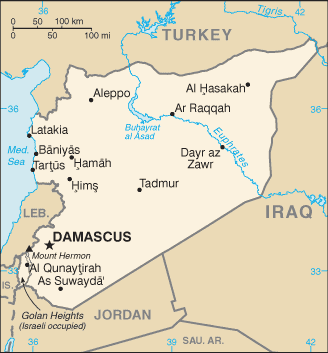
Members of the Free Syrian Army reportedly attacked the Christian-dominated al-Duvair village in Reef on the outskirts of Homs on Monday, where they massacred its citizens, including women and children, before the Syrian Army interfered. 

This reported attack comes shortly after intense fighting in the city of al-Qusseir over the weekend, in which Bashar Al-Assad’s forces inflicted heavy casualties on the rebels. 

Assad’s forces launched an offensive in April in an effort to cut off supply lines to the rebels by taking the city and its surrounding areas from the rebel groups that had been entrenched there since last year. Two weeks ago, the Syrian forces reached the center of the city 

While the sources describing Monday’s massacre are supportive of Assad, it’s possible that it occurred since the rebel groups fighting the Assad regime are composed mainly of members of al-Qaeda and al-Qaeda affiliated groups and have committed war crimes and atrocities in the past. 

Jabhat al-Nusra, the branch of al-Qaeda that fought and killed American and allied troops in Iraq, have positioned themselves in Syria and control the rebel movement.

Thursday, April 11, 2013

Assad: Erdogan Destroying Syria by Reconciling with Israel

President Bashar al-Assad
Syria’s President charged on Friday that the improvement in the relations between Turkey and Israel, following Prime Minister Binyamin Netanyahu’s apology for the deaths of Turks on the Mavi Marmara, is proof that Turkish Prime Minister Recep Tayyip Erdogan is trying to destroy Syria.

"We cannot let stupid leaders destroy the relationship with Turkey," President Bashar Al-Assad attacked in the interview, which aired on Turkey’s Ulusal TV.

The Syrian president claimed that Turkey’s reconciliation with Israel is a "small part of Erdogan’s destruction of Syria."

“Because of the situation in Syria, Israel and Turkey united suddenly, this is proof," said Assad, adding, “Erdogan walked shoulder to shoulder with Israel. Our goal should be to maintain the relationship [between Syria and Turkey], not to destroy it."
Assad also attacked the Turkish prime minister over the civil war taking place in his country,

Friday, March 15, 2013

Iran and Hezbollah 'have built 50,000-strong force to help Syrian regime'

Syrian rebels
Syrian rebels in Idlib province. Israel has warned against arming the fighters in case weapons reach al-Qaida-affiliated groups. Photograph: Hussein Malla/AP


Iran and Hezbollah have built a 50,000-strong parallel force in Syria to help prolong the life of the Assad regime and to maintain their influence after his fall, Israel's military intelligence chief has claimed.
Major General Aviv Kochavi said Iran intended to double the size of this Syrian "people's army", which he claimed was being trained by Hezbollah fighters and funded by Tehran, to bolster a depleted and demoralised Syrian army.
Kochavi, the director of military intelligence in the Israel defence forces (IDF), also said Assad's troops had readied chemical weapons but so far had not been given the order for them to be used.
At the same time, he warned of the increasing sway of extremist groups in the opposition, particularly the al-Nusra Front, which he claimed was beginning to infiltrate Lebanon and was making connections with a Sinai-based militant organisation, Ansar Bait al-Maqdis, which is focused on attacks on Israel.
Israel opposes the western arming of Syrian rebels because of its fears that the weapons will end up in the hands of such groups.

Thursday, February 7, 2013

SYRIA: Rebels battle Assad troops in Damascus


A man stands in an empty street near a burning building hit by a mortar shell fired by Syrian Army soldiers, in the Zamalka neighbourhood of Damascus February 6, 2013. REUTERS/Goran Tomasevic

(Reuters) - Syrian government jets bombarded the Damascus ring road on Thursday in a bid to halt a rebel advance which threatens President Bashar al-Assad's hold on the capital, insurgent commanders and opposition activists said.
Warplanes fired rockets at southern parts of the route where rebels have spent the past 36 hours overrunning army positions and road blocks encircling the heart of the city, the site of key state security and intelligence installations.
Assad, battling to crush a 22-month-old revolt in which 60,000 people have died, has lost control of large parts of the country but his forces, backed by air power, have so far kept rebels away from the centre of Damascus.
World powers fear the conflict - the longest and deadliest of the uprisings that started spreading through the Arab world two years ago - could envelop Syria's neighbors, further destabilizing an already explosive region.
"The regime really wants its positions on the ring road back. It is a major defense line for the capital," Aby Ghazi, a rebel commander based in the eastern suburb of Irbreen told Reuters.

Thursday, January 24, 2013

SYRIA - Human Rights Watch: Christians in crosshairs


Multiple reports of attacks on minority religious sites have surfaced in Syria as the armed conflict to out Syrian President Bashar Assad has killed more than 60,000 people and driven over 650,000 out of the country, according to UN estimates. 
The 22-month-old rebellion has taken on increasingly sectarian dimensions, as primarily Sunni Muslim rebels have battled pro-government Alawites – an offshoot of Shiite Islam – and many Christians who link their survival to that of the Assad government.
Christians have increasingly viewed the current government as a guarantor of their religious freedoms. Religious persecution faced by Egyptian and Iraqi Christians in the wake of regime change has only increased fears that religiously tolerant Syria will be transformed by Islamist elements of the opposition.
Such sentiments have put them in the crosshairs of rebel fighters.
In August, Syria’s state news agency SANA reported a massacre in nearby Jandar village which left 16 civilians, mostly Alawites and Christians, dead.
In June, at least 9,000 Christians from the western Syrian city of Qusayr neighboring Homs were reportedly forced to seek refuge after an ultimatum from a local military chief of the armed opposition. In March, sources inside the Syrian Orthodox Church have claimed the systematic “ethnic cleansing of Christians" by the Free Syrian Army was taking place in Homs. A letter sent to Agenzia Fides – the Vatican’s press agency – by Orthodox sources in Syria said that “Militant armed Islamists…have managed to expel 90 per cent of Christians in Homs and confiscated their homes by force.”
Agnes Mariam, a local Christian leader in Syria, told RT in September that the persecution of Christians was a reflection of how their faith had excluded them from Islamist elements within the opposition. “The Christians have been discriminated against not because they are Christians, but because by being Christians they couldn’t participate in Islamist demonstrations. Sometimes, this led to severe violence against them. You know, we had more than 200,000 Christians that had to flee out [of Syria] because of this ambiguous position.”

Tuesday, January 15, 2013

Secret State Department cable: Chemical weapons used in Syria

A secret State Department cable has concluded that the Syrian military likely used chemical weapons against its own people in a deadly attack last month, The Cable has learned.


United States diplomats in Turkey conducted a previously undisclosed, intensive investigation into claims that Syrian President Bashar al-Assad used chemical weapons, and made what an Obama administration official who reviewed the cable called a "compelling case" that Assad's military forces had used a deadly form of poison gas.
The cable, signed by the U.S. consul general in Istanbul, Scott Frederic Kilner, and sent to State Department headquarters in Washington last week, outlined the results of the consulate's investigation into reports from inside Syria that chemical weapons had been used in the city of Homs on Dec. 23.
The consul general's report followed a series of interviews with activists, doctors, and defectors, in what the administration official said was one of the most comprehensive efforts the U.S. government has made to investigate claims by internal Syrian sources. The investigation included a meeting between the consulate staff and Mustafa al-Sheikha high-level defector who once was a major general in Assad's army and key official in the Syrian military's WMD program.
An Obama administration official who reviewed the document, which was classified at the "secret" level, detailed its contents to The Cable. "We can't definitely say 100 percent, but Syrian contacts made a compelling case that Agent 15 was used in Homs on Dec. 23," the official said.
The use of chemical weapons by the Assad regime would cross the "red line" President Barack Obama first established in an Aug. 20 statement. "We have been very clear to the Assad regime, but also to other players on the ground, that a red line for us is we start seeing a whole bunch of chemical weapons moving around or being utilized. That would change my calculus. That would change my equation," Obama said.
To date, the administration has not initiated any major policy changes in response to the classified cable, but a Deputies Committee meeting of top administration officials is scheduled for this week.
The report confirms the worst fears of officials who are frustrated by the current policy, which is to avoid any direct military assistance to the Syrian rebels and limit U.S. aid to sporadic deliveries of humanitarian and communications equipment.
Many believe that Assad is testing U.S. red lines.
"This reflects the concerns of many in the U.S. government that the regime is pursuing a policy of escalation to see what they can get away with as the regime is getting more desperate," the administration official said.
The consulate's investigation was facilitated by BASMA, an NGO the State Department has hired as one of its implementing partners inside Syria. BASMA connected consular officials with witnesses to the incident and other first-hand information.
The official warned that if the U.S. government does not react strongly to the use of chemical weapons in Homs, Assad may be emboldened to escalate his use of such weapons of mass destruction.
"It's incidents like this that lead to a mass-casualty event," the official said.
Activist and doctors on the ground in Homs have been circulating evidence of the Dec. 23 incident over the past three weeks in an attempt to convince the international community of its veracity. An Arabic-language report circulated by the rebels' Homs medical committee detailed the symptoms of several of the victims who were brought to a makeshift field hospital inside the city and claims that the victims suffered severe effects of inhaling poisonous gas.
Activists have also been circulating videos of the victims on YouTube and Facebook. In one of the videos, victims can be seen struggling for breath and choking on their own vomit. (More videos, which are graphic, can be found hereherehereherehere and here.)
Experts say the symptoms match the effects of Agent 15, known also by its NATO code BZ, which is a CX-level incapacitating agent that is controlled under schedule 2 of the Chemical Weapons Convention, to which Syria is a party.
"The symptoms of an incapacitating agent are temporary. If someone is exposed to BZ, they are likely to be confused, perhaps to hallucinate," said Amy Smithson, a senior fellow with the James Martin Center for Nonproliferation Studies. "While it is not good news that a chemical agent of any kind may have been used in the Syrian conflict, this Agent 15 is certainly on the less harmful end of the spectrum of chemical warfare agents believed to be in the Syrian arsenal."
The Cable spoke with two doctors who were on the scene in Homs on Dec. 23 and treated the victims. Both doctors said that the chemical weapon used in the attack may not have been Agent 15, but they are sure it was a chemical weapon, not a form of tear gas. The doctors attributed five deaths and approximately 100 instances of severe respiratory, nervous system, and gastrointestinal ailments to the poison gas.
"It was a chemical weapon, we are sure of that, because tear gas can't cause the death of five people," said Dr. Nashwan Abu Abdo, a neurologist who spoke with The Cable from an undisclosed location inside of Homs.
Abdo said the chemical agent was delivered by a tank shell and that the range of symptoms varied based on the victim's proximity to the poison. The lightly affected people exhibited gastrointestinal symptoms, nausea, vomiting, and abdominal pain, he said. Victims who received a higher concentration of the poison, in addition to the gastrointestinal symptoms, showed respiratory symptoms as well.
"The main symptom of the respiratory ailments was bronchial secretions. This particular symptom was the cause of the death of all of the people," he said. "All of them died choking on their own secretions."
The doctors said their conclusion that the poison was a chemical agent and not tear gas was based on three factors: the suddenness of the deaths of those who were directly exposed, the large number of people affected, and the fact that many victims returned with recurring symptoms more than 12 hours after they had been treated, meaning that the poison had settled either in their nervous systems or fat tissue.
The State Department, in response to inquiries from The Cable, declined to comment on the secret cable from Istanbul or say whether or not chemical weapons were used in the Homs attack, but said that the administration believes Assad's chemical weapons are secure.
"I'm not going to comment on the alleged content of a classified cable," State Department Spokesman Patrick Ventrell told The Cable. "As you know, the United States closely monitors Syria's proliferation-sensitive materials and facilities, and we believe Syria's chemical weapons stockpile remains secured by the Syrian government. We have been clear that if Assad's regime makes the tragic mistake of using chemical weapons or failing to secure them, it will be held accountable."

Friday, January 11, 2013

Top U.S. General Says Stopping a Syrian Chemical Attack Is ‘Almost Unachievable’


If Syrian dictator Bashar Assad decides to use his chemical weapons, there won’t be a thing the U.S. military can do to stop him, America’s top military officer conceded on Thursday. Nor will the U.S. step into a “hostile” atmosphere, with or without Assad, to keep those chemicals under control.
It’s been a month since U.S. intelligence learned that Assad’s forces were mixing some of their precursor chemicals for sarin gas, as Danger Room first reported. The Syrian military even loaded aerial bombs with the deadly agent. Assad hasn’t used the weapons — yet. Should he change his mind, there’s little chance the U.S. would know it before it’s too late to stop the first chemical attack in the Mideast in over 20 years.
“The act of preventing the use of chemical weapons would be almost unachievable,” Gen. Martin Dempsey, the chairman of the Joint Chiefs of Staff, told reporters at the Pentagon. “You would have to have such clarity of intelligence, persistent surveillance, you’d have to actually see it before it happened. And that’s unlikely, to be sure.”

Thursday, January 10, 2013

RUSSIA: Take Syrian president’s ideas into account

Bashar Assad on political offense. 49073.jpeg
As Russian and US diplomats prepare for a meeting with the international mediator for Syria, Lakhdar Brahimi, Russian diplomats are calling for a balanced approach to settling the 21-month political crisis.
"The Russian side expects that the search for forms of international support for the settlement process of the acute domestic crisis in Syria…will take into account the ideas expressed in a speech by the President of the Syrian Arab Republic," the Foreign Ministry said in a statement. 
Syrian President Bashar Assad pledged in a televised speech on January 6 that he would halt military operations once fighting and foreign aid to the militant opposition stopped.
The Syrian leader also agreed to the release of 2,130 political prisoners in exchange for the release of 48 Iranians who had been held by Syrian rebels.
Russian and US officials, while supportive of ending the spiraling violence that has killed tens of thousands of Syrians, remain at odds over what part Assad should play in any negotiations. 

Wednesday, January 9, 2013

Syrian chemical weapons could be activated in 2 hours


The Syrian regime has “dozens of 500-lb bombs” being armed with Sarin nerve gas, according to reports of satellite imagery from seen by the Pentagon at the end of last year.


The bombs were being loaded on to vehicles near Syrian airbases and could be airborne within two hours, if President Bashar al-Assad ordered their use, the officials told President Barack Obama.
The details of the briefing were released to the New York Times and explain a sudden warning issued by Mr Obama to the Syrian regime at the beginning of December.
His statement, which said that any use of chemical weapons would have “consequences” and that “the world would act”, was followed by private messages to the Syrian authorities from Russia and neighbours including Turkey and Iraq that they would be held “personally responsible”.
Those messages, which diplomats told the paper were coordinated from American, European and Arab capitals, seem to have been enough to deter the weapons’ use for the time being, if it were intended.
Leon Panetta, the US Defence Secretary, who said the regime would cross a “red line” triggering military intervention if it used the bombs, followed up a week later by saying the worst fears were over.
Whether Syria might use chemical weapons has become one of the most contentious issues surrounding the crisis.

Tuesday, January 8, 2013

US, Britain Slam Assad ‘Peace Plan’

In a rare public speech today, Syrian President Bashar Assad laid out what he called a “peace plan” aimed at reconciling with combating forces in the ongoing civil war, offering political reforms and a new constitution.
The offers were predictably endorsed by Assad’s supporters and angrily condemned by his opponents, with the US claiming the whole offer was an attempt to “cling to power” because Assad didn’t explicitly promise to resign immediately.

Assad’s offer of talks directly ruled out talks with Western-backed rebels, making them pretty much meaningless in the first place, but since those rebels have ruled out ever negotiating with Assad anyhow, both sides could rightly be accused of being stubborn and dragging the war on rather than accept a settlement.
In the end, the rebels are holding out for a “deal” that will unconditionally install them as a new regime, and Western supporters of those rebels seem content to egg them on under the assumption this will eventually be on offer.

Saturday, January 5, 2013

Syrian conflict could worsen Christian exodus


Fighting in Syria continues to put pressure on the minority Christian population, leading to fears that more Syrians will join the many Christians who have already left the Middle East.
 
Journalist Nasir Habish told Vatican Radio that Syria’s Christians are among those most affected by the conflict between rebel and government forces.
 
“The Syrian situation, right now, is very difficult, and I think in the future will be more difficult,” Habish said. “And I think the war will continue.”
 
He said Christians are “running away from Syria right now,” with many refugees fleeing to Lebanon and most proceeding to Europe.
 
“We don’t want to lose the Christianity in the Arab region,” he said. “This is the land of Jesus. I can’t imagine the land of Jesus without Christians.”


The United Nations has said that more than 60,000 people have died in the conflict. The latest fighting includes a repelled rebel attack around the Taftanaz airbase in the northwestern province of Idlib.
Government forces are seeking to recapture the Damascus suburb of Daraya, which hundreds of rebel fighters have held for weeks. Pro-government newspapers report that the latest offensive on Daraya inflicted heavy losses on the rebels, the Associated Press says.
 
The uprising against President Bashar Assad began in March 2011. More than half a million Syrians have become refugees.
 
The United States has been providing clandestine support for the rebels for months. On Dec. 11, President Barack Obama joined France and Britain in recognizing the rebel coalition, calling it “the legitimate representative of the Syrian people.”

The conflict has some sectarian aspects. Rebels tend to be Sunni Muslims, the majority religion in Syria. President Bashar’s government is mainly Alawite, a minority Muslim group. The government has support from some Sunnis and many religious minorities, including many Christians who make up only 10 percent of the population.
 
Many Christians in the region fear Syria will become another Iraq, where poor security after the U.S. invasion in 2003 has allowed militant Islamic groups to target Christians for intimidation, killings and kidnappings that helped drive hundreds of thousands of Christians out of the country.
 
Syria's Christian youth taking up
arms against Assad
Sister Agnes-Mariam de la Croix, mother superior of the Greek Catholic Monastery of St James the Mutilated in Syria, has charged that the Syrian uprising has been “hijacked by Islamist mercenaries who are more interested in fighting a holy war than in changing the government.”
 
She said the conflict has turned into “a sectarian conflict” in which Christians are “paying a high price,” the Daily Mail reports.


She said at least 80,000 Christians have been forced from their homes in the Homs region. Over 300,000 Christian Syrians are believed to be refugees.
 
Sr. Agnes-Miriam, who is presently in Lebanon, said militants wearing the black bandanas of Al Qaeda laid siege to her monastery between Damascus and Homs for two days to try to prevent Christmas celebrations.
 
She is a critic of Western support for the rebels, saying this supports “extremists” who want to create an Islamic state.


Some Christians support the rebels. Aya, a 51-year-old Christian artist from Aleppo who opposes the Syrian government, told the Associated Press that Christian silence in the face of the abuses of the Assad government could make them more vulnerable to reprisals.
 
“Many Christians think that this regime is good for us,” she said. “They think that if they keep quiet, Assad will stay, and protect us. But this is an illusion.”
 
Aya herself fled to Beirut in October.
 
The plight of Syrian Christians is shared by many Christians throughout the Middle East. The British think tank Civitas in December released a report warning about violence against Christians in the Middle East, Africa and Asia.
 
It estimates that between half and two-thirds of Middle East Christians have left their homelands or have been killed in the past 100 years.
 
“There is now a serious risk that Christianity will disappear from its biblical heartlands,” the report said.


Thursday, January 3, 2013

UN: 60,000 people have died in the Syrian conflict


The UN has raised the estimate of the number people killed in the Syrian conflict to more than 60,000. In November, the UN High Commissioner for Human Rights Navi Pillay put the figure at 59,648 people. The UN official said that the fatalities have turned out to be “higher than they expected” adding the figure “is truly shocking”.

Free Syrian Army claims it can make chemical weapons


A prominent member of the Free Syrian Army claims the rebels have all the components to produce chemical weapons and have the know-how to put them together and use if necessary.
“If we ever use them, we will only hit the regime's bases and centers,” the political adviser of the Free Syrian Army (FSA), Bassam Al-Dada, was quoted by Turkey's state-run Anatolia news agency. 
The adviser stressed that the Syrian opposition would only use chemical weapons if the ruling regime did so first. 
If President Bashar Assad threatens Syrian opposition fighters with chemical weapons, Al-Dada noted, he should know that the opposition “also possess them.”
In June 2012, Adnan Sillu was quoted by Al Arabiya that “probably anyone from the Free Syrian Army or any Islamic extremist group could take them over”. He claimed that the stores of mustard gas and nerve agents — such as in Homs, east of Aleppo and east of Damascus – were not properly secured.
Earlier in December, he claimed that the Syrian regime's arsenal of chemical weapons almost matches Israel’s. 
The EU, US and allied nations have repeatedly expressed their concern that the main threat from Syria’s chemical weapons is that they could fall into the hands of terrorists who have infiltrated the ranks of the Syrian rebels.
The concern increased significantly last month after Syria’s United Nations ambassador, Bashar Jaafari, warned that the Syrian opposition might use chemical weapons against innocent civilians after they gained control of “a toxic chlorine factory” east of Aleppo, and try to blame President Assad’s regime. 
Fear that Syria could also use chemical weapons against its neighbors was cited by Turkey as one of the reasons why it requested six Patriot missiles from NATO to be stationed on its border with Syria. The alliance approved the deployment

Wednesday, January 2, 2013

Russia: Spying Imams and mosque plots reveal Chechen link to Syria


The Chechen link to Syria rears its Muslim beardWith the crisis in Syria seemingly never ending, the question of Russia’s influence in the world has resurfaced. The former Soviet state has been playing its hand in the Arab world with an eye to widening its influence.
 
While Syrian President Bashar al-Assad may be glad of the Slavic support, the history of Muslim/Russian relations inside the ex communist state shows he would be wise to be wary.

However, with foreign minister, Sergei Lavrov, announcing earlier this month that his “military advisers… have kept close watch over its [Syria’s] chemical arsenal”, the Middle East may already be in too deep.
 
Lavrov may have said “military advisers” but most Middle East watchers suspected that Russian intelligence services had a greater part to play. The Federal Security Service (FSB), formerly the KGB, has a fearsome reputation, particularly when dealing with Muslims.
 
The secret war in Chechnya, the largely Muslim area of Russia, has seen dissidents as far away as Istanbul and Dubai assassinated in recent years by the FSB.
 
Earlier this month, claims that the Russian intelligence services had infiltrated mosques in the volatile Islamic region re-emerged when one Twitter user began to post about the allegations.
 
@Turk4Syria, an online activist, argued that mosques in Chechnya were “basically a department of the Russian secret service”, accusing the imam of the Ahmad Kadyrov Mosque of ordering the assassination of Shamsuddin Batukayev, former head of the Shari’a Courts in the Chechen Republic of Ichkeria. The claims are supported by the Kavkaz Center, an ostensibly independent news network, covering the region.

Moscow has been keen to back more secular figures in the province, such as current Chechen leader, Ramzan Kadyrov, despite his brutal tactics when putting down an “Islamic insurgency” in the Russian republic.
 
It is a course of action by the Russians with strong echoes of their current line on Syria. With the Syrian Oppositionincreasingly finding support from 'Jihadist’ fighters with extremist religious opinions, Russia has held out as a supporter of President Assad, despite his vicious assaults on civilians.
 
Meanwhile, Russian intelligence services are rumored to be prevalent in the Levantine state, a presence hinted at periodically by Moscow’s politicians.
 
Back in their own country, Jihadist fighters have also flocked to Russia’s Islamic region, many of whom originally fought the Soviets in Afghanistan. Moscow has sought to underline the ideological split between these hardcore religious fighters and their more moderate counterparts in Chechnya. For, after all, with the province in a perpetual state of flux internally, the move for an independent state stands little chance of success.

Once again the parallels with Syria are startling; and so, while other international players may be on virgin territory when dealing with the Syrian crisis, Russia is most certainly an old hand.
 
Whose side is Russia on in Syria? Can Assad count on Russian support more in light of Jihadi influence in the opposition camp with parallels to Islamic warriors in Chechnya? How might the Chechen link play out in the Syrian crisis? Share your political insights in the space below.

Sunday, December 30, 2012

SYRIA: Bashar al-Assad isolated and ‘fearful’ of assassins


Syria’s embattled President Bashar al-Assad has become “isolated and fearful” as his regime looks ready to crumble under a 21-month-long rebellion that has claimed more than 40,000 lives, according to a published report.
Assad, who has repeatedly said he has no intention of stepping down, has “all but vanished from public view,” as the country’s civil war drags on, The Washington Post reports.
“Assad is nearly as invisible within the shrinking world of his presidency, restricting contacts to a small circle of family members and trusted advisers,” the report said, citing anonymous sources.
The Syrian leader has grown so paranoid he changes bedrooms every night and is apparently worried about being poisoned, “tightening controls over food preparation to thwart would-be assassins,” sources told The Post.
Even members of Assad’s own regime have publicly acknowledged they are unlikely to defeat the rebellion. Syrian Vice President Farouk al-Sharaa told a Lebanese newspaper earlier this month that Syrian security forces cannot reach a "conclusive" result with the opposition.
Meanwhile, rebels continue to gain ground in the country. Armed fighters captured the town of Harem near the border with Turkey on Tuesday, and the exiled Syrian National Coalition has now been recognized by more than 110 nations as the legitimate representative of the Syrian people.
Even Syria’s biggest supporter, Russia, has now admitted that Assad might fall. Russian President Vladimir Putin said last week that Assad’s regime is growing weaker but warned that his decline might worsen the country’s civil war.
Ongoing efforts by the United Nations and Russia to broker talks between Assad’s government and the rebel groups have been unsuccessful. On Saturday, they essentially announced another stalemate.
Russia's foreign minister Sergey Lavrov said Saturday that Syrian President Bashar Assad has no intention of stepping down and warned against international efforts to pressure him out of office.
Assad “will stay to the end in his post,” Lavrov said, adding the Syrian leader maintains he is acting to “defend the Syrian people, Syrian sovereignty and so forth...There's no possibility to change this position."
Lavrov met Saturday in Moscow with the U.N envoy to the Syrian crisis, Lakhdar Brahimi. Brahimi held talks with Assad in Damascus this week, but announced no compromise. The envoy also expressed concern about the conflict, saying it is becoming "more and more sectarian."

RUSSIA: The Russian town full of fallen dictators that could be Bashar Al-Assad's next home


BARVIKHA, Russia — A few years back, before he settled in this bucolic town in a pine forest near Moscow, Askar Akayev, then the president of Kyrgyzstan, had a very stressful day.


Outside his presidential palace, an angry mob had gathered. An overturned car was on fire. Protesters had shinned over a wrought-iron fence and were breaking ground-floor windows and prying open doors.
Then came word from a security adviser: The time had come.
“I left in the suit I was standing up in,” Mr. Akayev told a journalist soon after his downfall in March 2005. Within days he was here, staying in a government-owned sanitarium — and in good company.
This improbable small town of villas and luxury boutiques, built around the sanitarium where Mr. Akayev stayed, is home to half a dozen or so deposed leaders and members of their families.
And in its snowy tranquillity, it offers one strange, possible future for the embattled president of Syria, Bashar al-Assad, as Western governments have been pressuring Russia since summer to smooth his departure with an offer of asylum.
For now, even with rebel fighters closing in on Damascus, diplomats in Russia, Mr. Assad’s most important ally, have denied they are considering granting him safe haven as a step toward resolution of the conflict. But the Russians have come through with 11-hour rescues of their allies before.
“The Russians have experience with getting heads of state out in the nick of time,” said Mark N. Katz, a professor of government and politics at George Mason University in Virginia. “They could be trying to signal to Assad there is an offer, but the window of opportunity is not going to remain open for a long time.”
Leaders’ hurried packing and just-in-time flight to this place from angry street crowds or the nearing sound of gunfire brought measures of resolution to conflicts in the former Yugoslavia, Georgia, Kyrgyzstan and elsewhere.
Russia has been inching closer to agreeing to a settlement that would include Mr. Assad’s departure, if that is even possible at this juncture, with rebels occupying parts of the capital and firing mortar rounds at the presidential palace in the Muhajireen neighborhood of Damascus.
On Thursday, the United Nations envoy to Syria, Lakhdar Brahimi, and Russian diplomats agreed to revive a peace initiative that stalled last summer after the Russians insisted it refrain from specifically excluding a role for Mr. Assad in any transition government. It was unclear whether Russia would accede to such a demand in any new agreement, and if so, whether the Syrian leader would land here.
Not all political exiles live in the districts of spacious country homes that lie here, along the Ryublyovsky Highway, but many do.
By many accounts, once here, these people enjoy the quiet and privileged afterlife of former elites of Soviet or Russian client states that have folded. In a snowy shopping center, the Barvikha Luxury Village, Gucci, Ralph Lauren and Dolce & Gabbana shops were open on a recent visit, of possible interest to Mr. Assad’s wife, Asma al-Assad, who is known to dress fashionably.

Thursday, December 27, 2012

Moscow says there is no joint Russia-U.S. plan on Syria


A Syrian government delegation led by Deputy Foreign Minister Faisal Muqdad on Thursday held talks at the Russian foreign ministry as Moscow denied the existence of a joint plan with the United States to end the crisis in the country. 

Muqdad held talks in the morning at the foreign ministry in Moscow, foreign ministry spokesman Alexander Lukashevich said, adding that the results would be announced later in the day.

“The meeting has taken place. We will announce the results later,” he told reporters.

“This is of course a part of the efforts we are undertaking to encourage dialogue not just with the government but all opposition forces,” he added.

It was not immediately clear who was present at the closed-door meeting but the ITAR-TASS news agency on Wednesday said Muqdad’s visit would include talks with Foreign Minister Sergei Lavrov.

The meeting came amid a flurry of end-of-year diplomacy in Russia over the Syrian crisis that will also see talks between U.N.-Arab League Syria peace envoy Lakhdar Brahimi and Lavrov on Saturday.

Egyptian Foreign Minister Mohamed Amr is also arriving in Moscow later on Thursday for a visit that will include talks and a news conference with Lavrov on Friday.

Russia has to the fury of the West refused to cut cooperation with the Syrian regime of President Bashar al-Assad in the conflict that according to activists has now claimed over 45,000 lives.

The diplomatic drive comes amid Western media reports of a new Russia-US initiative that would see Assad stay in power until 2014 while preventing him from further renewing his mandate.

But Lukashevich vehemently denied the existence of any such plan.

“There was not and is not such a plan and it is not being discussed,” he said, adding that Russia’s Syria policy was still based on an accord with world powers made back in June for an inter-Syrian dialogue.

Russia has always insisted it will not prop up Assad’s regime but has also emphasized Moscow will not seek to persuade the Syrian president to step down, saying it is up to the Syrian people to decide the country’s future.
Peace envoy

Meanwhile, international peace envoy Lakhdar Brahimi on Thursday called for “real” change in war-torn Syria and the installation of a transition government with full powers until elections can be held.

The U.N.-Arab League envoy made the remarks at a news conference in Damascus, during his latest bid to persuade Syria’s warring parties to negotiate an end to the conflict estimated to have killed at least 45,000 people.

Tuesday, December 25, 2012

Syrian Christians pray for peace on Christmas Eve (PHOTOS)

A Syrian  woman lights a candle during early Christmas eve mass, at the Mar Elias (St. Elijah) Christian Orthodox church in Bab Tuma, a predominantly Christian quarter of Damascus, on December 24, 2012. (AFP Photo)


 As disastrous civil war continues to ravage Syria, Christian communities across the country gathered to attend Christmas masses and pray for peace in the strife-torn land after almost two years of violence.
"I pray that peace and safety returns to the hearts of all Syrians," Heba Shawi, a Catholic attending mass at Notre Dame church in the Damascus district of Qusur told AFP. "I hope the smiles come back to children's faces."
Bishop Joseph al-Absi, who led the mass at the Melkite Greek Catholic Cathedral in Damsacus, prayed for peace in Syria, asking God to protect the country and it leadership, according to SANA news agency.
There has not been much joy in the air as usual as Syrian people continue to suffer from the ongoing fighting between the rebels and government forces that has already claimed over 40,000 lives. This year, there was only one Nativity crib on display in Damascus.
Due to security concerns some services had to be held at 6:00 pm instead of midnight.
"The festive season is very sad this year. But we thank God despite everything," insurance broker Riad Ghanem told AFP.
Syrians attend early Christmas eve mass, at the Mar Elias (St. Elijah) Christian Orthodox church in Bab Tuma, a predominantly Christian quarter of Damascus, on December 24, 2012. (AFP Photo)
There are some 1.8 million Christians, most of the Greek Orthodox, in Syria. Many of them have remained loyal to the Syrian regime fearing that the fall of Bashar Assad would result in a Sunni-led government which would crack down on minorities. Assad and the ruling elite who come from a minority Alawite sect – an offshoot of Shia Islam – have long been a safeguard of security and rights of the minorities.
Meanwhile in Rome, Pope Benedict XVI marked Christmas Eve with mass in St. Peter’s Basilica. The pontiff called on the faithful to find place for God in their busy, technology-driven lives. He also urged them to offer prayers for "our brothers and sisters in Syria, who are dying mercilessly.”
Last week UN human rights report said that the Syrian civil war is becoming increasingly sectarian, as Sunni-majority rebel forces fight government troops supported by country’s religious and ethnic minorities.
The report – which is based on interviews with Syrians who fled the country and covers the period between September 28 and December 16 – said that foreign fighters with links to extremist Sunni groups are infiltrating Syria to fight against the regime of President Bashar Assad.
The foreign fighters, described as “militant, radical Islamists, or Jihadists,” are reportedly operating independently but coordinate with the Free Syrian Army, an armed opposition group supported by Western nations.
Syrian women decorate a Christmas tree at a cafe in the old city of Damascus on December 20, 2012. (AFP Photo / Carole Alfarah)

Thursday, December 20, 2012

Al Qaeda Grows as Assad Forces Shell Civilians Across Syria


As the Assad regime becomes increasingly desperate, its forces are starting to shell civilians in every major city across the country.

Syrian rebels are zeroing in on Assad
Troops loyal to President Bashar al-Assad are attacking civilians and rebel forces alike around Hama, Homs and Aleppo, according to a report issued Wednesday by the United Nations Relief and Works Agency (UNRWA). 

Nearly 50,000 people have died since the savage civil war began in March 2011, with a simple scrawled grafitti message of protest by a teen on a wall in Dera'a. 


Large-scale electricity and water shortages have been reported across Syria, an increasing concern as the frigid winter sets in. In Aleppo, the country's northern commercial hub, power has been unavailable for the past week, and there have been reports of no running water for the past five days, UNRWA said. 

Every major artery to the city has been cut off in clashes between government and rebel forces with the exception of the Damascus-Aleppo highway.
Meanwhile, the international Al Qaeda terrorist organization is taking advantage of the chaos in the country to stage a comeback there, much as it did in Libya during the revolution that deposed dictator Muammar Qaddafi last year.

Syria's Al-Nusra Front terror organization is an affiliate of Al Qaeda, believing in the hope of reviving the Islamic Caliphate that will build a Muslim Empire to eventually rule the world. It is one of 13 factions in the radical Islamist rebel council that announced its secession from the main opposition force several weeks ago.
The United States added the Al-Nusra Front to the official list of terror organizations last week.

The greater danger lies in its ability to draw others to its ranks: The group is gaining popularity as Assad's Alawite faction, an offshoot of the Iranian affiliated Shi'ite Islam, falls out of favor. Al-Nusra is beginning to recruit from the ranks of Sunni Muslims, who until now have remained moderate and loyal to the mainstream rebels. Al-Nusra Front was responsible for the deadly suicide and car bombings recently in Damascus, Dera'a, Homs and Hama, according to the SITE Intelligence group. Dozens were killed in these attacks; in one suicide bombing, 60 alone were murdered.

Air strikes, clashes and shelling also continued for a sixth day inside Yarmouk, a suburb of Damascus that began as a refugee camp for Arabs who had fled Israel in times of war, and their descendants. Originally home to more than 150,000 residents, Yarmouk has become a ghost town over the past week, with some 90 percent of its people having fled the violence.


Category

1915 Armenian Genocide 21st-century Christian martyrs‎ Al Qaeda Apostles Arab Christian Arab-Orthodox Archimandrite Tikhon Shevkunov Asia Australia BBC Belarusian Orthodox Church Bethlehem Bible movies Bulgarian Orthodox Church Byzantine C.I.A. Cairo China Christian Armenians Christmas Traditions Christmas tree Conspiracy Constantinople Documentary Easter Ecumenical Patriarch Ecumenical Patriarch Bartholomew I Ecumenical Patriarchate of Constantinople Elder Ephraim of Vatopaidi Elder Porphyrios Epiphany FREE Greetings Cards FREE books Fr Seraphim Rose Georgian Orthodox Church Greek Orthodox Church Greek Orthodox Easter Holy Fathers Holy Scripture Holy Tradition Internet Interview Italy Jesus Christ Middle East Miraculous Icon Mount Sinai Movie Trailers Orthodox Church in America Palestine Prophecy Russia Russian Orthodox Church Saints Shroud of Turin Son of God St Nicholas of Myra The Mount Athos Food Evolution UK Ukraine Ukrainian Orthodox Church Vatican Watch FREE full movie africa al assad albania anti-Morsi protests army bank bible bible translations bulgaria byzantine music christianity christians christmas church coptic church copts cyprus daily news economy egypt egypt pope elder elder Paisios elder joseph of vatopaidi english subtitles europe food france fyrmacedonia germany greece greek greek food greek music greek orthodoxy health and medicine icon iran islam islamist israel jerusalem jews jihad killed libya mafia monastery money mother of god mount athos music muslim muslims news orthodox church pakistan patristic tradition photo photos picture politics pope protests quotes recipes religion romania romanian orthodox church saint science spy syria theotokos travel turkey tv usa vatopaidi video war world
Related Posts Plugin for WordPress, Blogger...