Search This Blog

Image and video hosting by TinyPic
Showing posts with label Apostles. Show all posts

Sunday, November 17, 2013

Vatican to put St Peter's relics on display for first time


 For the first time, the bones traditionally believed to be the relics of St Peter the Apostle will be on public display for veneration.

Friday, November 30, 2012

Saint Mary Magdalene - The Revision of the Apostole Role


Outside the Orthodox Church, the name of Saint Mary Magdalene, artistically, philosophically, and, until recently in the West, ecclesiastically and theologically, has been identified, one way or another, with the broader area of eroticism. 
Various artists or authors of narratives with a mythological veneer, such as, for example, Dan Brown, William Phipps, Chris Gollon, Martin Scorsese and many others, seek, or wish to invent, a mistress for Jesus of Nazareth and curiously, absolutely all of them, latch on to Mary Magdalene. This is not strange, because, for a very long time, even within Church literature, Magdalene was presented as the most attractive and bewitching female personality in the New Testament. 
Many, indeed, even to this day, think of her as a former prostitute, who, of course, repented as a result of her existential encounter with Christ. In the case of one of the modern British artists, Chris Gollon, whom we mentioned above, in his painting The Pre-Penitent Magdalene, Mary is portrayed as a provocative femme fatale, adorned with all the trappings you’d expect and heavily made up. On the same wave-length, but with a serious, symbolic, poetic background, there is the short text entitled “Magdalene”, in Dinos Christianopoulos’ collection Εποχή τωνισχνών αγελάδων (Thessaloniki, 1950).
And yet, nowhere in the reliable historical sources, particularly the most ancient- that is those of the New Testament- is there any mention of all this. On the contrary, in three of the four canonical Gospels, Mary Magdalene is mentioned by name only in relation to the narratives of Christ’s passion and resurrection. 
In Mark, Matthew and John, she is referred to as a witness of the crucifixion (There were also women looking on from a distance: among them was Mary Magdalene…Mk. 15, 40). In John, she is placed last (standing near the cross of Jesus were his mother, and his mother’s sister, Mary the wife of Clopas and Mary Magdalene) and at His tomb (and Mary Magdalene and Mary the mother of Joses saw where the body was laid, Mk. 15:47, Matth. 27:61). 
Above all, however, Mary Magdalene is one of the first witnesses of Christ’s resurrection,  i.e. of the new tomb, and in John, in fact, the first (Mk. 16, 1; Matth. 28, 9; Luke 24, 1-12; Jn. 20, 14-18).
It is only in Saint Luke’s Gospel that the name of Mary Magdalene is also mentioned in relation to the public activity of Christ before the passion and resurrection in all four Gospels. At the beginning of chapter 8 there is a description of how Jesus: 
“went on through towns and villages, proclaiming and bringing the good news of the Kingdom of God. The twelve were with him, as well as some women who had been cured of evil spirits and infirmities: Mary, called Magdalene, from whom seven demons had gone out… who provided for them out of their resources” (Luke, 8, 1-3).
Mary Magdalene Before Conversion by James Tissot
The epithet Magdalene, which always accompanies her name, at least in the Gospels, is an indication that she was not married, because in that case her name would also have that of her husband attached. 
“Magdalene” shows that this particular Mary came from the commercial town of Migdal (Taricheae) on the west bank of the Sea of Galilee or Tiberias. She must have been a well-to-do woman, provided, of course, we can trust Luke’s information, since she played her part with generous material assistance in what was for the age the revolutionary work of Jesus and His twelve disciples. According to the same source, she had had personal experience of the healings powers of Jesus, probably through a kind of exorcism. 
But on the basis of a strictly historico-critical approach to the evidence in Luke, modern science has reservations, since in this particular Gospel, there is a clear tendency to minimize the role of Magdalene, in stark contrast, in fact, to the other three Gospels. We should note that Luke is the only one of the Evangelists to report that the risen Christ appeared exclusively to Peter (Luke 24, 34; see also I Cor. 15, 5). 
According to Ann Graham Βrock (Mary Magdalene, the First Apostle: The Struggle for Authority, Cambridge, MA: Harvard University Press, 2003, pp. 19–40), there is no reference in Luke to any appearance of Christ to Mary Magdalene. It may be then, that the reference to seven demons derives from this prejudice, unless it has symbolic significance.
If this is the picture presented by the original sources of Christian tradition, then it is reasonable to wonder: “How has Magdalene been transformed over time into a penitent harlot and later, with a good dose of imagination into something even more?
Modern critical research has tended towards the conclusion that this may have happened as the result of conscious efforts on the part of later scholars of the history of the Christian message, to gradually reduce the importance of her role, at least as this was presented in the most ancient sources of the Gospel tradition. 
How this happened has to do initially with the gradual, and, of course, unsubstantiated identification of Mary from Magdala with other women mentioned in the Gospels. First of all with the anonymous woman from Bethany, who anointed His head with myrrh, an entirely symbolic act recognizing Christ as the Messiah shortly before he was given up to be crucified (Mk. 14, 3-9 and Matth. 26, 6-13). 
We should note that this action is interpreted as a “practical” confession of Jesus’ Messianic status, in the same way as Peter’s verbal confession in Caesarea Phillipi: “You are Christ, (the Son of the living God” (Mk. 8, 28).
In the later Gospels, the scene of the anointing of Jesus is brought forward in terms of time to the beginning of His public ministry (by Luke to 7, 36-50) and the most important difference is that it is not Christ’s head which is anointed but His feet (both in Luke and John, who does, however, retain the timing of the event as being with narrative of the passion, though he does identify the unknown woman with another Mary, Lazarus’ sister). Luke adds the motif of her repentance, which is followed by the forgiveness of her sins by Jesus.
The second erroneous identification of Magdalene is with the anonymous adulteress (Jn. 7, 53- 8, 11) whom Christ rescues from stoning with His well-known phrase: “Let him among you who is without sin cast the first stone at her” (Jn. 8, 7). This was the interpretation accepted by the famous actor and director Mel Gibson, in his contentious film The Passion of Christ (For more on this identification, see Jane Schaberg, The Resurrection of Mary Magdalene: Legends, Apocrypha, and the Christian Testament, New York: Continuum, 2002,  pp. 65–77, 82).
This process of gradual redefinition of the apostolic role of Mary Magdalene, with erroneous readings and identification in the texts, was completed when it received Church sanction in the 6th century through Pope Gregory the Great (540-604), who, in a homily presents her as a model of repentance. 
Pope Gregory understood the anointing by the anonymous woman in a positive way, but also identified the anonymous adulteress with the person of Mary Magdalene and claimed that the spices she used to rub on Jesus’ feet were the same as the ones she had previously used on her own body. At the same time, the seven demons were associated with the seven deadly sins. 
Poe Gregory wrote characteristically that when Magdalene fell at Jesus’ feet, “she transformed the multitude of her sins into virtues so that she could serve God in total repentance” (Jane Schaberg, The Resurrection of Mary Magdalene: Legends, Apocrypha, and the Christian Testament, p. 82). In this way, the myth of Mary Magdalene as the harlot with the heart of gold was established. This is the motif chosen by Dinos Christianopoulos in the work we referred to above and by a host of other poets and authors until today.
paintings of james tissot
In a really strange, but interesting way, the myth of Mary Magdalene as the penitent harlot appears only in Western Christianity. In the Eastern, Orthodox Church she continues to be honoured for what she was: equal to the apostles, a prominent apostle, an apostle of the apostles, a saint, and witness of the resurrection. 
There is actually another homily from the 6th century, by a different Gregory, the Patriarch of Antioch, who tells how the risen Christ is supposed to have turned and addressed in these words the women, including Mary Magdalene, who “had run to the tomb”: “Tell my apostles the mysteries you’ve seen. You are the first apostles to the apostles. Let Peter, who denied Me, learn that I’m able to raise women up to be apostles, as well” (On this, see, “Gregory of Antioch: Homilia in S.Τheophania, CPG  7385–Gleanings of Text and Theme,” JTS 60 vol. 2 (2009), pp.  531-7).
This patriarch and saint of the Orthodox Church is clearly extending the historical role of Magdalene as apostle, which can be found in John’s Gospel and it is naturally equated with Magdalene’s experience during the first appearance of the risen Christ (“Early on the first day of the week, while it was still dark, Mary Magdalene came to the tomb and saw that the stone had been removed from the tomb” Jn. 20- 1, 11-19. 
Verses 2-10 are very clearly an addition to the older core, since they very obviously destroy the structure of the narrative). In contrast to the image given  in Luke, the fourth Gospel clearly presents Magdalene as the first witness of the resurrection, the chief event of divine providence.
This positive role  which, historically, i.e. on the basis of the historical evidence, Mary Magdalene played in the Gospel according to Saint John, was thereafter reinforced considerably in certain Christian circles, which actually elevated her memory and her honour to a greater degree than was appropriate. 
The apocryphal Gospel of Mary, which was published as late as 1955 is the product of such an ancient- for some, marginal- Christian community. In this apocryphal Gospel, and in other apocryphal texts relating to the New Testament, which retain some core of historical truth in their narratives (Saint Thomas’ Gospel, Saint Philip’s Gospel, Faith-Wisdom) the picture of Mary Magdalene is as follows: 
a) she had a prominent position among Jesus’ disciples; b) she survived as a character or a recollection even in an era  and culture which were heavily male-oriented and, for many people, intensely patriarchal in ideology; c) she stood out for her courage and spoke freely; d) she clearly played a leading role, even compared to the male disciples (her brothers, as she calls them); e) she was a person blessed to receive and interpret divine visions; f) she was praised for her correct and deep understanding of divine teaching; g) she was designated as a close and familiar disciple of Christ; h) she did not hesitate, when she had to,to oppose and sometimes come into open conflict with one or more of the apostles; and i) Jesus defends her.
Many of these nine characteristics are also to be found  in other non-canonical (apocryphal) texts. Of course, in some apocryphal texts of the original Christian tradition her role is altered in a negative way, or her name is expunged from narratives in which she plays a leading role in other versions of the same events. All of this stops after the 6thcentury, and then, suddenly, in the Middle Ages in the West, there appears the familiar fiction of Magdalene as a symbol of erotic love and sexuality.
The critical question is whether the portrait of Mary Magdalene as a leading figure in the first Church really does reflect historical reality. It is very likely that this is so, especially if we take into account the significant position she continues to occupy in the Eastern liturgical and hagiographical tradition. 
Indeed some students of the New Testament claim that she may even be included among the leading female figures to whom the Apostle Paul addresses a warm greeting in the famous chapter 16 of his Epistle to the Romans (“Greet Mary, who has worked very hard among you” 16, 6). That, of course, must remain hypothetical, but there is absolutely no historical evidence, or even a suspicion, that she was ever a harlot, or the mistress or companion of Jesus. 
On the contrary, it is confirmed beyond doubt that she was a prominent disciple of His, an apostle of the apostles, and these features of her passage through history have been deliberately marginalized or even successfully removed- at least until today, when scientific study has now demonstrated the real importance of the “Magdalene Story”.
Note. The facts were drawn from an article by Professor Petros Vasileiadis, of the Theological School of the Aristotle Univeristy of Thessaloniki, on the web sitehttp://blogs.auth.gr/moschosg

Saturday, February 5, 2011

The Astonishing Missionary Journeys of the Ap. Andrew Part 2

Part 2


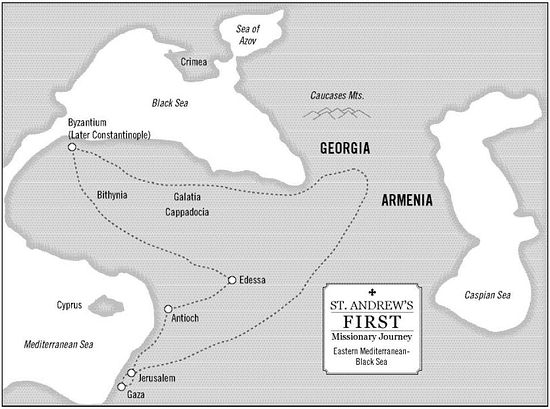
THE FIRST MISSIONARY JOURNEY:
Judea to Constantinople, Pontus, and the Caucasus

Загрузить увеличенное изображение. 968 x 720 px. Размер файла 144252 b.
RTE: Can you trace St. Andrew's routes for us?
GEORGE: Yes, according to local tradition, St. Andrew first preached in Judea to the Samaritans and in Gaza, which at the time of Christ was inhabited by Greek Philistines. If you compare the Masoretic text to the Septuagint, the word ”Philistine” is translated as ”Greek.” This is clear and it is acknowledged by historians.
After Gaza, he went to Lydda in Palestine, where St. George would later be martyred, to Antioch, and then to Ankara and Edessa, today's Urfa in Turkey, which was an important center for the first Christians. Abgar, King of Edessa, became a Christian and this is where the icon of the Lord, ”Made-Without-Hands” is from. According to the sources, this may have been the first Christian kingdom on earth, perhaps as early as 35 or 36 A.D. just a few years after the Crucifixion. After Edessa, some traditions say that St. Andrew went to the Greek town of Byzantium (later Constantinople) in 36 A.D. and appointed the first bishop, St. Stachys,[1] who was one of the seventy disciples of the Lord. Then he preached in Bythinia, Cappadocia and Galatia, up through Greek Pontus, which today is northern Turkey. Then traditions say he turned to Georgia, Armenia and the Caucuses. This was the first trip, after which he returned to Jerusalem.

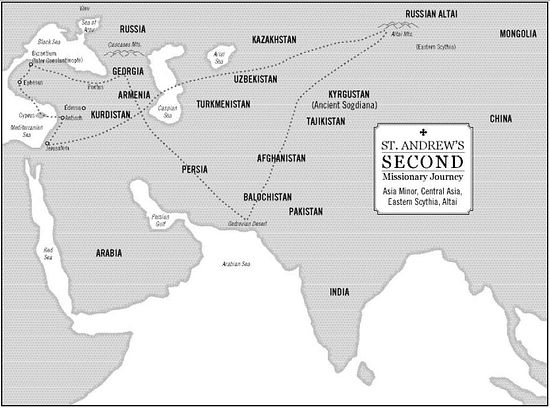
THE SECOND MISSIONARY JOURNEY:
Jerusalem to Central Asia


Загрузить увеличенное изображение. 977 x 724 px. Размер файла 149625 b.
The second trip was quite different. He followed the same route from Jerusalem, but after Antioch he took a ship to Ephesus to meet St. John. On the way he touched on Cyprus for a few days, at the Cape of St. Andrew. I'm not sure if he met any Cypriotes, it was only a stopping point for the ship. According to Cypriot tradition, because the crew and passengers needed fresh water and this was a desert place, he went ashore and prayed until water poured forth from a rock.
After Ephesus, he went to Antioch, then to Nicea where he stayed for some time. From there he went to Pontus again, and to Georgia. From Georgia, several traditions say that he passed down to Parthia (Persia) through Kurdistan, and then further to the Cynocefaloi in the desert of Gedrozia (now Balochistan) near the coast and the present Pakistan-Iranian border.
RTE: Who were the Cynocefaloi?
GEORGE: This is an extremely interesting subject as these people are mentioned in many early texts. Cynocefaloi translates literally as ”the dog-head people.” They are also spoken of in the Life of Saint Makarios, which locates the tribe in a desert far beyond Syria. Tzetzis, a Byzantine historical commentator, refers to them as inhabitants of India, of which modern Pakistan would have been a part. In the Greek Life of St. Christopher (who some speculate came from this area), it is said that that he came to the Roman world passing through the Persian desert, and Marco Polo mentions them as inhabitants of the Indian Ocean. So they could be the same primitive tribes that Alexander the Greek found on his way to the sea coast of the Gedrosian Desert (modern Makran in Pakistan).
Our main source for the Cynocefaloi is Ktesias (5th century B.C.), a well- known ancient geographer, pharmacist and historian from Knidos, whose writings were taken seriously by Byzantine Church fathers, for example by Patriarch Photius the Great (see his Myriobiblos). In Ktesias' book ”Indica,” which St. Photius himself used, there is a whole text dedicated to the Cynocefaloi, ”an Indian tribe.” These ancient folk tales (Ethiopian, Slavic, Persian, Arabic, Armenian, Greek, etc.) all refer to the dramatic contact of Alexander the Great and the Cynocefaloi.
RTE: This also explains why I've seen many old Greek icons of St. Christopher with a dog's head. At first I was shocked, it seemed like blasphemy and I wondered what on earth the Greeks were thinking. No one was able to explain it, except that St. Christopher's life from the Menaion says that he was so tremendously ferocious-looking that when Emperor Decius saw him, he fell off his throne from fright. Do you think there was a connection?
GEORGE: Exactly. The sources say that St. Christopher came across the Persian Desert. These people lived on the other side of the desert.
I have my own theory, although this explanation is not in the old texts that cite these people, because the sources assume the reader is already familiar with the place names and locations. Several sources say that St. Andrew was in this northeast region of Pakistan, and we know that there were peoples in this area who slashed their cheeks from mouth to ear, so that all the teeth showed. Marco Polo saw this tribe, whom he called the Cynocefaloi. He said that they looked like mastiffs; that is, they didn't have elongated heads like German shepherds with the long nose, but like mastiffs. You can imagine – a mastiff has a round, flat face shaped more like that of a human. They cut the cheeks, filed the teeth, cropped the ears, and reshaped the skulls of their babies so that they would grow into a very ferocious aspect. All of this was to protect themselves from the constant invasions of the area.
If you go to some sub-Saharan tribes today along the Nile in Rwanda, or along the Amazon, or in New Guinea, the faces of some tribal peoples can frighten you terribly. They systematically mold their faces into something ferocious – the shape of the head, cheeks, teeth…. These people were ferocious in looks, but not ferocious in their ways. They were simply a primitive people who needed to protect themselves
According to the Syriac text, when St. Andrew went to these people they were transformed into normal human beings. In my opinion this means that after their baptism they simply stopped doing these things. In Deuteronomy it is forbidden to scar or mutilate the face, so this would have been part of the apostolic heritage that St. Andrew taught to this people.
The Syriac sources say that when St. Andrew first saw them he was horrified. He panicked and fled back to the shore to jump into the boat, but as he reached the shore he smelled incense and realized that the Lord Himself had guided the boat there. He even questioned God at first, ”Why did you bring me to this place?” (He is a man you know. St. Andrew is a man like all of us, but he is special.) But when the people came to him, they were kind, they gave him hospitality. They were just fine primitive people, as are many tribes in the Amazon today, even those who fight each other.
We hear of this nowadays from people who have come into contact with ”barbarian” tribes with strange customs, according to our cultures. Because they accept these people, they in turn are accepted by them. In Papua, New Guinea, in the Amazon, in the jungles of Africa, these people often embrace westerners who settle and live with them in a matter we can hardly imagine, with real love and tenderness. This happened to the apostles as well. The real problem for the apostles was when they were in the ”civilized” world, not amongst primitive peoples.
So, from this place some sources say that St. Andrew went back through Pakistan and Afghanistan on the Silk Road to Sogdiana, now Samarkand and Bokhara in Uzbekistan, and not far from the border of western China – ”Soh-Yok” in Chinese, which means ”the ancient provinces.”
We ask now how he could have possibly gone to Sogdiana, but since archeologists and historians have found the route of the Silk Road, it is obvious that it was very accessible. All of the ancient biographers of his life say that he was in central Asia, but they don't speak of any adventures in those places, so this means that either the texts were destroyed or nothing of note happened. Usually we only write down the difficult or the very miraculous, so if his visits were peaceful, perhaps the accounts didn't survive.
RTE: Is Sogdiana anywhere near the Chinese region where they recently found first-century Christian inscriptions and tombs?
GEORGE: No, those tombs are at the other end of China, but there was possibly a Chinese disciple of St. Thaddeus of the Seventy, whose name is St. Aggai in the Syriac tradition. This Aggai is said to have preached in Parthia, in Sogdiana, and in central Asia: Uzbekistan, Afghanistan, Pakistan, Iran and India. He found the tomb of St. Thomas in southern India, and after venerating the fragrant relics of St. Thomas, he died. His name in the Chinese sources may have been Wang-Hai – the important thing here is that according to the sources he was a silk producer and we know that no one could be a silk producer at that time unless he was Chinese. So, perhaps St. Aggai was the first Chinese disciple of an apostle of Christ. These newly-discovered Christian tombs and monuments date from about 75 A.D., so these really were apostolic times.
There are also traditions from the Yellow Sea, near Shanghai, of St. Thomas having been in China. This is not physically impossible because the area where modern-day Kazakhstan borders Mongolia and China was the cradle of the Huns, the eastern Scythians, and the Sacas. Gundophorus, the king of India who met St. Thomas, was a Sacan king, and the Sacan empire was vast, stretching from Siberia to China and India. People knew these routes, they were well-traveled.
The Proto-Bulgarians who followed the Huns even had a church dedicated to St. Andrew, although after later invasions they had to be re-Christianized. Also we have the Hephtalit Huns, a barbaric Turcik tribe who were the first Christian nation in central Asia (third-fourth century).
It is very important to understand that there are three separate traditions of St. Andrew's missionary journeys to western China, eastern-central Asia, and Kalbin (Khalbinski Hrebet, a mountainous area on the borders of present-day Kazakhstan, Mongolia, and Russia.) One of these traditions is from Kazakhstan, another is Syriac, and the third is from the Bulgars of the Russian steppes, who migrated through Greece and eventually settled in
Italy, filling their villages with churches dedicated to St. Andrew.
According to Epiphanius,[2] a ninth-century monk historian of Constantinople, St. Andrew also went north of China, to the land of the Scythian Massagetae and Masakas (the cradle of the Bulgarians and Turks at the junction of present day Mongolia, Kazakhstan and Altai), the Proto- Bulgarian tribes, the Ungric and Trocharians, and also to the mountains of Kalbin in Altai, Siberia.
The route from Sogdiana to the land of the Massagetae was a route that Romans, Jews, and Greeks didn't use. It was a road that the nomadic tribes used when they collected payments from the Chinese for protecting the Silk Road. Regional traditions say that St. Andrew was there, and he seems to have been accepted by these nomads, who were considered to be some of the most savage people of that time. I don't think he was treated badly, because there are no records of misadventures in these places. This was eastern Scythia, not western Scythia which was Ukraine and Russia, and the Chinese were very afraid of the eastern Scythians. The Trocharians who lived here were Nordic, white people with blue eyes, blond hair and red beards who were living in China and in Mongolia.
RTE: A decade ago I saw people like that a little further north near the Mongolian border in Altai, Siberia. Along with the Altai who have obvious Mongol roots, they are a second native ethnic group. The Russians call them ”Turks,” although they know they aren't from Turkey, to differentiate them from the Mongolians and Chinese.
GEORGE: Yes, exactly. These people moved up into Altai through Mongolia. They were from below Kalbin, in northern Asia.
RTE: I was recently told by a woman from the Urals that there is a wide- spread Siberian tradition that St. Andrew preached as far north as the present-day village of Kazanskoe in the Russian Urals, and prophesied that there would be widespread Christianity there someday. The village has a church dedicated to him.
GEORGE: Yes, and there are many other Russian traditions about his visiting Altai, Novgorod, Karelia, and Kiev.
St. Andrew returned from Altai, and, still following the footsteps of local traditions, he would have taken a different route to the Caspian Sea through the steppes where, according to many early traditions and texts, he preached to the Alans. From there he went to Kurdistan, where he was nearly martyred. He escaped, however, and returned to Jerusalem. 

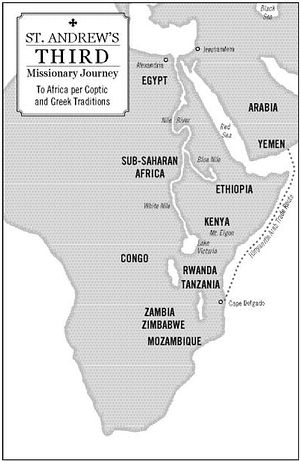
THE THIRD MISSIONARY JOURNEY:
Coptic Ethiopian Traditions

Загрузить увеличенное изображение. 532 x 819 px. Размер файла 88905 b.
His third missionary journey, if we accept the traditions, began after the first apostolic synod in 49 A.D. This is the only point time-wise when he possibly could have gone to Africa. The sources for the African stories are Ethiopian Coptic traditions, and an apocryphal Greek source, of which we have a revised, edited Latin version by St. Gregory of Tours. If he did go to Africa, it was for a special reason, because this was not the place he origi- nally had been sent to preach. He was to preach in Bythinia, to the Greeks and to the eastern Scythians.
RTE: By ”sent to preach” do you mean the tradition that the apostles picked lots as to where they would go?
GEORGE: Yes, but I think it was not only by picking lots that they decided. They organized a plan, they didn't all just set out into the wilderness.
Now these Coptic traditions say that he made a trip to the Berber (meaning ”Barbarian”) lands, but we don't know exactly where this was because the Berbers were living from the Siwa Oasis in Egypt to Morocco, Mauritania, Mali and Niger, and were the ancestors of the present-day Kabyls (the Turaregs) in Algeria. Perhaps he simply went to a place in modern-day Egypt. From there, these sources say that he went to the land of the Anthropofagi, a very definite place in the area of the Great Lakes on the borders of Tanzania, Uganda, Rwanda and Congo. Because, according to the ancient text, there was a volcano there, I believe that this was Lake Kioga, but this is my own opinion. Then, the legends say, he made his way to the abyss near Zimbabwe. According to research of the last century, the Himyarite Arabs were travelling at that time from Yemen to Mozambique to Zimbabwe, the ancient Ofir, where Hiram supposedly took the gold for King Solomon, so possibly the Jews, Phonecians, and Arabs knew this road, but not the Greeks or the Romans.
RTE: Who were the Anthropofagi?
GEORGE: According to the Coptic ”Acts of St. Andrew and St. Matthias (Matthew),” an extremely colorful and fantastic apocryphal story, on his third missionary journey St. Andrew was commanded, either from heaven or by the apostles, to go and help St. Matthew because he had been captured by the Anthropofagi, who were man-eaters, cannibals.
RTE: These traditions say that St. Matthew was captured by cannibals and St. Andrew was sent to rescue him?!
GEORGE: Yes, although some traditions say that it was St. Matthias, the majority of the sources think it was St. Matthew because Matthias went to Georgia, while St. Matthew went to Alexandria and Ethiopia. The Coptic sources are definite on this.
Some people have suggested that this ”land of the man-eaters” referred to in many ancient texts, was really in Pontus, in Sinope (today's northern Turkey), but this is not possible. Sinope and Pontus were classical Greece. The only thing they can base this on is that Pausanias, a second-century A.D. geographer, came upon some isolated Greek inns where they sold dried or preserved bits of human organs as medicinal remedies, but this was never a social way of being, even in out of the way places.
RTE: Yes, but how much credence can we put in these apocryphal texts?
GEORGE: As I said, from our vantage we can't look back in history and determine if something apocryphal was literally true, was based on something true that was elaborated on, or is a complete fantasy. There were different opinions among the Fathers. I believe St. Andrew could have been in Africa, and I substantiate this in my book, but remember, my primary task was to take every tradition, without judging the source, and try to discover if he could have physically traveled there, and, if so, how it fits time-wise and geographically with his other journeys. Admittedly, some of these can seem like wild tales to western readers.
There are many early traditions and texts, and not only Orthodox texts. Even those from heretical traditions like the monophysites may contain correct historical details. They include propaganda for their teachings that aren't right, but these can be revised or ignored. This is why St. Gregory of Tours, writing in the sixth century, and Hieromonk Epiphanius a monk-historian in Moni Kallistraton in Constantinople in the fifth, both use the text of Leucius Charinus, who was somewhat of a Manichean. St. Gregory recounts the trav- els of St. Andrew in his ”Acts of Andrew,” and Epiphanius in Patrologia Greca. They only corrected the doctrinal errors, and from this we can see that many of these early traditions were considered valid even by saints.
RTE: Can you explain how you worked with these texts?
GEORGE: It is difficult, as I spend sixty pages of my book tracing the sources of the African journey, but I will try to give you a synopsis. There are several minor sources for this tradition and two major ones: the Greek text I just mentioned of the ”Acts of Andrew,” which may have been by Leucius Charinus, (later cleansed of heresy by St. Gregory of Tours in a Latin version) and the ”Acts of Andrew and Matthias (Matthew)” by a Coptic source.
The original Greek ”Acts of Andrew” was condemned by Pope Gelasius in the Decretum Gelasianum De Libris Recipiendis Et Non Recipiendis, which was not a synodal decree, but a local condemnation of some apocryphal texts as a reaction to the falsification of holy tradition that existed in the third and fourth century amongst heretics. This was before the Chalcedonian Council. The Decretum, although respected by Orthodox believers has never been a dogma per se, but it is a serious and enlightened guide, which everyone should consider as a valuable protection against heresy.
Although it condemns ”the Acts in the name of the Apostle Andrew,” and ”the Gospels in the name of Andrew,” (which were possibly the work of a Manichean gnostic, Leucius Charinus), it does not condemn the Coptic ”Acts of Andrew and Matthias (or Matthew) in the Land of the Anthropofagi” nor the ”Acts of Peter and Andrew” which were of Coptic origin. One might object that the Coptic texts are also forbidden under the term, ”the Acts in the name of the apostle Andrew” but this reasoning doesn't match the other cases in the Decretum where, when we have condemned texts listed as ”the acts” of two people, they are described by both names (e.g. ”the book which is called the ‘Acts of Thecla and Paul,'” ”the book which is called ‘The Repentance of Jamne and Mambre,'” ”the Passion of Cyricus and Julitta”).
The Decretum condemns ”all the books which Leucius, the disciple of the devil, made…” but no one insists that the ”Acts of Andrew and Matthias (or Matthew) in the land of the Anthropofagai” and the ”Acts of Peter and Andrew” are the work of Leucius Charinus. On the contrary, most scholars accept that these texts are the work of an unknown Coptic monk (with the national, not the religious meaning of Coptic, because this was the pre- Chalcedonian period). This author could have been a gnostic heretic or equally, he could have been an Orthodox ascetic of the desert. We don't have enough evidence to support either view.
Both the great church historian Eusebius of Caesarea and St. Epiphanius of Salamis[3] also condemned the ”Acts of Andrew,” but not ”The Acts of Andrew and Matthias (Matthew) in the Land of Anthropofagi” and the ”Acts of Peter and Andrew.” As far as we know, they didn't even refer to these texts. The reason I am even considering material that was originally from this condemned text is that in the sixth century St. Gregory of Tours corrected the heretical points in ”The Acts of Andrew” by Charinus, publishing a revised text with the name ”Vita and Patio” (Life and Passion of Saint Andrew,)” which has been generally approved by the Holy Orthodox Church (parts of it appearing in hymns and services, and in the Synaxarion) as a basis for the Life of Saint Andrew. In this revision, St. Gregory of Tours accepts that Apostle Andrew preached to the Anthropofagai in Africa before his trip to Achaia-Greece. He obviously believed this. His version has never been condemned by the Church, and I use it as one of my possible sources.
Neither have the Catholic or Orthodox Churches condemned the Latin ”Golden Legend” of Voragine or the Anglo-Saxon epic poem ”Andreas” (probably of Cynewolf) in which the old story of ”The Acts of Andrew and Matthias (or Matthew) in the land of Andropofagi” re-appears in both a pious (Voragine), and folkloric (Andreas) form. This does not mean that they are accepted as historical fact, it just means that they do not contain heresy. Western scholars view them as legends.
In the Decretum of Pope Gelasius, there are other texts condemned as well: ”the book which is called ‘The Assumption of Holy Mary,'” ”the book which is called the ‘Lots of the Apostles',” ”The Passion of Cyricus and Julitta,” and so on. If you read these, you find that in many points they are almost identical to the holy and sacred tradition of our Orthodox Church minus the heresies. (Compare these texts and the Orthodox Great Synaxarion). Even the names ”Joachim and Anna,” the holy parents of the Mother of God, are only found in apocryphal texts which have survived from this early era. This does not mean that we can consider these sources as completely true or valuable in themselves. Rather, we accept that some of what is written in them can also exist in our holy Orthodox tradition. We cannot declare that everything in them is wrong (such as the dormition of the Mother of God, when the Lord took her body and soul to heaven, the martyrdom of Apostle Andrew in Patras, the martyrdoms of Cyricus and Julitta, the tradition that the apostles ”drew lots”). In fact, these condemned sources may have some true historical facts mixed with legends and fairy- tales, and poisoned by heretical nonsense. The nonsense is what Pope Gelasius condemned and what St. Gregory cleaned up. Another example of this borrowing is that Orthodox writers and church fathers have generally accepted the texts of Tertullian as a valuable historical source, although his doctrinal errors were also condemned by the Decretum.
There are other sources of this tradition of St. Andrew in Africa as well: the hymnograpy of some Pre-Chalcedonian churches (e.g. Ethiopians and Copts) and the synaxarion of the Armenians which says that ”Andrew preached among the cannibals, or in the land of Barbarians (Enivarvaros), a place identical to Azania according Claudius Ptolemy. As Orthodox, we cannot ignore this, because it is very likely that these sources come from the ancient period of the unity of the Churches. If not heretical, they could be an Orthodox tradition, although this has not yet been confirmed.
There are also non-Christian historical sources saying the same thing – Arab Islamic texts that say that the Holy Apostle Andrew preached in ”the land of the cannibals, that was a land of the blacks.” These sources are important because they are not Christian, they come from the early traditions and memories of the Arabic peoples.
Finally we have to remember that not every apocryphon is a forgery or a legend. Orthodox theologians and fathers have taught us to classify as an apocryphon those ancient Christian documents of unknown or unreliable validity. Some are heretical, some are forgeries, others are fantasies and romances. Some have interesting information that may even seem familiar as they incorporate real pre-existing sources (which we no longer have copies of) that are the basis of some of our Orthodox tradition, hymnography, and iconography. Not all apocryphal texts have been condemned by the Church. Of those that haven't been condemned, our Christians fathers and theologians were free to express their own opinions. In Orthodox tradition, no human opinion is considered infallible. Only our beloved Jesus Christ is infallible, and only the Ecumenical Councils declared unmistakable truths.
RTE: Thank you, that was very thorough, and you've obviously worked hard to get to the bottom of these sources. Can we go on now to whether St. Andrew could have physically gotten to Africa, and what the traditions say happened there?
GEORGE: Yes. These traditions say that when St. Andrew left Ethiopia, he went to the land of the cannibals, and this is not impossible because, according to Ptolemy, the land of the Anthropofagi is some distance after the Prasum Promontory. Prasum was somewhere in the coastal area between Zimbabwe and Tanzania; African historians locate it on Cape Delgado in modern Mozambique, an ancient place where the Bantu, Indonesians, Kushites, Arabs and Greeks met to trade. It was a known and used route. The land of Anthropofagi is on Ptolemy's map, and according to many traditions was a place inhabited by a Bantu tribe.
According to ancient Greek sources, the Land of the Anthropofagi is only in one possible place: in sub-Saharan Africa, between modern Rwanda and Uganda. The Coptic texts also speak of Prasum, Rapta, and ”the land where the Anthropofagi dwell.” Their description of the land and society of the Anthropofagi is exactly like that of the Bantu people in Tororo, Uganda near Mt. Elgon and Lake Victoria today, about 300 miles from southern Ethiopia. We have the exact placement from the text: ”between the Mountains of the Moon and the land of Barbaria,” and according to the Coptic text, St. Andrew left from the land of Barbaria to the land of the Anthropofagi – we even have the ancient longitudes and latitudes of these places. In the early Greek and Coptic texts the Land of Anthropofagi was called Mirmadona, and in the Bantu language today, Emere muntu na means, ”the place where men are food.”
At the end of the chronicles, St. Andrew frees St. Matthew and fights with Amayel, the demon-god of these people. The accounts say he fought with the devil and with demons in many places, but this demon of the land of the Anthropofagi was so powerful that St. Andrew couldn't fight him alone, so he asked God to send Archangel Michael to help him. Archangel Michael came, they joined forces and Amayel was destroyed. It was such a huge thing that the narratives say the people stopped their demonic practices and became Christian. According to the Coptic ”Acts of Sts. Andrew and Matthias,” the native St. Plato was the first bishop of the land of the Anthropofagi.
Strangely enough, today the people of this area call the demonic spirits in this place Amayebe. Also, as a journalist I know that there is now a very strange sect, part of a guerilla force in Congo-Zaire that teaches ”we must eat people to receive power,” and they are eating human flesh. The name of the sect is Amayei-Amayei, almost identical to the old name of the demon.
RTE: Is there any living tradition of early Christianity in sub-Saharan Africa?
GEORGE: There is no memory of St. Andrew's presence or of early Christianity except in Ethiopia. Until recently, most of sub-Saharan Africa had no written traditions, and at first I was shy to write that even a small group of Bantu fighters have gone back to cannibalism. I thought, ”This is going to be an insult for the Bantu,” until I realized that many people during their history have been cannibals. One doesn't have to be embarrassed that a few Bantu may have turned back to cannibalism; what is important is to understand that the devil himself is fighting the Bantu people because they have a special grace of God. It is natural that they would be attacked, that the evil one would corrupt the soul's longing for the body and blood of Christ because he wants to keep them away from God – Africans are coming to Christianity by the millions.
If you go to Orthodox churches of the Bantu you see a faith that is real and miraculous. In the Orthodox churches of Africa miracles are part of the every-day life of the people. They have miracles, but they also readily accept things we cannot, like death and disease, with great faith in the will of God. They have miracles but they are not seeking miracles; that is the Protestant way. They can accept the non-miracle as a miracle as well, as God's Providence.
If he indeed went there, St. Andrew could have returned through Ethiopia, then taken the road to Meroe, up the Nile and back to Jerusalem, which was a well-known route for the Greeks and Arabs.
RTE: Are there also traditions of St. Andrew preaching in Ethiopia?
GEORGE: Yes, we have local traditions of him in Ethiopia from Coptic manuscripts and some early traditions of the Church that are not easily understood now. For centuries we thought they were just legends, but if you read the geographical notes, they precisely describe the kingdoms of Ethiopia at that time, the Meroitic Kingdoms. But these texts describe them in a way that only Copts can easily understand that this is Ethiopia. For example, in America you won't always say, ”San Francisco.” You may say, ”the Golden Gate,” or ”the Bay Area,” or in the 1950s you could have said, ”Frisco.” In New York you say, ”the City.” It is the same with the term ”the sacred mountains.” Every Ethiopian understands that this was Gebel Barkal, but only if you are Coptic or Ethiopian do you know this. 

THE FOURTH MISSIONARY JOURNEY:
To the North
Загрузить увеличенное изображение. 1104 x 819 px. Размер файла 219204 b.
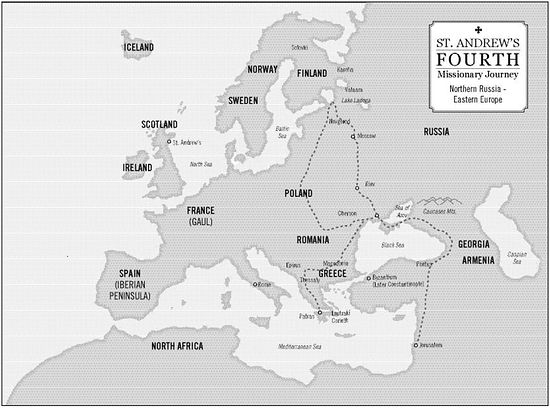
After the dormition of the Mother of God, St. Andrew began his final journey from Jerusalem. The trail of tradition says that he went back to Pontus, then to Georgia, to the Caucuses, and to the Sea of Azov in southern Russia. From there he went to Donets, to the Crimea, up the Dnepr River to Kiev and to the Scythians of the Ukraine. In the Crimea, where he stayed with the Greeks of Sebastopol and Cherson, we know that there were first-century Christian communities organized by St. Andrew himself. From the Crimea and Kiev in the Ukraine, he would have gone north by river to what is now Moscow, to Novgorod and then to Lake Ladoga (Valaam). Early written narratives no longer exist, but this is a very likely route because the river trade from Crimea to northern Russia and Karelia (Lake Ladoga) was common and relatively easy. Extensive trade from the south is attested to by the great number of Roman and Byzantine coins found in Valaam and Karelia. There is also a local tradition that he went to Solovki, and they've found some very old coins in the Solovki Islands in the White Sea depicting St. Andrew, but we can't claim he was there solely on the basis of finding coins with his image. We can't completely exclude this legend, because it might be true, but we have no historical evidence to support it. Conceivably, he could have traveled from Valaam to Solovki with the Lapp reindeer herders who moved between Solovki in the summer and the protected shores of Ladoga in the winter.
Although we don't have extremely early texts, the accounts from Lake Ladoga and Valaam are not legends, they are tradition. We have an 11th century Russian text and we also have the tradition of Valaam itself. From Valaam it appears that he went to the Baltic Sea (then possibly to Scotland and back to the Baltic, although, as I said earlier, this is not certain). Then, through Poland and Slovakia to Romania, where he settled for twenty years.
Finally, he went back to Sebastopol (Crimea) to Sinope, and then to Greece and to his end in Patras.
We can trace his return route on this fourth journey because we have traditions for him during this time in Poland, Byelorussia, and even in Germany, although this is doubtful. We also have solid traditions for him in the lands of the Goths, although before the Goths moved into the Ukraine they lived in Poland alongside Germanic tribes. Possibly he returned through modern-day Poland and the tribes that later moved up into Germany carried the tradition of St. Andrew's passing with them, but we can't say that he was in Germany itself.
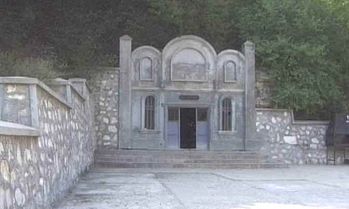
It was on his return south that he settled in Romania for twenty years. During that time he traveled in Moldavia and Bulgaria, on the Danube and along the coast of the Black Sea, but mostly he was in and around his cave in Dervent, Dobrogea, in southern Romania.
St. Andrew's Romanian cave is still kept as a holy place and Romanian Orthodox have gone there on pilgrimage for almost two thousand years. We also know the locations of other caves he lived in: in Pontus near the Black Sea (now Turkey), in Georgia, in Russia, in Romania, and in Loutraki near Corinth. It is all him, the same man.
Загрузить увеличенное изображение. 672 x 504 px. Размер файла 27920 b.
 St. Andrew's Cave, Romania.
St. Andrew's Cave, Romania
RTE: Why did he stay in Romania for so long?
GEORGE: I didn't understand this myself at first, but it appears that he felt very close to the Romanians because they were monotheists. According to Flavius Josephus, their clerics were like Essenes. They were virgins, strict vegetarians who didn't even eat fleshy vegetables, but only seeds and nuts like ascetics in the desert. Dacian society was very free, the women had a good, equal position there, not like Greco-Roman society, and the Dacians didn't keep slaves. In fact, they were unique in the world at that time because they didn't have slaves. According to Romanian traditions and archeological findings, the Dacians became Christian under St. Andrew himself in the first century. It is natural that he would have felt at home with the Dacian clergy and that they would have readily accepted him and converted.
The Ethiopic tradition also describes St. Andrew as a very strict vegetarian. This is possible because, although most of the other apostles were married, both he and John the Evangelist were virgins. They had been disciples of St. John the Baptist and followed his hesychast tradition. They were the first monks and ascetics of the Christian world. Even in our Orthodox hymnography we remember St Andrew as being closely associated with St. John the Baptist. In Orthodoxy we have choices: we have vegetarian hermits, sometimes very strict, living only on bread and water all their lives, and we also have saintly kings who ate pork and beef.
He was in Romania for twenty years and I think he loved this land more than anything after being with Christ. I believe that God allowed it as a consolation because he had been on such difficult missionary journeys. We have descriptions of places where he wasn't welcome, where he was forced to leave and his despair over this. Things were often very difficult, particularly when he was in the Slavic lands where human sacrifice was still practiced.
You can imagine, he was tired of living with this, and when he came to the Dacians, who had no slaves, where men and women were equal, where Jews and Greeks were accepted in the same manner, and where there were ascetic hermit-priests, you can understand how easily he fit in. He was able to teach, he was happy there. In fact, they thought that the religion he brought was not only better than theirs, but was a continuation of their old religion. They saw their native religion as a foreshadowing of Christianity. Twenty years is a long time, and you can understand why the Romanians remember more of him than any other tradition.
From Romania there are traditions that he went to Cherson in the Crimea and from there to Sinope, to Macedonia, and preached a bit in Epirus (northern Greece and southern Albania). Although we have references from early texts that he preached in Epirus, we don't have any local traditions there. The rest of the sites I've quoted are supported by both written texts and oral tradition.
To be continued.


[1] St. Stachys, first bishop of Byzantium (later Constantinople), feast day October 31.
[2] Hieromonk Epiphanius: Ninth century historian and priestmonk of Moni Kallistraton in Constantinople, who wrote a life of Saint Andrew: “Epiphanii Monachi et Presbyteri – de Vita et Actibus et Morte Sancti, et Plane Laudandi, et Primi Vocati Inter Apostolos Andrae” [in P.G. Migne, vol. 120]. He is also the author of the old- est extant Life of the Theotokos (P.G. Migne, vol. 120.). Epiphanius deeply venerated St. Andrew and tried to recreate his journeys based on ancient sources. Traveling extensively in the areas St. Andrew was known to have been, he gathered many local traditions and texts connected with the apostle’s missionary journeys. It was a magnificent work for his era. Some of his passages concerning the martyrdom of St. Andrew are identical with the apocryphal “Acts of Andrew,” and it is very likely that he also used Leucius Charinus’ text.
[3]St. Epiphanius of Salamis, Cyprus (feast day, May 12): Condemned “The Acts of Andrew” and declared in his Panarion that, amongst other heretics, the Encratites, the Apostolici, and the Origenists used that text.

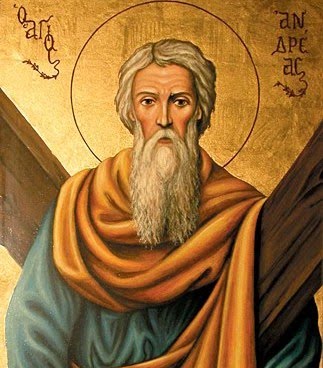
The Astonishing Missionary Journeys of the Ap. Andrew Part 1

Загрузить увеличенное изображение. 323 x 368 px. Размер файла 35662 b.
 Holy Apostle Andrew.
Holy Apostle Andrew
Part 1


George AlexandrouGeorge Alexandrou, international reporter, writer, and political commentator, on his thousand-page book in Greek, He Raised the Cross on the Ice, exploring the sources, traditions, routes and cultures of St. Andrew's apostolate.

George Alexandrou
GEORGE: People journeyed over vast areas in antiquity and we know quite a lot about their travels. For instance, Claudius Ptolemy drew a map of the ancient world in the second century after Christ (and this is a real map of the world as we know it today). From Ptolemy and other Hellenistic geographers and historians we know that there were extensive trade routes such as the Silk Road, the Cinnamon Road, the Spice Road, the Golden Road from the Kingdom of Zimbabwe to the Mediterranean Sea, and the Amber Road from the Baltic Sea to Rome, through Denmark and the British Isles. The Verangian Road (as it was called by the Byzantines) was traveled by Herodotus 1,400 years ago, and went from the Crimea through Kiev, straight to Valaamo and the Baltic Sea. Centuries earlier it was called the Dneper Road. There was another major route connecting the Mediterranean to Cornwall in the British Isles, the Tin or Pewter Road. Then we had the famous Silk Route, which united the Chinese Han Empire with Rome. There was also a trade route along the Nile between Meroe and Axum, the kingdoms of Sudan and Ethiopia. The Cinnamon Road connected Shanghai in China with Indonesia and Borneo, through Java to Tanzania. The Spice Road united China through Burma, Sri Lanka and present-day Pakistan to the Red Sea. You can imagine, these were all important routes and a simple, unostentatious man like St. Andrew could take any of them easily.

RTE: Were the ancient and classical maps more accurate than later medieval maps in the West?
GEORGE: Yes, later Christians would say, ”Paradise was here, the earth was flat, etc.,” but if you look at the old Greek maps, they not only knew the earth was round, but the longitudes and latitudes are the same on their maps as we know them today. They are not exactly the same because we count ours from Greenwich and they didn't, but you can correlate them precisely. You can even find America and Australia on some maps (i.e. the map of Crates the Maleot in 150 B.C.). This is why I believe we can accurately locate these places from the old traditions. When barbaric peoples invaded the older Christian civilizations and became Christian themselves, this was right spiritually, but it was a catastrophe for civilization. Night fell on education and learning, although spiritually and culturally it was a dawn for the barbarians. It was their time, for the first time in history.

RTE: Although there were dangers from bandits and smugglers, there probably weren't the kind of border controls we have now.
GEORGE: Yes, but even now there are dangers. Going to Siberia isn't any safer now than it was 2,000 years ago, but there was often another attitude towards travelers then. Although there were always dangers, in many ancient cultures a traveler was sacred, he was from far away and people didn't want to despoil him; they wanted to hear about his country and his civilization. You didn't need visas, documents, you were not even in need of friends because you were a special person, a traveler. You were coming with far-off ideas, different beliefs, strange dress. You were more often a person to admire than someone to fight or to steal from. In the ancient world pass- ing travelers were laden with gifts – this was Marco Polo's experience. Those were different times. With my own decades of traveling to difficult and exotic places, it is easy for me to understand how St. Andrew could have traveled as extensively as the traditions recount.

RTE: When we first spoke about your research you made the remark that when the Lord told the apostles to preach the gospel to the ends of the earth, they did not think this meant their descendants. They took this literally.
GEORGE: Yes, we have many written traditions from the second and third centuries A.D. that the apostles went to Middle Asia, to sub-Saharan Africa, to India, even to old Burma. They went to the land of Sogdiana, which is modern Uzbekistan/western China… we had all these memories and traditions of the first years of Christianity, but we thought they were just strange tales. Now, with the help of archeology, we understand that these roads did exist, and that many, many people took them. We know, for example, that the Indonesians were traveling from Java to Tanzania across the Indian ocean. They had large, well-balanced outrigger canoes, and they would load them with their families, livestock, food and water, and set out from Java – sometimes traveling for a lifetime. This is how they discovered Madagascar. They sailed the open oceans without any fear. The Celts also were extensive travelers in the North Atlantic with their leather-covered boats, the curraghs.
Another example of widespread travel is that in 330 B.C., Pithias knew northern Europe well. He had been to Cornwall, to Scotland, to Thule (some say that ancient Thule was Iceland, others Greenland, others Northern Scandinavia) and from there he traveled to Marseilles in forty-five days.

RTE: In forty-five days!
GEORGE: Yes. And in Claudius Ptolemy's (100-170 A.D.) geography we have Diogenes – a second Diogenes, not the philosopher – who, during the apostolic times, left by ship from Alexandria and went to Azania, present-day Tanzania, to a place called Rapta. From Tanzania he walked for twenty-five days to the mountains of Ruvenzori between Lake Albert and Lake Edward in what is now Rwanda, Uganda, Congo-Zaire. You see, it was a small world at that time, and the Greeks already knew the source of the Nile.
So, when the Lord told the apostles to go to the ends of the earth, the Greco-Roman knowledge of the world at that time was quite specific. They knew where the ends of the earth were. For the ancient Greeks and Romans, the world ended in an abyss, the ”Antipodes,” after the Prasum Promentory in Zimbabwe. However, the ancient Israelites, the Himyarite Arabs, Phoenicians, and Nabbataean Arabs knew that this was not the final abyss, but the dzimba dza mabwe, possibly the mines of King Solomon, or the Bantu Empire of Monomotapa (Mwene Muntapa).
My point is that, geographically, Ptolmey gave us all the known places and no one can say that this is rubbish. China, Indonesia, Lapland, Britain, Scandinavia were all known. It was not easy to go to the ends of the earth, but it was possible. In his epistles, St. Paul speaks of being obliged to spread the gospel or he will be lost. In Greek, these words, ”to the ends of the earth” are very precise, they are in no sense allegorical and the apostles would have understood this literally. The ancient geographers used this phrase as a precise geographical definition.
That the apostles accomplished this to some degree is borne out by the Church historian Tertullian, who wrote in 170 A.D.: ”We have deacons, we have priests and we have churches, to the ends of the earth.”[1] Then he describes the places: the Sarmatians, Sub-Saharan Africa, the British Isles, and the Scythians. The territory of the Sarmatians, for instance, stretched from the Caspian Sea to Lake Baikal; and from Mongolia to Siberia.

THE CROSS OF THE NORTH
RTE: How did you begin to write about St. Andrew in particular?
GEORGE: If you had told me a year ago that I would be writing a book on St. Andrew, I would have said you were crazy. I never imagined that I would do such a thing. But when I had some serious problems, I went to New Valaamo Monastery in Finland where I was given the extremely kind hospitality of the monks and Igumen Sergei. It was like entering the doors of paradise. You can imagine; it was cold, quiet, silent, and the only things I had to face were God, nature, and myself.

Загрузить увеличенное изображение. 1034 x 769 px. Размер файла 390306 b.

At the time I wanted to write a book about the Kalash, the descendants of Alexander the Great on the northwest border of Pakistan, who are still pagan. Their religion is still very connected with ancient Greek paganism, and I feel an urgency to preserve their mythology and legends because this is an endangered culture and there are only two thousand of them left. I had planned to begin this work in Finland, but I understood that the monastery was not exactly a proper place to write about pagans… so instead I began writing about the Karelian Orthodox saints. I was impressed that many Greek monks from Mt. Athos had gone to Karelia and that Karelian monks had gone to Mt. Athos and later returned to the Russian north – like St. Arseny of Konevits. 

One of our Greeks who went to Karelia was Monk Eliezar, and we have had a continual stream of Greek monks, hermits and ascetics in Karelia. Tradition says of Sts. Sergius and Herman, the founders of Valaam Monastery in Russia, that one was a Greek from Mt. Athos and the other a local Karelian. (Others say they were both Greeks from Kiev, and a third version holds that one was Greek and the other a pagan priest, but the fact remains that in each variant they had Greek influence and ideas.)

I am fascinated by what I call ”The Cross of the North.” This is a geographical cross that you can trace on a map. The vertical bar links the far north of Russia to Greek Orthodoxy in the south. The crossbar connects Finnish, Russian and American Orthodoxy, from Sts. Sergius and Herman of Valaam, through the deserts of the ”Northern Thebaid” to St. Herman of Alaska on Spruce Island.
I was thrilled to be at Valaamo, receiving the tradition of Valaam Monastery and writing about the saints. The abbot helped us very much. My wife is Ukrainian, a Russian national, and we were given access to the monastery archives and allowed to copy anything we liked. This was a very great gift of God and of Valaamo. We translated from many books and then came back to Greece to begin writing. Even then I knew that I must begin by writing the life of St. Andrew the Apostle.

RTE: The tradition that St. Andrew was in Karelia is still held today?
GEORGE: Yes, by the monks of Old Valaam Monastery in Russia, some monks of New Valaamo in Finland, and by Finnish and Russian Karelians as well. St. Andrew is at the center of the icon, ”Synaxis of All the Saints of Valaam” at New Valaamo Monastery.
As I began to write, I found myself coming across more and more scattered information about St. Andrew from all over the world. Finally, my Greek editor, Sophia Oriphanidou, said, ”Wait on the lives of the saints of Karelia, write first about St. Andrew himself.” I didn't feel right working on a book about an apostle, but I told myself, ”Yes, I'm a very bad guy, but it happens that I have to write this book, so I will.” It was an inner obligation that I knew I couldn't avoid. I'm not worthy to write about him, but I had to, and I ask everyone to forgive me.
Once I began, many sources came to me and people came forward to help, from northern Russia, central Asia, eastern Europe, Ethiopia – texts and oral traditions, even from the Kalash people of Pakistan, whom I mentioned earlier. Their texts speak of the presence of a messenger from God by the name of Indrein, and I cite this tradition in my book in their local language, because in the old Romanian, St. Andrew is called Indrean. I collected many local traditions, everything I could find. At first it was very difficult, but then things began coming.

RTE: You said earlier that it was as if they were being put in your way.
GEORGE: Yes, but at the beginning it was chaos, just scattered information from around the world. Also, I knew that I didn't want to make traditions out of legends. I just wanted to follow the sources and see where they led; it was like putting a huge puzzle together.
I have already covered about a thousand pages and I quote almost fifty languages and dialects. The book is in Greek, of course, and I'm calling it, ”He Raised the Cross on the Ice.”
RTE: What languages did you work in?

GEORGE: The oral traditions and texts referring to St Andrew are in ancient Greek, modern Greek, Pontian and Calabrian Greek, Georgian, Abhazian, Slavonic, Serbian, Russian, Ukrainian, Romanian, Kalasha, Baganda, Kurdish, Ethiopian Geez, Ethiopian Amharic, Coptic, Arabic, Aramaic Syrian, Turkish, Turcik of Central Asia, Iranian, Bulgarian, old English, English, German, Italian, Latin, Albanian, Finnish, Karelian, Armenian, and many dialects.
I also had to deal with many languages, scripts and dialects, living and extinct, that didn't deal directly with St. Andrew, because I had to read the sources concerning the world in which he lived. These were in Hebrew, Samaritan, Bantu, Kushitic, Teso, San, Tokharian, Sanskrit, Chinese, Mongolian, Korean, Amazigh-Berberic, Gothic, Gaelic, Saami-Lappish, Swedish, Norwegian, Polish, Tadjik, Sogdian, and so on. Of course, I wasn't able to learn all these languages, but I was fortunate enough to find native speakers and scholars around the world to help me with these sources. And here I have to thank my wife and spiritual sister Olga, because her help with the Slavic sources was fundamental for my research.
Megas Farantos, the well-known professor of dogmatic theology in Greece and Germany, who represents the Ecumenical Patriarchate and the Greek Church in dialogue with the Roman Catholics and other religions, was a great help to me. He trusts my work and academically supports me. He told me, ”Don't critique the traditions, this is not your job. Accept them or don't accept them, but don't critique them.” Secondly, he said, ”Adopt a principle of working. They can fight your interpretation, but not your principle.” So, I took as a principle the premise that, ”I accept all evidence as possible, whether it is a writing of the Holy Fathers, an oral tradition from Uzbekistan, a Coptic text from Ethiopia, a simple dream, or the archeological excavations of a Chinese scholar.” It is impossible from our time to absolutely say that a certain isolated tradition is true or false. My idea was to work from another direction by putting down all the scattered sources to see if the different tra- ditions of St. Andrew's journeys fit together geographically and time-wise. I wanted to see if they were even possible. Then, once I exposed the contradic- tions, perhaps I could find the actual routes of St. Andrew's journeys.
The question was if, by setting the various traditions side-by-side, I could trace St. Andrew's travels with any probability. Our strongest evidence, and what we always hoped for, was early written commentary about the apostle's visit to an area along with a separate, verified oral tradition from the same place that has been passed down until now. As I went on, I discovered that in time and geography the Kazakhstani tradition fit the Sogdiana tradition (modern Uzbekistan), the Sogdiana tradition fit into the Parthian tradition the Syriac tradition. It was like a train, one car after another, until I had only twenty years missing from St. Andrew's return to the Black Sea from Valaamo until he went to Sinope – and from there to Patras in Achaia, to his martyrdom.

RTE: Were you able to resolve those twenty years?
GEORGE: Yes, I found a local Romanian tradition that St. Andrew lived twen- ty years in a cave in Romania, in Dervent, and during this time he traveled through what is now Romania, Bulgaria and Moldavia. But the most incredible thing was that, according to the early Romanian traditions, the years he was there was the exact period I was missing from the other traditions.
The most important thing is that these puzzle pieces – the separate local traditions of Bulgaria, Romania, Ethiopia, of the Aramaic people, the Syrians, the Copts, even the Greek and Roman church traditions all fit together, but you have to follow them step by step to recreate his life. Finally, I had only one piece that I couldn't fit, even as a possibility: the Declaration of Arbroath, the fourteenth-century Scottish declaration of independence from England which says that the Scots were taught the Christian faith by St. Andrew himself. Historians dismiss this, but I have to point out that his presence there was not physically impossible.

RTE: And who signed this declaration?
GEORGE: The nobles of the Scottish nation, in 1320.[2] The Arbroath tradition is interesting because there is no other written claim of St. Andrew in any place in Scotland, although there are a few scattered legends that say he was in Scotland generally. The most common tradition says that St. Rule (or Regulus), who was possibly a Greek monk from Patras, brought some relics of St. Andrew from Patras to St. Andrew's in Scotland in the fourth century. St. Andrew is the patron saint of Scotland, and that the relics were there is undisputed. They disappeared from the cathedral only during the Calvinist Reformation destruction. There is a second tradition that says they were brought by an eighth-century abbot, but according to the nobles of the Scottish nation, St. Andrew was actually there, and I wanted to finish my book by simply seeing whether this was possible or not.

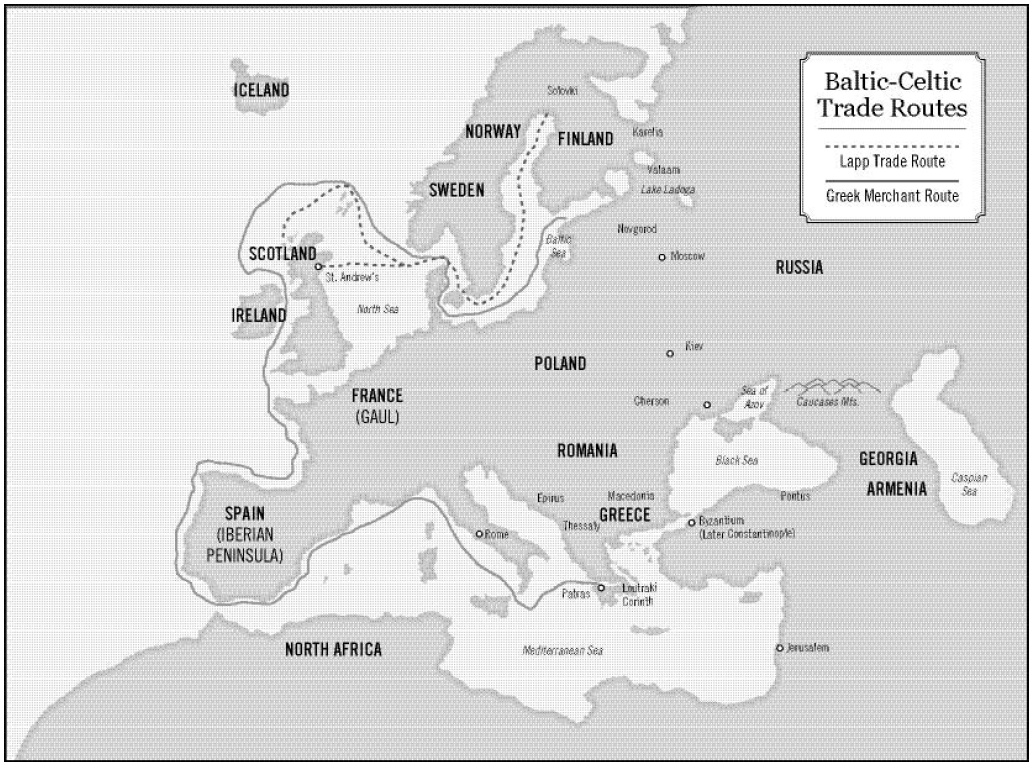
For a long time, it didn't seem that there were any traveled routes connecting this place in Scotland to other places St. Andrew is known to have been, until I learned of a group of Lapps called ”the Seal People.” These were seal fishermen who lived on the Baltic coast in an area St. Andrew is known to have been. They traded by sea from Scandinavia to the Hebrides, the Orkney and Shetland Islands, and to northern Scotland – a place now called St. Andrew's, where the relics lay for centuries.

In the first century, Rome had already captured southern Britain, and the Scots and Picts further north were very hard-pressed. When trade in the south was closed to them, they began to use this old Celtic-Lapp route over Norway, Denmark and Sweden. The ancient Greeks had already mapped this road, and Pithias of Marseilles went to these places about 330 B.C., and probably to Iceland and Greenland as well. I can't say that St. Andrew traveled with the Lapps, of course, but this route did exist, and if he did go to Scotland it would have to have been after his visit to the Baltic Sea and before Romania.

Except for this remote chance, I didn't see how he could have gotten to Scotland until I found something else that made it very possible. According to ancient Greek writers there was an inland route for Greek merchants from the Baltic Sea. From the Greek Crimea they traveled up the Russian rivers, the Dnepr, Dvina etc. to what is now St. Petersburg (as St. Andrew himself did according to Russian tradition). Then to avoid the hard Russian winter, they didn't return to Greece the same way but sailed the Baltic, where they bought amber, and then to Scotland where they made their way down the coast to Cornwall trading for tin. 

From Cornwall, they traveled down the Iberian Peninsula to Gibraltar, then past
the (then) Greek cities of Marseilles, Nice, Antibes and the area of Monaco, and then to Rome, Sicily, and Greece.
This is why the ancient Slavic sources recount that St. Andrew left Russia for Rome. In fact, I don't believe he ever got to Rome, because if he had this would surely have been recounted in the Latin tradition. For reasons that I go into in my book, I think that he returned to the Germanic lands where the Romans had created a new road connecting the Baltic with the Danube. From the Danube he could have sailed down to Dobrogea in Romania.

RTE: Would it also have been possible that some of the tribes he encountered in eastern Europe might have migrated to, or traded in, Scotland and that this was the origin of the tradition?
GEORGE: Yes, there are some theories that the Scot aristocracy were descendants of the Verangian Russ or the Scythians, but I'm doubtful about this. In the Declaration of Arbroath the nobles are talking about St. Andrew being in Scotland. That was their statement.

RTE: How do modern Scottish Christians see this?

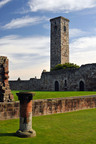
The Tower of St. Regulus, Scotland.
GEORGE: They believe that the Arbroath tradition was based on St. Regulus' bringing the relics from Patras in the fourth century (or an abbot in the eighth), but I'm still open to the possibility that there is something older at work. The Declaration of Abroath is very important and from a time when people were careful of oral tradition. I would be surprised if they so quickly mixed up the tradition of his presence with that of his relics. Unfortunately, there is no collaborating evidence that he was there, so I can't say it was even probable, just possible. 

 RTE: How could he have traveled so freely among these vastly different peoples?
GEORGE: He was a humble, simple man, and for a simple man nothing is impossible. If he had been an arrogant European explorer he would never have trusted these people, he would have found his own way like Pitheas, who made a boat and sailed to Greenland from Marseilles. Although he respected their knowledge, Pitheas didn't fully trust the locals because he was a Greek and they were barbarians.

You see, my book is a cultural tapestry. It includes the Scythians, the ancient Scots, early Africa. It is about St. Andrew, but it is also about the world he moved in: the Slavs, the Pharisees, Epicureans, Stoics, the North Africans, the Lapp nomads, the Han Dynasty in China, the Mongols and the Turks. My editor told me, ”Don't just write the life of St. Andrew, describe the places he went and the people he would have met.” When I began writing about these places, I found that I had to depict the whole era – how Siberia and Finnish- Russian Karelia are connected to central Asia, Africa and Scotland – so that a reader can understand what the world was like at that time.


To be continued.

PART 2


Source:


[1] Tertullian, An Answer to the Jews, Chapter. 7, Ante-Nicene Fathers, Vol. 3, p. 157-8. T&T Clark, translated by S. Thelwall.
[2] From the Declaration of Arbroath, 1320: “Most Holy Father and Lord, we know and from the chronicles and books of the ancients we find that among other famous nations our own, the Scots, has been graced with widespread renown...The high qualities and deserts of these people, were they no otherwise manifest, gain glory enough from this: that the King of Kings and Lord of Lords, our Lord Jesus Christ, after His Passion and Resurrection, called them, even though settled in the uttermost parts of the earth, almost the first to His most holy faith. Nor would He have them confirmed in that faith by merely anyone but by the first of His Apostles – by calling, though second or third in rank – the most gentle Saint Andrew, the Blessed Peter’s brother, and desire him to keep them under his protection as their patron forever.”

Category

1915 Armenian Genocide 21st-century Christian martyrs‎ Al Qaeda Apostles Arab Christian Arab-Orthodox Archimandrite Tikhon Shevkunov Asia Australia BBC Belarusian Orthodox Church Bethlehem Bible movies Bulgarian Orthodox Church Byzantine C.I.A. Cairo China Christian Armenians Christmas Traditions Christmas tree Conspiracy Constantinople Documentary Easter Ecumenical Patriarch Ecumenical Patriarch Bartholomew I Ecumenical Patriarchate of Constantinople Elder Ephraim of Vatopaidi Elder Porphyrios Epiphany FREE Greetings Cards FREE books Fr Seraphim Rose Georgian Orthodox Church Greek Orthodox Church Greek Orthodox Easter Holy Fathers Holy Scripture Holy Tradition Internet Interview Italy Jesus Christ Middle East Miraculous Icon Mount Sinai Movie Trailers Orthodox Church in America Palestine Prophecy Russia Russian Orthodox Church Saints Shroud of Turin Son of God St Nicholas of Myra The Mount Athos Food Evolution UK Ukraine Ukrainian Orthodox Church Vatican Watch FREE full movie africa al assad albania anti-Morsi protests army bank bible bible translations bulgaria byzantine music christianity christians christmas church coptic church copts cyprus daily news economy egypt egypt pope elder elder Paisios elder joseph of vatopaidi english subtitles europe food france fyrmacedonia germany greece greek greek food greek music greek orthodoxy health and medicine icon iran islam islamist israel jerusalem jews jihad killed libya mafia monastery money mother of god mount athos music muslim muslims news orthodox church pakistan patristic tradition photo photos picture politics pope protests quotes recipes religion romania romanian orthodox church saint science spy syria theotokos travel turkey tv usa vatopaidi video war world
Related Posts Plugin for WordPress, Blogger...