


Showing posts with label pakistan. Show all posts
Showing posts with label pakistan. Show all posts
Saturday, November 1, 2014


Friday, May 30, 2014
Monday, April 7, 2014
Pakistani baby accused of attempted murder

Lahore (Pakistan) (AFP) - While
many children his age are still learning how to crawl, a nine-month-old
boy in Pakistan has been accused of attempted murder in a case observers
say highlights endemic flaws in the country's legal system.
Tuesday, October 22, 2013
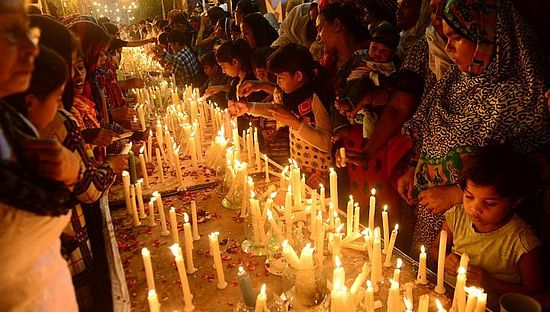
New details of attack on a Christian family in Islamabad revealed
Thursday, October 17, 2013
INDIA: Divine diplomacy - build Russian church, let temple stay
Render therefore unto Caesar the things which are Caesar’s; and unto God the things that are God’s
Matthew 22:21

New Delhi, Oct. 16: The paths are about to cross on the table of high diplomacy.
Places of worship
have crept into the agenda of summit talks between President Vladimir
Putin and Prime Minister Manmohan Singh next Monday.
Saturday, January 5, 2013
Girl Shot by Pakistani Taliban Is Discharged From Hospital

LONDON — Malala Yousafzai, the Pakistani schoolgirl shot in the head three months ago by the Taliban for advocating the education of girls, has been discharged from a British hospital. Doctors said she had made “excellent progress” and would be staying with her family nearby before returning for further surgery to rebuild her skull in about four weeks.
“Following discussions with Malala and her medical team, we decided that she would benefit from being at home with her parents and two brothers,” said Dr. Dave Rosser, the medical director.
The release was a promising turn for the teenage activist. Her shooting brought global condemnation of the Pakistani Taliban, whose fighters killed six female aid workers this week in the same region in northwestern Pakistan where Ms. Yousafzai was shot.
On Oct. 9, gunmen halted her school bus as it went through Mingora, the main town in the Swat Valley, singled her out and opened fire. A bullet grazed her brain, nearly killing her, and traveled through her head before lodging in her neck.
Six days later, after emergency treatment in Pakistan, she was airlifted to the hospital in Birmingham, which specializes in treating British soldiers wounded in action in Afghanistan.
Medical experts say Ms. Yousafzai has a good chance of making a full recovery because of her youth, but the long-term impact of her head injuries remains unclear.
In recent weeks, she has left the hospital regularly to spend time with her family. The Pakistani government is paying for her treatment.
Ms. Yousafzai rose to prominence in 2009 with a blog for the BBC’s Urdu-language service that described life in Swat under Taliban rule.
Now her father, Ziauddin, a school headmaster, has accepted a three-year position as education attaché at the Pakistani Consulate in Birmingham, making it unlikely that the family will return to Pakistan anytime soon. In any event, it may be too dangerous, because the Taliban have vowed to attack her again.
Pakistan: Top Taliban Leader Killed in a US drone strike
An American drone strike in Pakistan has killed top Taliban commander Maulvi Nazir, a senior intelligence official
Nazir, along with five close associates, was killed in a US drone strike, which took place near the town of Wana in Sar Kanda area of Birmil of South Wazristan Agency, one of seven federally administered tribal areas where militants thrive.
"The information we have received from our ground sources confirmed the death," a senior Pakistan Army Intelligence official. "The vehicle in which the key Taliban war lord was traveling in was struck by two missiles."
The Pakistani official spoke on the condition of anonymity because he is not authorized to talk to the media.
The U.S. rarely comments on its secretive drone program, and Pentagon spokesman George Little said he could not confirm Nazir's death, but he added that if true, it would be "a significant blow" to extremist groups in the region.
He said it would be helpful not only to the U.S. and to Afghanistan but also to Pakistan, because "this is someone who has a great deal of blood on his hands."
At least four people were killed in a separate drone strike Thursday in the North Waziristan tribal region.
America's use of drones against militants in Pakistan has increased substantially under President Barack Obama, and the program killed a number of top militants in the past year.
But the drone strikes infuriate many Pakistanis who see them as a violation of their country's sovereignty. Many Pakistanis complain that innocent civilians have also been killed, something the U.S. rejects.
Nazir's killing could cause even more friction in the already-tense relationship between Washington and Islamabad.
But in Pakistan, many members of the military had a more favorable view of Nazir and similar militant chiefs who focus their attacks in Afghanistan and don't strike Pakistani targets. Pakistan is believed to have reached a nonaggression pact with Nazir ahead of its 2009 military operation against militants in South Waziristan.
Still, Nazir outraged many Pakistanis in June when he announced that he would not allow any polio vaccinations in territory under his control until the U.S. stops drone attacks in the region.
Pakistan is one of three countries where polio is still endemic. Nine workers helping in anti-polio vaccination campaigns were killed last month, and the killings this week of five female teachers and two aid workers may also have been linked to the immunization campaigns.
As many as 10,000 people attended Nazir's funeral in the town of Angoor Adda, where the strike happened. One resident who was there, Ahmed Yar, said Nazir's body was badly burned and his face was unrecognizable.
Reports of individual deaths in such cases are often difficult to verify independently.
Nazir was active in many parts of Afghanistan and had close ties with the Afghan Taliban, said Mansur Mahsud, the head of the Islamabad-based FATA Research Centre, which studies the tribal regions.
"His death is a great blow to the Afghan Taliban," he said.
The Taliban is a widely diverse group. The Afghan Taliban is made up mostly of Afghans who fight against U.S. and NATO troops.
Within Pakistan, it's a bit more complex. The Tehrik-e-Taliban is an umbrella group consisting of militants who have been fighting for the overthrow of the Pakistani government because they believe it's too closely allied with the U.S. They would like to install a hard-line Islamist government and have been behind much of the violence tearing apart Pakistan in recent years.
Nazir and another senior Taliban commander, Hafiz Gul Bahadur, broke away from the TTP in 2009 and struck a truce with the Pakistani military. Instead they focus their fighters and money on battling U.S. forces in Afghanistan.
Nazir was believed to be about 40 years old, with three children and property in both Pakistan and Afghanistan. One of his brothers was also killed in a drone strike. Nazir used to be a member of Hizb-e-Islami, a powerful militant Islamist group in Afghanistan run by former Prime Minister Gulbuddin Hekmatyar.
Nazir had survived several assassination attempts, including at least two U.S. drone strikes.
Thursday, December 6, 2012
A Pakistani Christian girl forced to convert to Islam and raped

Vihari, Punjab: - A young Christian girl named, Asiya Masih, daughter of Francis Yaqoob, aged 14 years, was a resident of Chak no.198 EB, District Vihari. Francis Masih worked as a laborer in the fields of the landlords. Due to the poverty, Asiya Masih also helped her parents in the fields to earn some more money for the family.
On 11th November, 2012, she went to the fields to pick cotton flowers from the fields. The two culprits, Mohammad Javed and Mohammad Mumtaz who are the influential persons of their area, abducted her from the fields and took her to some unknown place. They took thumb impressions of Asiya Masih on different papers and forcibly converted her to Islam. They also raped her and tortured her for 11 days.
When Francis Masih came to know that Mohammad Javed and Mohammad Mumtaz had abducted his daughter, he made a complaint in the local police station but the police did not cooperate with him. Afterwards Javed and Mumtaz called Francis Masih and threatened him that if would contact the police, they would kill Asiya Masih. They also proposed Francis that if he wants his daughter back, then he would have to give them a written document that he would not take any police action.
Afterwards with the help of WVIP and Chaudhry Riaz Bashir, who is an influential Christian businessman, Francis Masih got his daughter back on the 22nd of November. But the Paish Imam of the local mosque has announced yesterday that as Asiya Masih was converted to Islam, she cannot live as a Christian again, if she did not follow the Religious customs of Islam, She and her family will face the consequences.
He also announced that all eight Christian families of the village should be banished and their houses should be burnt. And today at 5:00 P.M they are holding a meeting of Muslim clerics in Chack No- 198/EB District Vihari . WVIP Team leader of South Punjab and Legal Advisor Mr. Lazar Allahraka is making every effort to help these Christian families as well Aisya Masih. The Executive Director of WVIP, Mr. Farrukh H. Saif Requested the international community to lift their voices for the defenseless Christian Girls and women in Pakistan.
source
He also announced that all eight Christian families of the village should be banished and their houses should be burnt. And today at 5:00 P.M they are holding a meeting of Muslim clerics in Chack No- 198/EB District Vihari . WVIP Team leader of South Punjab and Legal Advisor Mr. Lazar Allahraka is making every effort to help these Christian families as well Aisya Masih. The Executive Director of WVIP, Mr. Farrukh H. Saif Requested the international community to lift their voices for the defenseless Christian Girls and women in Pakistan.
source
Thursday, November 1, 2012
VIDEO: Documentary NY Times - Diary of a Pakistani schoolgirl Malala Yousafzai Shot in the Head by Taliban
My ‘Small Video Star’ Fights for Her Life
I
had the privilege of following Malala Yousafzai, on and off, for six
months in 2009, documenting some of the most critical days of her life
for a two-part documentary.
We filmed her final school day before the Taliban closed down her
school in Pakistan’s Swat Valley; the summer when war displaced and
separated her family; the day she pleaded with President Obama’s special
representative to Afghanistan and Pakistan, Richard Holbrooke, to
intervene; and the uncertain afternoon she returned to discover the fate
of her home, school and her two pet chickens.
A year after my two-part documentary on her family was finished,
Malala and her father, Ziauddin, had become my friends. They stayed with
me in Islamabad. Malala inherited my old Apple laptop. Once, we went
shopping together for English-language books and DVDs. When Malala opted
for some trashy American sitcoms, I was forced to remind myself that
this girl – who had never shuddered at beheaded corpses, public
floggings, and death threats directed at her father — was still just a
kid.
Today, she is a teenager, fighting for her life after being gunned down by the Taliban for doing what girls do all over the world: going to school.
The Malala I know transformed with age from an obedient, rather shy
11-year-old into a publicly fearless teenager consumed with taking her
activism to new heights. Her father’s personal crusade to restore female
education seemed contagious. He is a poet, a school owner and an
unflinching educational activist. Ziauddin is truly one of most
inspiring and loving people I’ve ever met, and my heart aches for him
today. He adores his two sons, but he often referred to Malala as
something entirely special. When he sent the boys to bed, Malala was
permitted to sit with us as we talked about life and politics deep into
the night.
 |
| The author, right, with Malala Yousafzai and her father, Ziauddin. |
After the film was seen, Malala became even more emboldened. She
hosted foreign diplomats in Swat, held news conferences on peace and
education, and as a result, won a host of peace awards. Her best work,
however, was that she kept going to school.
In the documentary, and on the surface, Malala comes across as a
steady, calming force, undeterred by anxiety or risk. She is mature
beyond her years. She never displayed a mood swing and never complained
about my laborious and redundant interviews.
But don’t be fooled by her gentle demeanor and soft voice. Malala is
also fantastically stubborn and feisty — traits that I hope will enable
her recovery. When we struggled to secure a dial-up connection for her
laptop, her Luddite father scurried over to offer his advice. She didn’t
roll an eye or bark back. Instead, she diplomatically told her father
that she, not he, was the person to solve the problem — an uncommon act
that defies Pakistani familial tradition. As he walked away, she offered
me a smirk of confidence.
Another day, Ziauddin forgot Malala’s birthday, and the
nonconfrontational daughter couldn’t hold it in. She ridiculed her
father in a text message and forced him to apologize and to buy everyone
a round of ice cream — which always made her really happy.
Her father was a bit traditional, and as a result, I was unable to
interact with her mother. I used to chide Ziauddin about these
restrictions, especially in front of Malala. Her father would laugh
dismissively and joke that Malala should not be listening. Malala beamed
as I pressed her father to treat his wife as an equal. Sometimes I felt
like her de-facto uncle. I could tell her father the things she
couldn’t.
I first met Malala in January 2009, just 10 days before the Taliban
planned to close down her girls’ school, and hundreds of others in the
Swat Valley. It was too dangerous to travel to Swat, so we met in a
dingy guesthouse on the outskirts of Peshawar, the same city where she
is today fighting for her life in a military hospital.
In 10 days, her father would lose the family business, and Malala
would lose her fifth-grade education. I was there to assess the risks of
reporting on this issue. With the help of a Pakistani journalist, I
started interviewing Ziauddin. My anxiety rose with each of his answers.
Militants controlled the checkpoints. They murdered anyone who
dissented, often leaving beheaded corpses on the main square. Swat was
too dangerous for a documentary.
I then solicited Malala’s opinion. Irfan Ashraf, a Pakistani
journalist who was assisting my reporting and who knew the family,
translated the conversation. This went on for about 10 minutes until I
noticed, from her body language, that Malala understood my questions in
English.
“Do you speak English?” I asked her.
“Yes, of course,” she said in perfect English. “I was just saying
there is a fear in my heart that the Taliban are going to close my
school.”
I was enamored by Malala’s presence ever since that sentence. But
Swat was still too risky. For the first time in my career, I was in the
awkward position of trying to convince a source, Ziauddin, that the
story was not worth the risk. But Ziauddin fairly argued that he was
already a public activist in Swat, prominent in the local press, and
that if the Taliban wanted to kill him or his family, they would do so
anyway. He said he was willing to die for the cause. But I never asked
Malala if she was willing to die as well.
Finally, my favorite memory of Malala is the only time I was with her
without her father. It’s the scene at the end of the film, when she is
exploring her decrepit classroom, which the military had turned into a
bunker after they had pushed the Taliban out of the valley. I asked her
to give me a tour of the ruins of the school. The scene seems written or
staged. But all I did was press record and this 11-year-old girl spoke
eloquently from the heart.
She noticed how the soldiers drilled a lookout hole into the wall of
her classroom, scribbling on the wall with a yellow highlighter, “This
is Pakistan.”
Malala looked at the marking and said: “Look! This is Pakistan. Taliban destroyed us.”
In her latest e-mail to me, in all caps, she wrote, “I WANT AN ACCESS
TO THE WORLD OF KNOWLEDGE.” And she signed it, “YOUR SMALL VIDEO STAR.”
I too wanted her to access the broader world, so during one of my
final nights in Pakistan, I took a long midnight walk with her father
and spoke to him frankly about options for Malala’s education. I was
less concerned with her safety as the Pakistani military had, in large
part, won the war against the Taliban. We talked about her potential to
thrive on a global level, and I suggested a few steps toward securing
scholarships for elite boarding schools in Pakistan, or even in the
United States. Her father beamed with pride, but added: “In a few years.
She isn’t ready yet.”
I don’t think he was ready to let her go. And who can blame him for that?
Subscribe to:
Posts (Atom)

Subscribe To


 Posts
All Comments
Posts
All Comments
