Search This Blog

Image and video hosting by TinyPic
Showing posts with label mother of god. Show all posts

Friday, December 27, 2013

Biblical films' Hollywood comeback - Mary Mother of Christ

Superheroes are being elbowed out by Noah and Mary as Hollywood makes 2014 year of the biblical epic
Mary Mother of Christ, whose title character will be played by Odeya Rush
 
It is a part of Mary, Joseph and Jesus’s life that has not been shown on the big screen before,” reads a synopsis.

Thursday, November 28, 2013

Virgin Mary Icon In Honolulu Produces Myrrh - Cures Man Of Blindness (VIDEO)


Parishioners at a small, "cozy" Russian Orthodox Church in Hawaii say they have a lot to be thankful for.
"We certainly don't deserve it," Father Antole Lyovin says of the church's good fortune.

Sunday, January 6, 2013

St. Cyril of Alexandria: Theotokos - Mother of God


Let not any be troubled, hearing the holy Virgin called Mother of God, nor let them fill their souls with Jewish unbelief, yea rather with Gentile impiety. For the Jews attacked Christ saying, For a good work we stone Thee not but for blasphemy because Thou,being a Man, makest Thyself God: and the children of the Greeks, hearing the doctrines of the Church that God hath been born of a woman, laugh.
But they shall eat the fruit of their own impiety, and shall hear of us, The fool will utter folly and his heart imagine vain things. But the plan of our Mystery, albeit to the Jews it be an offence, to the Gentiles folly, yet to us who know it, verily admirable is it and saving and far removed from being to be disbelieved by any. 

For if there were any whatever who should dare to say that this flesh made of earth had become mother of the bare Godhead, and that she bare out of her own self the Nature which is over the whole creation, the thing would be madness and nothing else: for not of earth has the Divine Nature been made, nor will that which is subject to decay become the root of immortality nor that which is subject to death bear the Life of all things, nor yet the Unembodied be the fruit of the palpable body, that which is subject to birth [bear] that which is superior to birth, that which hath its beginning in time, that which is without beginning.
But since we affirm that the Word became as we and took a body like to our bodies and united this of a truth unto Himself, in a way namely beyond understanding and speech, and that He was thus too made Man and born after the flesh, what is there incredible therein or worthy of disbelief? albeit the human soul (as we have already full often said) being of other nature than the body, is yet born with it, just as we say that it too has been united therewith. Yet will no one (I deem) suppose that the soul has the nature of the body as the beginning of its own existence, but God inplaces it ineffably in the body and it is born along with it; yet do we define as one the animal that is made up out of both, i. e., man. 

Therefore the Word was God but was made Man too, and since He has been born after the flesh by reason of the human nature, she who bare Him is necessarily Mother of God. For if she have not borne God, let not Him Who is born of her be called God; but if the God-inspired Scriptures call Him God, as God Incarnate and made Flesh, and it be not possible in any other way to be Incarnate, save through birth of a woman, how is she not Mother of God, who bare Him?

 (Scholia on the Incarnation 28)

Thursday, December 13, 2012

Sunday, December 9, 2012

ELDER PAISIOS: Τhe Veneration of Sts. Joachim and Anna


- Elder, tell us about St. Joachim and St. Anna, the Ancestors of God. At one point you started to tell us something.

He said:

From a young age I had great reverence towards the Holy Ancestors of God. Indeed, I had told someone that, when they make me a monk, I would want them to give me the name Joachim. 


How much I have benefited from them! Sts. Joachim and Anna are the most dispassionate couple which ever existed. They did not have any carnal mindset.

This is how God made man and this is how he wanted men to be born - dispassionately. But after the fall passion entered the relationship between man and woman. 
As soon as a dispassionate couple was found, which is how God created man and as he wished men to be born, the Panagia was born, this pure creation, and then Christ became incarnate. My thoughts tell me that Christ would have descended earlier to earth, if there was a pure couple, such as were Sts. Joachim and Anna.


The Roman Catholics fall into delusion and believe, supposedly from piety, that the Panagia was born without the ancestral sin. While the Panagia was not free from the ancestral sin, she was born as God wished men to be born after their creation. 
She was all-pure, (1) because Her conception occurred without pleasure. The Holy Ancestors of God, after fervent prayer to God to grant them a child, conceived not by sexual lust, but by obedience to God. This fact I had experienced on Sinai. (2)


(1) The Theotokos was born according to a natural manner and not virginally. “She was all-pure”, because, as St. John of Damascus writes in his homily “On the Birth of our Most-Holy Lady Theotokos and Ever-Virgin Mary”, she was conceived “chastely” but increased with her struggle the holiness given to her from her parents, warding off all unnecessary and soul-endangering thoughts before experiencing them.


(2) The Elder lived in asceticism on Sinai, at Sts. Episteme and Galaction, from 1962 to 1964. This occurance he did not reveal to us."
(Source: Elder Paisios the Athonite, Book IV: Family Life, Holy Hesychasterion of “St. John the Evangelist the Theologian”, Souroti, Thessaloniki, 2007)

Sunday, October 28, 2012

Our Lady of the Wind ( icon )


Our Lady of the Wind
Patron of the Church of Our Lady of the Wind, Enfeh al-Koura

The nuns of Our Lady of Kaftoun painted this icon in December 2001, at the request of the parish of Enfeh, Lebabon and after having shown preliminary designs to fathers and theologians who gave their blessing. It is an offering from Michel Faiz Touma, for his parents the reposed Faiz and Nejmeh. It measures 90cm by 60cm and it was consecrated by Fr. Zakhour Nimeh, the parish priest of blessed memory. The feast of Our Lady of the Wind is the Feast of the Annunciation, where it takes the place of the icon of the Annunciation, and below it most of the image is the sea and fish (the Feast of the Annunciation is connected to permission to eat fish despite the fast).

An explanation of the icon “O Virgin, calm the tumult of our passions and quiet the storm of our sins…” (from the Paraklisis to the Theotokos).

This is the message of the icon of the Theotokos, Our Lady of the Wind and what is written underneath it. She is lifting up the prayers of the faithful who are drowning in the sea of sorrows and the tempest of temptations to the Lord Jesus who is always present and watching from heaven, which is represented by the sky-blue circles amidst the golden background. He blesses with both His hands in response to the intercession of His mother the sailors who struggle amidst the waves that toss about the fishing boat (and the boat is a symbol of the Church). He leads them to the shore, the place “below the wind” north of Ras Qal’at Enfeh where the church of Our Lady stands. 

They seek refuge under her serene protection, far from the storms and whirlwinds coming from the sea (a symbol of death and the world of darkness where the dragon plays (the psalm of vespers). The whirlpool which appears along our coasts in the winter is still called “the dragon” by local fishermen and this is reflected in the icon by depicting the storm in this form), from the southwest across from the cliff, but the Theotokos Our Lady of the Wind is standing next to her church, lifting up her left hand in supplication to her divine Son to preserve her children, while with her right hand she repels from them the storm coming from afar.

The icon goes from nature to the site of the church of Our Lady where the bay “below the wind”, which during most of the days of the year is protected from the southwesterly winds which cause storms and batter the cliff. The icon goes from the calm bay which forms a natural harbor for fishermen to the spiritual reality where Our Lady takes those who seek her intercession under her protection.

In the details, the waves appear as a spiral of the colors of the sea and the sky, and this is in imitation of the style of the extant mural icons in the church of Our Lady of the Wind, which probably go back to the twelfth century. They reflect the ambiance of the local sea and among them are fish, so often mentioned in the tradition of the Church.

Likewise palm trees, which decorate the coastline since Phoenician times, are mystically connected to the Virgin (in the Song of Songs and the Akathist) surround the church.
She is the Virgin Lady, the Theotokos who is honored by the faithful in the village and the surrounding region. And here are the ancient churches forming a ring around her church: from the right St. Simeon, St. Michael, and St. Katrina and from the left St. George and the Monastery of St. John the Baptist. 
Likewise she is surrounded by her monasteries: Deir al-Nouriyyeh drawn at the top of the cliff in the background along with the site of the ancient monastery in the middle of the mountain where Abd al-Masih al-Enfawi practiced asceticism and from which the light of the Virgin shined forth, according to the tradition of the monastery’s name. 

At the end of the peak is the church of St. Simeon the Stylite. As for the monasteries and shrines to Our Lady in the region for which there was not room to draw in the icon, they are present in a hidden way, and to complete the list they are: 
Our Lady of the Seas in Batroun, the Horshiyyeh Cave in Hamat, the shrine of al-Rihaniyyeh in Hari, al-Za’tariyyeh in Shaka, al-Zurou’ in Kfarhazim, Sayyidat Fi’, Our Lady of the Spring (al-Na’oura), Sayyidat al-Bazizat (the Nursing), Sayyidat al-Qutrubiyyeh in Enfeh, Sayyidat al-Khazaib in al-Harisha, the Monastery of Our Lady of Balamand, and Deir Sayyidat Natour, where the perspective of one looking at the icon stands.

She is the Virgin who herself saves through her intercessions all those sailing through the storms and waves on the sea of life.
She is the Lady of all places—land, sea, and air and is constantly present and protecting all who honor her. Through her intercessions, O Lord, have mercy on us and save us, amen.


source

Sunday, October 14, 2012

From Mount Athos to Thessaloniki - From Grece with love: Miraculous Icon of the Theotokos "Axion Esti" ( video )


The Holy Icon "Axion Esti" arrives in Thessaloniki from the Holy Mountain Athos. 


Panagia Axion Estin (Greek: Άξιον εστίν, Slavonic: Достóйно éсть, Dostóino yesť), or 'It is Truly Meet', the name given to the icon of the Virgin Mary before which, according to tradition, the hymn of Axion Estin was revealed.


Axion Estin - Monastery of Karyes, the Protaton (Athos)

It stands in the high place of the altar (sanctuary) of the katholikon (main church) of Karyes on Mount Athos.

According to tradition, an elder and his disciple lived in in a cell on Mount Athos. One Saturday night the elder left to attend the All-Night Vigil in the Protaton of Karyes. He told his disciple to chant the service alone. That evening an unknown monk who called himself Gabriel, came to the cell, and they began the Vigil together. 

During the ninth ode of the canon (the Magnificat), the disciple began to sing "My soul magnifies the Lord..." with the Irmos of St. Cosmas the Hymnographer (October 14), "More honorable than the Cherubim..." The stranger sang the next verse, "For He has regarded the low estate of His handmaiden..." Then he chanted something the disciple had never heard before, "It is truly meet to bless Thee, O Theotokos, ever-blessed and most pure, and the Mother of our God." Then he continued with, "More honorable than the Cherubim..."

When the disciple asked the visiting monk to write the words of the new hymn down, he took a roof tile and wrote on it with his finger, as though the tile were made of wax. The disciple knew then that this was no ordinary monk, but the Archangel Gabriel. At that moment the angel disappeared, but the icon of the Mother of God continued to radiate light for some time afterward. 

The Eleousa ("merciful") icon of the Virgin Mary, before which the hymn "It Is Truly Meet" was first chanted, was transferred to the katholikon (main church) at Karyes, known as the Protaton. The tile, with the hymn written on it, was taken to Constantinople when St. Nicholas II Chrysoberges was Patriarch (984-996). 

Since that time the icon has been considered the protector of the Holy Mountain and its holiest object.
The icon is commemorated by the Church on June 11 and July 13. The appearance of the Archangel Gabriel to a monk on Mt. Athos, and the revelation of the hymn "It Is Truly Meet..." is commemorated by the Church on June 11. 

Saturday, November 19, 2011

Παντάνασσα - Panagia Pantanassa (Most-Holy Queen of All) - miraculous icon

 Great  blessing of our Panagia! She helps us all that we need today!

Παντάνασσα


Τα Μεγαλυνάρια Elder Joseph of Vatopedi wrote to us as a all suppliant rule to the Most Holy Theotokos!


Thursday, April 7, 2011

Sermon on the Annunciation - Saint Proklos, Patriarch of Constantinople

The Annunciation - Icon in the Monastery of St. Catherine
The Annunciation - The Icons of the Monastery of St. Catherin, Sinai 

Our present gathering in honor of the Most Holy Virgin inspires me, brethren, to offer Her a word of praise, of benefit also for those who have come to this holy celebration. It is a praise of women, a glorification of their gender, which (glory) She brings to it, She Who is both Mother and Virgin at the same time.

O desired and wondrous gathering! O nature, celebrate that whereby honor is rendered to Woman; rejoice, O human race, that in which the Virgin is glorified. "But where sin abounded, grace did much more abound" (Rom 5:20). The Holy Mother of God and Virgin Mary has gathered us here. She is the pure treasure of virginity, the intended paradise of Second Adam, the place where the union of natures (divine and human) was accomplished, and the Counsel of salvific reconciliation was affirmed.
Who has ever seen, who has ever heard, that the Limitless God would dwell within a womb? He Whom the Heavens cannot circumscribe is not limited by the womb of a Virgin!

He Who is born of woman is not just God and He is not just Man. He Who is born has made woman, the ancient gateway of sin, the gateway of salvation. Where evil poured forth its poison, bringing on disobedience, there the Word made a living temple for Himself, bringing obedience there. From the place where the archsinner Cain sprang forth, there Christ the Redeemer of the human race was born without seed. The Lover of Mankind did not disdain to be born of woman, since She gave Him life (in His human nature). He was not subject to impurity by being in the womb which He Himself arrayed free from all harm. If this Mother had not remained a Virgin, then the Child born of Her might be a mere man, and the birth would not be miraculous in any way. Since She remained a Virgin after giving birth, then how is He Who is born not God? It is an inexplicable mystery, for He Who passed through locked doors without hindrance was born in an inexplicable manner. Thomas cried out, "My Lord, and my God!" (Jn 20:28), thus confessing the union of two natures in Him.

The Apostle Paul says that Christ is "to the Jews a stumblingblock, and to the Greeks foolishness" (1 Cor 1:23): they did not perceive the power of the mystery, since it was incomprehensible to their minds: "for had they known it, they would not have crucified the Lord of Glory" (1 Cor 2:8). If the Word had not settled within the womb, then the flesh would not have ascended onto the Divine Throne with Him. If it were disdainful for God to enter the womb which He created, then the angels also would have disdained service to mankind.

He, Who in His (divine) nature was not subject to sufferings, through His love for us subjected Himself to many sufferings. We believe that Christ was not made God by some gradual ascent toward the divine nature, but being God, He was made Man through His mercy. We do not say, "a man was made God," but we confess that God was incarnate and made Man.

He Who, in His essence did not have a mother chose His servant as Mother; and He Who appeared on earth in the image of man, does not have an earthly father. How is He both without a father, and without a mother, according to the words of the Apostle (Heb 7:3)? If He is only a man, then He cannot be without a mother, but actually He had a Mother. If He is only God, then He cannot be without a Father, but He has the Father. Yet as God the Creator, He has no mother, and as Man, He has no father.

We can be persuaded of this by the very name of the Archangel who spoke to Mary: his name is Gabriel. What does this name mean? It means "man of God." Since He Whom Gabriel announced is God and Man, then his very name points to this miracle beforehand, so that this act of Divine dispensation is accepted with faith.

It would be impossible for a mere man to save people, for every man has need of the Savior: "for all have sinned," says St. Paul, "and come short of the Glory of God" (Rom 3:23). Since sin subjects the sinner to the power of the devil, and the devil subjects him to death, then our condition became extremely desparate: there was no way to be delivered from death. Physicians were sent, i.e. the prophets, but they could only point out the malady more clearly. What did they do? When they saw that the illness was beyond human skill, they summoned the Physician from Heaven. One of them said, "Lord, bow Thy heavens, and come down" (Ps 143/144:5); others cried out, "Heal me, O Lord, and I shall be healed" (Jer 17:14); "Turn us, O God, and cause Thy face to shine; and we shall be delivered" (Ps 79/80:3).

Still others said, "But will God truly dwell with man upon the earth?" (3/1 Kgs 8:27); "let Thy tender mercies go before us, O Lord, for we are greatly impoverished" (Ps 78/79:8). Others said, "Alas, my soul! For the godly have perished from the earth; and there is none among men who orders his way aright" (Mich 7:2). "Draw near, O God, to my help" (Ps 69/70:1). "Though He should tarry, wait for Him; for He will surely come, and will not tarry" (Hab 2:3). "I have gone astray like a lost sheep; seek Thy servant; for I have not forgotten Thy commandments" (Ps 118/119:176). "God our God will come manifestly, and shall not keep silence" (Ps. 49/50:3).

He, Who by nature is Lord, did not disdain human nature enslaved by the sinister power of the devil. The merciful God would not allow it to be under the power of the devil forever, the Ever-Existing One came and gave His Blood in ransom. To redeem the race of man from death He gave up His Body, which He had accepted from the Virgin. He delivered the world from the curse of the law, annihilating death by His death. "Christ has redeemed us from the curse of the law," says St. Paul (Gal 3:13).

Know then that our Redeemer is not simply a mere man, since the whole human race was enslaved to sin. But neither is He just God, Who does not partake of human nature. He had a body, for if He had not clothed Himself in me, then neither would He have saved me. But, having settled in the womb of the Virgin, He clothed Himself in my fate, and within this womb He effected a miraculous change: He bestowed the Spirit and received a body.

And so, Who is made manifest to us? The Prophet David shows you by these words: "Blessed is He that comes in the Name of the Lord" (Ps 117/118:26). But tell us even more clearly, O prophet, Who is He? The Lord is the God of Hosts, says the prophet: "God is the Lord, and has revealed Himself unto us" (Ps 117/118:27). "The Word was made flesh" (Jn 1:14): there the two natures were united, and the union remained without mingling.

He came to save, but had also to suffer. What has the one in common with the other? A mere man cannot save; and God cannot suffer in His nature. By what means was the one and the other done? He, Emmanuel, being God, was made also Man. He saved by that which He was (God), and He suffered as that which He became (Man).

Therefore, when the Church saw that the Jewish throng had crowned Him with thorns, bewailing the violence of the throng, it said: "Go forth, ye daughters of Zion, and behold King Solomon, and the crown with which he is crowned by His mother" (Song 3:11). He wore the crown of thorns and destroyed the judgement of suffering from the thorns.

He alone is both in the bosom of the Father and in the womb of the Virgin; He alone is in the arms of His Mother and rides on the wings of the winds (Ps. 103/104:3). He, before Whom the angels bow down in worship, also reclined at table with publicans. The Seraphim dared not gaze upon Him, yet Pilate pronounced sentence upon Him. He Who the servant smote is also the one before Whom all creation trembles. He was nailed to the Cross, and ascended to the Throne of Glory. He was placed in the tomb, and He stretched out the heavens like a curtain (Ps. 103/104:2). He was numbered among the dead, and He emptied Hell. Here on earth, they cursed Him as a transgressor; there in Heaven, they glorified Him as the All-Holy.

What an incomprehensible mystery! I see the miracles, and I confess that He is God. I see the sufferings, and I cannot deny that He is Man. Emmanuel opened the doors of nature as man, and as God He preserved the seal of virginity intact. He emerged from the womb at birth the same way He entered through the Annunciation. Wondrously was He both conceived and born: He entered without passion, and He emerged without impairment.

As the Prophet Ezekiel says concerning this: "He brought me back by the way of the outer gate of the sanctuary that looks eastward: and it was shut. And the Lord said to me: This gate shall be shut, it shall not be opened, and no one shall pass through it; for the Lord God of Israel shall enter by it, and it shall be shut" (Ez 44:1-2). Here the Holy Virgin and Mother of God is clearly indicated. Let all contention cease, and let the Holy Scripture enlighten our reason, so that we too may receive the Heavenly Kingdom unto all eternity. 
Amen.


Saturday, April 2, 2011

The Mother of God never abandons her garden I guess!

Two nuns for Greece visited the seminary today and sat in on the high school Sunday school class. I talked about this article and other works I've read where we can see that monks aren't just isolated, uneducated people who can't get along in the modern world. They told us the monastery of Simonopetra is one where this is seen especially. Here's the story they gave about it:

After World War II, the Holy Mountain had considerably shrunk. Because of constant war in Greece, monks were getting older and no new monks were being tonsured. One monk at Simonopetra was concerned, and so came to the Theotokos, the guardian of Mt. Athos, and asked her, "Why are you letting your mountain die? We don't have the monks to keep this place going! Don't you understand that all of this will end?" And she replied, "I will send you monks soon." The monk was satisfied and told the brothers at Simonopetra that more monks would come soon, and not to worry.

A few years later, however, there still were no new monks. The same monk went back to the Mother of God. "There are still no new monks here, and we continue to get older. Why have you been waiting so long, Mother of God?" She replied, "Because they were only just born a short time ago. Now I have to raise them, send them to university to get degrees, and then they will become monks." Again satisfied, the monk left.

In the 70s, this same monk was in charge of Simonopetra. At that time, the monks of Meteora in Greece were made up of university graduates, a position which in that time only 6% of applicants were able to achieve (and graduating was the equivalent of having a doctorate in the US). Some were former rocket scientists, scholars, physicists, worked for NASA even. Seeing the decay of Mt. Athos, a large group of the monks at Meteora moved to Simonopetra. The elder then saw that the Theotokos was true to her promise.

The Mother of God never abandons her garden I guess! 

Sunday, February 6, 2011

How Saints Endured the Pain of Martyrdom and Suffering By Elder Paisios the Athonite

 
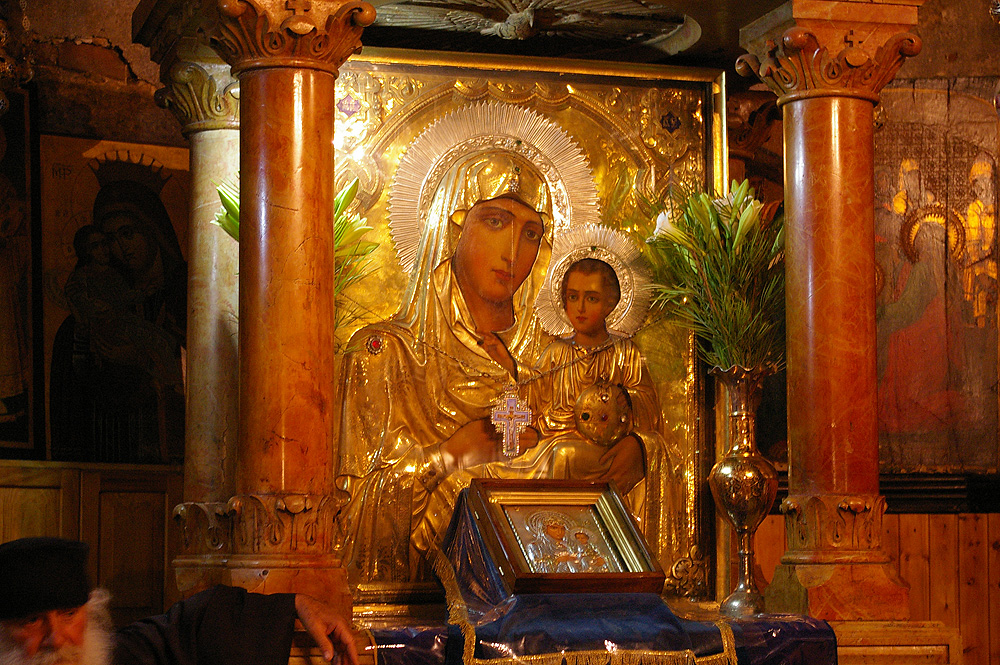
Panagia Ierosolymitissa (Gr. Ιεροσολυμίτισσα - Most Holy Lady of Jerusalem)


"The Virgin Mary looks a lot like the one on the icon of the Virgin Mary of Jerusalem. She is exactly the same. I have seen her many times and I don't know of any other icon resembling her so much".
Elder Paisios the Athonite (1924 -- 1994)


How Saints Endured the Pain of Martyrdom and Suffering


By Elder Paisios the Athonite (+1994)

In the past, people were so brave! In the Monastery of the Flavians in Asia Minor, the Turks had captured a man and slaughtered him. Then they told his wife, 'Either you deny Christ, or we will kill your children too.' And she replied, 'My husband is now with Christ, and I entrust my children to Christ and I will not renounce Christ.' What bravery! If Christ is not in us, how can there be such bravery? Today, people without Christ are building their home on rubble...

What love the holy Martyrs had for Christ, what bravery! ... [For example,] St. Gideon the Karakallenos (+1818) -- what amazing forbearance he had! To his executioners he said, 'Take my hand, take my leg, take my nose.' In short, take everything! Incredible! But for a man to reach that point, he must not love himself, he must love God. A mother runs into a fire to save her child. She doesn't feel any pain, because her love is stronger than the burning of the fire. Her love for her child masks the pain. So you can imagine how much more the love for Christ can mask the pain of martyrdom!...

For the Saint approaching martyrdom, the love for Christ is stronger than the pain; it neutralizes it. The Martyrs felt the executioner's sword to be sweeter than the bow of a violin. When the love of Christ really blossoms, then martyrdom becomes a festival; fire refreshes better than a bath, because the burning feeling is dispelled by the burning of divine love. A flaying becomes a caress...

Divine eros takes hold of the heart, takes hold of the mind, and man goes 'mad'. He does not feel the pain of anything else, because his mind is on Christ; and his heart is overflowing with joy. So many Saints went to their martyrdom and felt such joy, one would think they were going to a festival!...

If one does not start sacrificing something now, like giving up some desire or selfishness, how will he ever be able to sacrifice his life at a given time? If, even now, he thinks of the labor, and tries to avoid working a little harder than the next person, how will he ever attain the state of risking his own life to save another's? ... When there is no spirit of sacrifice, everyone looks only to save himself...

These years are like a pressure-cooker that is boiling and whistling. It takes endurance, bravery and manliness. If something should happen, be sure not to leave yourselves completely unprepared. Be prepared from now to face any potential difficulty. What did Christ say? Didn't He say, 'Be ye ready?' (Luke 12:40)...

Living in such difficult times as today, gives us one more reason to be all the more prepared. It is not only sudden death that we may encounter; there are other dangers as well. Therefore, dispel the spirit of ease and comfort for ourselves. Let the spirit of philotimo prevail. May you always have the spirit of sacrifice...

A woman, who had everything, once told me that having children is a dizzy bother. She couldn't be bothered to be a mother! When a mother thinks like that, she becomes useless; for mothers, after all, are suppose to love naturally... When a person has a sense of sacrifice, he does not complain, he is not lazy; he rejoices. That is the key: to have a spirit of sacrifice...

Oh, what joy it brings! Nowadays people don't savor this joy of sacrifice, and this is why they are tormented. They have no ideals in them; they are too bored to live. A generous heart and self-denial are what drives us. Without this force, we are tormented...

The miracle happens when someone can be compassionate and feel the other's pain. It is this very pain that moves God and brings about the miracle. For there is nothing else that moves God as much as a noble and sacrificial spirit. But now, in our time, this kind of nobility is rare, because self-love and self-restraint have entered the picture. Seldom does someone say, 'Let me give my turn, my place, to someone else, and it's alright if I am delayed.'...

The good is good, only when the one who does it sacrifices something from himself -- some sleep, some rest and so on. That is why Christ said [of the widow], 'But she, out of her need, hath cast in all the living that she had.' When I am at ease and do some good, it does not have the same value. But when I am tired and some one asks me, let's say, for directions and I do it, then it has value...

Can you imagine what joy is experienced by the one who sacrifices himself? One cannot even express the joy he feels. Sublime joy emanates from sacrifice. Only when we sacrifice ourselves can we be related to Christ, for Christ is sacrifice. Man can live in Paradise from here and now, or he can live in Hell. Whoever does good is overjoyed, for he is rewarded with divine consolation. Whoever does evil, suffers.


Category

1915 Armenian Genocide 21st-century Christian martyrs‎ Al Qaeda Apostles Arab Christian Arab-Orthodox Archimandrite Tikhon Shevkunov Asia Australia BBC Belarusian Orthodox Church Bethlehem Bible movies Bulgarian Orthodox Church Byzantine C.I.A. Cairo China Christian Armenians Christmas Traditions Christmas tree Conspiracy Constantinople Documentary Easter Ecumenical Patriarch Ecumenical Patriarch Bartholomew I Ecumenical Patriarchate of Constantinople Elder Ephraim of Vatopaidi Elder Porphyrios Epiphany FREE Greetings Cards FREE books Fr Seraphim Rose Georgian Orthodox Church Greek Orthodox Church Greek Orthodox Easter Holy Fathers Holy Scripture Holy Tradition Internet Interview Italy Jesus Christ Middle East Miraculous Icon Mount Sinai Movie Trailers Orthodox Church in America Palestine Prophecy Russia Russian Orthodox Church Saints Shroud of Turin Son of God St Nicholas of Myra The Mount Athos Food Evolution UK Ukraine Ukrainian Orthodox Church Vatican Watch FREE full movie africa al assad albania anti-Morsi protests army bank bible bible translations bulgaria byzantine music christianity christians christmas church coptic church copts cyprus daily news economy egypt egypt pope elder elder Paisios elder joseph of vatopaidi english subtitles europe food france fyrmacedonia germany greece greek greek food greek music greek orthodoxy health and medicine icon iran islam islamist israel jerusalem jews jihad killed libya mafia monastery money mother of god mount athos music muslim muslims news orthodox church pakistan patristic tradition photo photos picture politics pope protests quotes recipes religion romania romanian orthodox church saint science spy syria theotokos travel turkey tv usa vatopaidi video war world
Related Posts Plugin for WordPress, Blogger...