Search This Blog

Image and video hosting by TinyPic

Sunday, May 6, 2012

Dialogue between a Geron (Elder) and an atheist

 
One morning, the Elder (Geron) Epiphanios Theodoropoulos was in a conversation with 2-3 visitors at his home. One of them was an ideological atheist and a communist.  Suddenly, someone from outside came rushing in, and informed them that the city of Athens had been flooded with photographs of Mao Tse Tung, with the inscription “Glory to the great Mao”. It was the day that the Chinese dictator had died.
Geron:
That’s the way things are, my child.  Atheists do not exist.  Only idolaters exist, who take down Christ from His throne and in His place they enthrone their own idols.  We say: “Glory be to the Father and the Son and the Holy Spirit”.  They say: “Glory to the great Mao”.  You pick and choose which one you prefer.
Atheist: 
You also choose your drug, grandpa. The only difference is, that you call it Christ, others call it Allah, or Buddha, etc. etc… 
Geron:
My child, Christ is not a drug. Christ is the Creator of the entire universe. He is the one Who governs everything wisely, from the multitudes of infinite galaxies, down to the minutest particles of the microcosm. He has given life to all of us.  He is the One Who brought you into this world and has bestowed you with so much freedom, that you can actually doubt Him, and even deny Him.
Atheist:
Grandpa, its your right to believe in all of those things.  But that doesn’t mean they are true.  Do you have any proofs?
Geron:
You think all of this is just a fairy tale, don’t you?
Atheist:
Naturally.
Geron:
Do you have any proof that it is a fairy tale? Can you prove that what I believe is false?
Atheist:
……………....
Geron:
You didn’t reply, because you don’t have any proof either.  Which means, you believe they are fairy tales.  I spoke to you of believing, when I referred to God; you, however, although rejecting my belief, essentially believe in your faithlessness, since you cannot back it up with proofs either. However, I must tell you that my belief is not something “out of the blue”; There are certain supernatural events, upon which it is founded.
Atheist:
Just a minute! Since we are talking about believing, what would you say to Muslims or Buddhists for example?  Because they also talk about believing. And they too have high moral standards.  Why is your belief better than theirs?
Geron:
So! The criterion of the truth is supposedly judged by this question of yours?  Because the truth is most certainly one; truths cannot be many in number. The thing is, who is the possessor of the truth? That is the major question. Hence, it is not a matter of a better or worse belief! It is a matter of the only true belief!
I agree, that other beliefs also have moral teachings. Naturally, Christianity’s moral teachings are incomparably superior. But, we do not believe in Christ because of His moral teachings. Or for His prompting to “Love one another”, or for His sermons on peace and justice, freedom and equality. We believe in Christ, because His presence on earth was accompanied by supernatural events, which was a sign that He is God.
Atheist: 
Look, I also admit that Christ was an important philosopher and a great revolutionary, but let’s not make Him a God now……
Geron:
My dear child!  All the great disbelievers in history were snagged by that detail.  The fishbone that stuck in their throat, which they just couldn’t swallow, was exactly that:  That Christ is also God.
Many of them were willing to say to God: “Don’t tell anyone that You are God incarnate; Just say that You’re an ordinary human, and we shall be more than ready to deify you. Why do You want to be an incarnate God, and not a deified human?  We are willing to glorify You, to proclaim You as the greatest among men, the holiest, the most ethical, the noblest, the unsurpassable, the one and only, the unprecedented…  Isn’t that enough for You ?
Ernest Renan –he was the head of the chorus of deniers- thunders out the following, with regard to Christ: “For tens of thousands of years, the world shall be uplifted through You”, and “You are the cornerstone of mankind; if one were to wrench Your name away from this world, it would be like shattering its foundations” and “the aeons shall proclaim that amongst the sons of men, never was there born anyone that could surpass You”.  But this is where Renan and his likes stop. Their very next phrase is: “But a God, You are not!
And those poor wretches cannot perceive that all of these things constitute an indescribable tragedy!  Their dilemma is inevitably relentless: Either Christ is an incarnate God, in which case, He is indeed, only then, the most ethical, the holiest and noblest personage of mankind, or, He is not an incarnate God, in which case, He cannot possibly be any of these. In fact, if Christ is not God, then we are talking about the most horrible, the most atrocious and the most despicable existence in the history of mankind.
Atheist:
What did you just say ?
Geron:
Exactly what you heard!  It may be a weighty statement, but it is absolutely true. And I will tell you why. 
Let me ask: What did all the truly great men say about themselves, or what opinion did they have of themselves ?
The “wisest of all men”, Socrates, proclaimed that “I came to know one thing: that I know nothing”.
All the important men in the Old and New Testament, from Abraham and Moses, through to John the Baptist and the Apostle Paul, characterized themselves as “earth and ashes”, “wretches”, “monstrosities”, etc…. [1]
But, strangely enough, Jesus’ attitude is quite the opposite!  And I say strangely enough, because it would have been natural and logical for Him to have a similar attitude. In fact, being far superior and surpassing all others, He should have had an even lower and humbler opinion of Himself [2].  Ethically more perfect than any other, He should have surpassed everyone and anyone in self-reproach and humility, from the moment of the world’s Creation to the end of Time.
But, the exact opposite is observed! 
First of all, He proclaims that He is sinless: “Who among you shall check Me for sin?” (John, 8:46). “The lord of this world is coming, and he can find nothing in Me.”  (John, 14: 30)
He also pronounces very high ideas of Himself: “I am the light of the world” (John, 8, 12);  “I am the path and the truth and the life”  (John, 14: 6)
But, apart from these, He also projects demands of absolute dedication to His Person.  He even penetrates the holiest of man’s relationships, and says: “Whomsoever loves their father or mother more than Me, is not worthy of Me. and whomsoever loves their son or daughter more than me is not worthy of me”. (Matthew, 10: 37).  “I came to turn man away, against his father, and the daughter against her mother and the daughter-in-law against her mother-in-law” (Matthew, 10: 35).  He even demands a life and a death of martyrdom from His disciples: “They shall deliver you to councils and flog you in their synagogues; and you shall be dragged before leaders and kings for My sake…. And brother shall deliver his brother to death and the father his son, and the children shall revolt against their parents and shall put them to death…. And you shall be hated by everyone, for my namesake…. And he that shall endure to the end, he shall be saved…. Do not fear those who destroy the body….. Whomsoever shall deny Me before mankind, I too shall deny him…. Whomsoever has forfeited his soul for My sake, shall recover it.” (Matthew, 10: 17 onward)
And now I ask you:  Has anyone ever dared to demand for himself the love of mankind, forsaking their very life? Has anyone ever dared to proclaim his absolute sinlessness?  Has anyone ever dared to utter the words: “I am the truth”? (John, 14: 6)  No-one, and nowhere!  Only a God can do that. Can you imagine your Marx uttering things like that?  They would take him for a lunatic and nobody would be willing to follow him!
Now, just consider, how many people sacrificed everything for Christ’s sake, even their very life, having believed in the veracity of His words regarding Himself!  If His proclamations about Himself were false, Jesus would have been the most despicable character in history, for having led so many people to such a huge sacrifice!  What ordinary man – no matter how great, how important, how wise he may be – would deserve such a tremendous offer and sacrifice?  Well?  No-one!  Not unless he were God!
In other words: Any ordinary man that would demand such a sacrifice from his followers would have been the most loathsome person in history.  Christ, however, both demanded it, and achieved it. Yet, despite this ‘achievement’, He was proclaimed by the very deniers of His divinity as the noblest and holiest figure in history.  So, either the deniers are being illogical when they proclaim this most loathsome figure as “holiest”, or, in order to avoid any illogicality, and to rationalize the co-existence of Christ’s demands and His holiness, they must concede to accepting that Christ continues to remain the noblest and holiest figure in mankind, but, only under the condition that He is also God!  Otherwise, as we said, He would be, not the holiest, but the most loathsome figure in history, being the cause of the greatest sacrifice of all ages, and in the name of a lie!  Thus, Christ’s divinity is proved by His very deniers, on the basis of those very characterizations of His person!
Atheist:
What you just said is really very impressive, but it is nothing but speculation. Do you have any historical facts that would confirm His Divinity?
Geron:
I told you at the beginning, that the proofs of His Divinity are the supernatural events that took place while He was here on earth.  Christ did not rest on the proclamation of the above truths alone; He certified His statements with miracles as well.  He made blind people see and cripples walk; He satisfied the hunger of five thousand men and manifold numbers of women and children with only two fish and five loaves of bread; He commanded the elements of nature and they obeyed; He resurrected the dead, amongst which was Lazarus, four days after his death. But the most astounding of all his miracles was His own Resurrection.
The entire edifice of Christianity is supported on the event of the Resurrection.  This is not my speculation. The Apostle Paul said it: “If Christ had not risen (from the dead), our faith would be futile”. (Corinthians I, 15: 17).  If Christ is not resurrected, then everything collapses. But Christ was resurrected, which means He is the Lord of life and death, therefore God.
Atheist:
Did you see all of this?  How can you believe it?
Geron:
No, I didn’t see any of it, but others did: the Apostles. They in turn made this known to others, and they actually “signed” their testimony with their own blood. And, as everyone acknowledges, a testimony of one’s life is the supreme form of testimony.
Why don’t you likewise bring me someone, who will tell me that Marx died and was resurrected, and that he is willing to sacrifice his life in order to testify it?  I, as an honest man, will believe him.
Atheist:
I will tell you. Thousands of communists were tortured and died for their ideology.  Why don’t you embrace communism in the same way?
Geron:
You said it yourself.  Communists died for their ideology. They didn’t die for real events.  In an ideology, it is very easy for deception to seep through; and because it is a characteristic of the human soul to sacrifice itself for something it believes in, this explains why so many communists died for their ideology. But that doesn’t compel us to accept this ideology as something true.
It is one thing to die for ideas, and another to die for events.  The Apostles didn’t die for any ideas.  Not even for the “Love one another”, or any of the other moral teachings of Christianity. The Apostles died for their testimony of supernatural events. And when we say ‘event’, we mean that which is captured by our physical senses, and is comprehended through them.
The Apostles suffered martyrdom for “that which they heard”, “that which they saw with their own eyes”, “that which they observed and their hands touched”  (John I, 1) [3]
Just like the clever speculation by Pascal, we say that one of the three following things happened to the Apostles: either they were deceived, or, they deceived us, or, they told us the truth.
Let’s take the first case.  It is not possible for the Apostles to have been deceived, because everything that they reported, was not reported to them by others. They themselves were eye and ear witnesses of all those things.  Besides, none of them were imaginative characters, nor did they have any psychological inclination that made them accept the event of the Resurrection.  Quite the contrary - they were terribly distrustful.  The Gospels are extremely revealing, in their narrations of their spiritual dispositions: they even disbelieved the reassurances that some people had actually seen Him, resurrected. [4].
And one other thing. What were the Apostles, before Christ called them?  Were they perhaps ambitious politicians or visionaries of philosophical and social systems, who were longing to conquer mankind and thus satisfy their fantasies?  Not at all.  They were illiterate fishermen. The only thing that interested them was to catch a few fish to feed their families.  That is why, even after the Lord’s Crucifixion, and despite everything that they had heard and seen, they returned to their fishing boats and their nets. In other words, there was not a single trace of disposition in these men for the things that were to follow.  It was only after the day of the Pentecost, “when they received strength from on high”, that they became the teachers of the universe.
The second case:  Did they deceive us?  Did they lie to us?  But then, why would they deceive us?  What would they gain by lying?  Was it money? Was it status?  Was it glory?  For someone to tell a lie, he must be expecting some sort of gain.  The Apostles though, by preaching Christ - and in fact Christ crucified and resurrected – the only things that they secured for themselves were: hardships, labours, lashings, stonings, shipwrecks, hunger, thirst, nakedness, attacks from robbers, beatings, incarcerations and finally, death.  And all this, for a lie?  It would be undoubtedly foolish for anyone to even consider it.
Consequently, the Apostles were neither deceived, nor did they deceive us. This leaves us with the third choice: that they told us the truth.
I should also stress something else here:  The Evangelists are the only ones who recorded true historical events. They describe the events, and only the events. They do not resort to any personal judgments.  They praise no-one, and they criticize no-one.  They make no attempt to exaggerate an event, nor eliminate or underestimate another.  They let the events speak for themselves.
Atheist: 
Are you excluding the possibility that in Christ’s case, it was just an incident of apparent death?  The other day, the newspapers had written about someone in India whom they buried and three days later they exhumed him and he was still alive.
Geron:
My poor child!  I will recall the words of the blessed Augustine again:  “O faithless ones, you are not actually mistrustful; indeed, you are the most gullible of all.  You accept the most improbable things, and the most irrational, the most contradictory, in order to deny a miracle!”
No, my child. It was not a case of apparent death with Christ. First of all, we have the testimony of the Roman centurion, who reassured Pilate that Christ’s death was a certainty.
Then, our Gospel informs us that on the same day of His Resurrection, the Lord was seen talking with two of His disciples, walking towards Emmaus, which was more than ten kilometers away from Jerusalem.
Can you imagine someone, who could go through all the tortures that Christ underwent, and three days after His “apparent death”, spring back again?  If anything, he would have to be fed chicken soup for forty days, in order to be able to open his eyes, let alone walk and talk as though nothing had happened!
As for the Hindu, bring him here to be flogged with a scourge – do you know what a scourge is? It is a whip, whose lashes each have a lead chunk or a piece of broken bone or sharp nails attached to their end – bring him here, so we can flog him, then force a crown of thorns on his head, crucify him, give him bile and vinegar to drink, then pierce his side with a spear, put him in a tomb, and then, if he comes back from the dead, then we can talk.  
Atheist:
Even so, but all the testimonies that you have invoked belong to Christ’s Disciples.  Is there any testimony on this matter, that doesn’t come from the circle of His Disciples?  Are there any historians for example, who can certify Christ’s Resurrection?  If so, then I will also believe what you say.
Geron:
You poor child!  You don’t know what you’re saying now!  If there had been such historians who had witnessed Christ resurrected, they would have been compelled to believe in His Resurrection and would have recorded it as believers, in which case, you would again have rejected their testimony, just like you rejected Peter’s testimony, John’s testimony, etc.  How can it be possible, for someone to actually witness the Resurrection and yet, NOT become a Christian?  You are asking for a roasted fowl, on a waxen skewer, that also sings!  It just can’t be done !
I will remind you though – because you are asking for historians – of what I said earlier: that the only true historians are the Apostles.
Nevertheless, we do have testimony of the kind that you want; and it is by someone who didn’t belong to the circle of His Disciples: it was Paul.  Paul not only wasn’t a Disciple of Christ, he actually persecuted Christ’s Church relentlessly.
Atheist:
They say that Paul suffered from sunstroke and that it was the cause of his hallucination.
Geron:
My child, if Paul was hallucinating, the thing that would have come to the surface, would have been his subconscious.  And in Paul’s subconscious, the Patriarchs and the Prophets would have been top ranking.  He would have hallucinated about Abraham, and Jacob and Moses, and not Jesus, whom he considered a rabble-rouser and a fraud!
Can you imagine a faithful old granny seeing Buddha or Jupiter in her dream or delirium?  She would most probably see Saint Nicholas or Saint Barbara, because she believes in them.
One more thing. With Paul, we have –as Papini notes- the following miraculous phenomena:  First of all, the abruptness of his conversion. Straight from faithlessness to faith. With no intermediate preparatory stage.  Secondly, the steadfastness of his faith. No wavering, no doubts.  And thirdly, his faith lasted for a whole lifetime.  Do you believe that all these things can occur after a case of sunstroke?  They can in no way be attributed to such a cause.  If you can explain how, then explain it.  If you can’t, then you must admit the miracle.  And you must know that for a man of his time, Paul was exceptionally well-educated. He was not your average little person, who was totally clueless.
I will also add something else.  We today, my child, are living in an exceptional era. We are living the miracle of Christ’s Church.
When Christ said of His Church that “the gates of Hades shall not overpower Her” (Matthew 16:18), His followers were very few in number. Almost two thousand years have passed, since that day. Empires vanished, philosophical systems were forgotten, world theories collapsed. But Christ’s Church remains indestructible, despite the continuous and dramatic persecutions it has undergone. Isn’t that a miracle?
And one final thing.  In Luke’s Gospel it says that when the Holy Mother visited Elizabeth (the Baptist’s mother) after the Annunciation, she was greeted with the words: “blessed are you amongst women”.  And the Holy Mother replied as follows: “My heart magnifies the Lord. Behold, from this moment on, all generations shall call me blessed” (a’ 48).
What was the Holy Mother at that time?  She was just an obscure daughter of Nazareth. How many knew her?  And yet, since that day, empresses have been forgotten, distinguished women’s names have been extinguished, the mothers and wives of great generals went into oblivion. Who remembers, or even knows, Napoleon’s mother or Alexander the Great’s mother? Almost no-one.  But, millions of lips across every length and breadth of the world, throughout the ages, venerate that humble daughter of Nazareth, the “more precious than the Cherubim and incomparably more glorious than the Seraphim”.  Are we, or aren’t we –the people of the twentieth century– living in this day and age the verification of those words of the Holy Mother?
The exact same things are observed in a “secondary” prophecy of Christ:  While He was staying at the house of Simon the leper, a woman came to Him and poured her expensive fragrant oil over His head. Christ commented: “Amen, verily I say to you, that wherever this gospel will be preached in the world, it will also mention what this woman did, in her memory” (Matthew, 26: 13).  Now, how large was His circle of followers at the time, so that one could say that they outdid themselves in order that their Master’s prophecy be fulfilled?  Especially a prophecy such as this one, which, by today’s world standards, is of no importance to most people.
Are they or aren’t they miracles?  If you can, explain them.   But if you can’t, then admit them as such.
Atheist:
I have to admit that your arguments are pretty solid. But I would like to ask you one more thing:  Don’t you think that Christ left His work unfinished?  That is, unless He deserted us.  I can’t imagine a God that would remain indifferent to mankind’s suffering.  We are down here toiling, while He, up there, remains apathetic.
Geron:
No, my child.  You aren’t right. Christ did not leave His work unfinished.  On the contrary, He is the one unique case in history where a person has the certainty that His mission was accomplished, and had nothing further to do or to say.
Even the greatest of philosophers, Socrates, who discussed and taught during his whole lifetime, and towards the end composed an intricate “Apology”, would have even more to say, if he had lived.
Only Christ – in the time bracket of three years – taught what He had to teach, did what He had to do, and finally said (on the Cross): “It is finished”.  Another sample of His divine perfection and authority.
As for the abandonment that you mentioned, I can understand your concern.  Without Christ, the world would be a theatre of insanity.  Without Christ, you cannot explain anything: why are there sorrows, why injustices, why failures, why sicknesses, why, why, why…. Thousands of monumental “why”s.
Try to understand!  Man cannot approach all of these “why”s with his finite logic.  It is only through Christ that everything can be explained. All these trials merely precondition us for eternity. Perhaps then, we might be honored by the Lord with a reply to some of those “why”s.
It might be worthwhile, if I read you a beautiful poem (*) from Constantine Kallinikos’ collection “Laurels and Myrtles”, with the title “Questions”: 
 
I asked a desert father of seventy years,
whose silver strands were blown by the wind:
Tell me o father, why, on this earth,
do the light and the dark inseparably move ?
And why must they - like twins - together sprout:
the thorn and the rose, the tear and the smile?
Why, in the loveliest part of the woodland green
have scorpions and vipers concealed their nests?
Why must it be, that the tender bud,
before unfolding its fragrant bloom,
be struck by a worm in the heart of its stem,
And left to die, like a shrivelled rag ?
Why are the plow, the seed and the hands
a must for the wheat, to become our bread?
Why must everything useful, noble, divine
always be purchased with tears and our blood,
while selfishness ever  rampantly reigns,
and lewdness is swallowing up the world?
And why, amongst such harmony around,
must tumult and disorder find their way?
 
The hermit replied, with his somber voice
and right arm pointing to the sky,
that there, beyond those clouds of gold,
the Almighty weaves a tapestry divine.
But since we are wanderers of the lower plane
We see nothing but the knots and strings below,
It is no wonder, why the mind sees wrong,
when it should always be thankful and give praise:
for the day will come, when Christians all,
with souls that ride the skies with wings,
will gaze atop God’s tapestry and see
how careful and orderly everything was!
My child, Christ never abandoned us.  He is forever with us, as a helper and a supporter, until the end of time.  But you will realize this, only when you become a conscientious member of His Church and be joined by Her Sacraments.
[Re-published, from the book of the Holy Recluse Monastery of the Theotokos “FROM THE LIFE AND THE TEACHING OF FATHER EPIPHANIOS”]   
(*) The poem has been loosely translated, for its message only.

R E F E R E N C E S  
[1] From within sacred history, we observe how Abraham considers himself “earth and ashes” (Genesis 18: 27). Similarly Job (42: 6). The great Moses hesitates to undertake the mission of liberating the Israelites from Egypt, believing himself to be too small and inadequate for such a job: “And Moses said to God : ‘Who am I, that can go to the Pharaoh, king of Egypt,…… I am not capable……. weak voiced and stuttering, I am.” (Exodus 3: 11, 4: 10). The same is said at a later date by the Judge Gideon: “My Lord, how can I save Israel?…. for I am the youngest of my father’s house…” (Judges 6: 15). David calls himself “a dead dog, and a louse” (Kings I, 24: 15), a worm and not a man, the disgrace of mankind and the derogation of the people” (Psalms 21:27).  Isaiah cries out: “woe is me, the wretched one, for I am deeply troubled, because, being a man and having impure lips, I reside amongst the people with impure lips, and yet I have looked upon the king, Lord Shabuoth with my very eyes”  (Isaiah 6:5).  Jeremiah laments: “O Sovereign Lord, behold, I cannot speak, for I am the younger…. Cure me my Lord, and I shall be healed; save me, and I shall be saved. For You are my boasting.” (Jeremiah 1:6,  17:14).  The three Young Men utter a confession about themselves and all of the population: “….for we have sinned and broken the law, by distancing ourselves from You, and we are sinners in everything and we did not obey Your commandments….. with a crushed soul and a humbled mind, may we be received by You…”  (Daniel, Azarias’ prayer, 56 and 16).
John the Baptist, the “greatest amongst those born of woman”, confessed : “I am not the Christ. And they asked him: Who then are you? Are you Elijah?  I am not. Are you the Prophet? And he replied: No. …… I am just a voice in the wilderness, crying out “straighten the path of the Lord……. I am not worthy enough, to even loosen the strap of His (Christ’s) sandal…” (John I, 20).  Finally, the one and only and unprecedented Paul, considers himself a “monstrosity” and unworthy “to be called an apostle”, a “wretched person”, and “the first amongst all sinners” ( Corinthians I, 15:89, Romans 7:24, Timothy I, 1:15).  But, we won’t take up any more time here…
[2] by applying the standard of:  “the greater you are, the more you should humble yourself”. (Sirah, 3:18) 
 
[3] This is precisely what is stressed in John’s Gospel:  “the one who witnessed, testified” (19: 35); In other words, the one who wrote those things was the one who actually saw the soldier pierce Christ’s side with the spear, and he saw blood and water coming out of the wound.  
[4] “They hesitated to prostrate themselves to Him” (Matthew 28:17). “And they (=the apostles), upon hearing that He was alive and was seen by her (=Mary Magdalene), disbelieved”. (Mark 16:13).  “He derided them for their disbelief and their hard-heartedness, because they did not believe those who had seen Him risen”  (Mark 16:14). “It appeared to them (=the Apostles) that their (=the myrrh-bearers’) words were like ravings (=foolishness, delirium), and they disbelieved them” (Luke 24:11). “We had hoped that He was the one who was destined to redeem Israel” (Luke 24:21). “If I do not see the imprint of the nails on His hands and place my finger on the imprint of the nails, and place my hand on (the wound of) His side, I shall not believe." (=words of Doubting Thomas, John 20:25), etc.

Saturday, May 5, 2012

Archimandrite Sophrony (Sakharov) about man who was visiting Mount Athos


One day, a man who was visiting Mount Athos asked several wise elders the following question: ‘What is the most important thing in your life?’ 

 Each time he was answered like this: ‘It is divine love; to love God and to love one’s neighbour’. 

He said:  
‘I don’t have love, either for prayer, or for God, or for other people. What must I do?’ And then he decided by himself: ‘I will act as if I had this love’. 
Thirty years later, the Holy Spirit gave him the grace of love.


Elder Porphyrios the Kapsokalivite on Winning People Over Through Love


You must not wage your Christian struggle with sermons and arguments, but with true secret love. When we argue, others react. When we love people, they are moved and we win them over. When we love, we think that we offer something to others, but in reality we are the first to benefit.


* This excerpt is from “Precious Vessels of the Holy Spirit” translated and compiled by Herman A. Middleton

Saint Nicholas Velimirovic - A Hymn of Praise for the Teachers & Prophets of the East


All the prophets have from the beginning cried out to my soul, imploring her to make herself a virgin and prepare her­self to receive the Divine Son into her immaculate womb;
Imploring her to become a ladder, down which God will descend into the world, and up which man will ascend to God;1
Imploring her to drain the red sea of sanguinary passions within herself, so that man the slave can cross over to the promised land, the land of freedom.2
The wise man of China admonishes my soul to be peaceful and still, and to wait for Tao to act within her. Glory be the memory of Lao-tse, the teacher and prophet of his people!
The wise man of India teaches my soul not to be afraid of suffering, but through the arduous and relentless drilling in purification and prayer to elevate herself to the One on high, who will come out to greet her and manifest to her His face and His power. Glorious be the memory of Krishna, the teacher and prophet of his people!
The royal son of India teaches my soul to empty herself completely of every seed and crop of the world, to abandon all the serpentine allurements of frail and shadowy matter, and then - in vacuity, tranquility, purity and bliss - to await nirvana.  Blessed be the memory of Buddha, the royal son and inexorable teacher of his people!
The thunderous wise man of Persia tells my soul that there is nothing in the world except light and darkness, and that the soul must break free from the darkness as the day does from the night. For the sons of light are conceived from the light, and the sons of darkness are conceived from darkness. Glorious be the memory of Zoroaster, the great prophet of his people!
The prophet of Israel cries out to my soul: Behold, the vir­gin will conceive and bear a son, whose name will be - the God-man.3 Glorious be the memory of Isaiah, the clairvoyant prophet of my soul!
O heavenly Lord, open the hearing of my soul, lest she become deaf to the counsels of Your messenger.
Do not slay the prophets sent to you,4 my soul, for their graves contain not them, but those who slew them.
Wash and cleanse yourself; become tranquil amid the turbulent sea of the world, and keep within yourself the counsels of the prophets sent to you. Surrender yourself entirely to the One on high and say to the world: “I have nothing for you.”
Even the most righteous of the sons of men, who believe in you, are merely feeble shadows which, like the righteous Joseph, walk in your shadow. For mortality begets mortality and not life. Truly I say to you: earthly husbands are mis­taken when they say that they give life. They do not give it but ruin it. They push life into the red sea and drown it, and beforehand they wrap it in darkness and make it a diabolical illusion. There is no life, O soul, unless it comes from the Holy Spirit. Nor is there any reality in the world, unless it comes down from heaven.
Do not slay the prophets sent to you, my soul, for killing is only an illusion of shadows. Do not kill, for you can slay no one but yourself.
Be a virgin, my soul, for virginity of the soul is the only semi-reality in a world of shadows. A semi-reality - until God is born within her. Then the soul becomes a full reality.
Be wise, my virgin, and cordially receive the precious gifts of the wise men from the East, intended for your Son. Do not glance back toward the West, where the sun sets, and do not crave gifts that are figmental and false.
_______________________________________________________
1.         Cf. Genesis 28:12 and John 1:51.
2.         Cf. Exodus 14.
3.         Cf. Isaiah 7:14.
4.         CL Matthew 23:37.

source 

Saint Maximus the Confessor on the Essence of the Beatitudes


The world has many poor in spirit, but not in the right way; and many who mourn, but over money matters… and many who are meek, but in the face of impure passions; and many who hunger and thirst, but to rob another’s goods and to profit unjustly.
And there are many who are merciful, but to the body and to its comforts; and clean of heart, but out of vanity; and peacemakers, but who subject the soul to the flesh; and many who suffer persecution, but because they are disorderly; many who are reproached, but for shameful sins.
Instead, only those are blessed who do and suffer these things for Christ and following his example. For what reason? “Because theirs is the kingdom of heaven,” and “they shall see God,” and so forth. So that it is not because they do and suffer these things that they are blessed (since those just mentioned do the same), but because they do and suffer them for Christ and following his example.

source 

Saint Cosmas of Aetolia on Love for One’s Neighbor


If we want to fare well in this life and to go to  Paradise , and to call our God love and father, we must have two loves: the love for God and the love for our neighbor. It is natural for us to have these two loves, and contrary to nature not to have them. Just as a swallow needs two wings in order to fly in the air, so we need these two loves, because without them we cannot be saved.
The Martyrs won Paradise through their blood; the Ascetics, through their ascetic life. Now you, my brethren, who have children, how will you win Paradise? By means of hospitality, by giving to your brothers who are poor, blind, lame.

Let us have love for God and for our fellow men. Then God comes and brings us joy and implants the eternal life in our hearts, and we fare well in this life and also go to Paradise , there to rejoice forever!
Has God given us wealth? It is our duty to eat and drink so much as is sufficient, and to have enough clothes; the rest we should spend for the poor. God has not given us wealth in order that we might eat and drink to excess, and make costly clothes and build stately houses, while the poor die of starvation. Such, then, is our duty. Realize it. From today on act in this manner, and you shall be saved.
We who are pious Christians ought to love our enemies and forgive them. We ought to offer them food and drink, and entreat God for their souls. And then we should say: “My God, I beseech Thee to forgive me, as I have forgiven my enemies.

If you want God to forgive you all your sins and write your names in Paradise , say to your enemies three times: “May God forgive you and have mercy upon you!”

source 

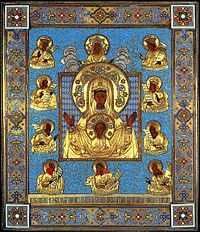
On Sunday 13th May at 6 pm - miracle-working Kursk-Root Icon of the Mother of God in London


On Sunday 13th May at 6 pm, the solemn meeting of the miracle-working Kursk-Root Icon of the Mother of God will take place at the Cathedral of the Dormition of the Mother of God in London. The holy icon will be at the Cathedral till Tuesday 15th May and will depart after the Divine Liturgy on that day.


source 

What is Resurrection ?


What is Resurrection? 

Victory against human logic.
  Victory against the secular mind.
Victory against natural laws.
  Reminder that unless there is a substantial and a higher reality in which we are involved. 


Friday, May 4, 2012

Beautiful Byzantine chant - alternating Greek and Arabic


The famous byzantine Lamentations of the Tomb of Christ, sung during the Matins of Holy and Great Saturday (Holy Friday evening). The official name of the hymns is "Εγκώμια", which is greek and means "Praises". The Praises (although considered being hymns of lament) are chanted in Plagal 1st and 3rd Tones, which are actually used for chants intended for triumphant occasions. On this performance parts of all three Staseis of the Praise are chanted. Note that in the beginning of each part, the second verse is chanted in Arabic.


0:00 - 0:25 Greek
 0:25 - 0:45 Arabic
0:45 - 3:45 Greek
 3:45 - 4:03 Arabic
4:03 - 6:45 Greek
 6:45 - 7:05 Arabic
  7:05 - 10:25 Greek

St Frideswide of Oxford

 Holy Mother Frideswide, pray to God for us!


Some years ago there was a young student in Oxford who felt that he had lost his way. Seated in a famous library with a pile of books before him, he closed his eyes and began to pray for guidance. When he opened them, he found himself looking at the Latin motto of that University, inscribed on the library ceiling: ‘Dominus Illuminatio Mea’ – the Lord is my Light. At once the young man arose from his seat, returned his books, walked out of the library, mounted his bicycle and headed for Binsey.
Two miles from the hustle and bustle of the centre of the City of Oxford, there stands a little mediæval chapel and a holy well. This oasis of peace and sense is Binsey Chapel and the holy well of the Patroness of Oxford, St Frideswide.

According to her Life which was written down in c. 1125 on the basis of traditions then current in Oxford, Frideswide was born in about the year 680. A Wessex princess, her father, Didan, was a local prince of the region of Oxford and her mother was called Sæthrith. Her upbringing was entrusted to a pious woman called Ethelgith. Very early the young princess showed monastic inclinations, for from childhood her motto had been: ‘Whatever is not God is nothing’. According to her Life when she was a young girl, she was pursued by a certain pagan prince of Mercia, Ethelgar, who sought her in marriage. She escaped his intentions by fleeing into the woods of Binsey, and then down the river Thames with two companions towards the then village of Oxford. Somewhere here she hid for three years, using a former pigsty as her cell. However, prince Ethelgar, still pursued by lust, pursued her, but was then struck blind. It was only through his repentance and Frideswide’s prayers that his sight was restored. Thereafter she was left in peace to follow the monastic path.

She was to found a double monastery on the site of what is now Christchurch Cathedral in Oxford. This was dedicated to Mary the Mother of God. But in order to live alone the Saint returned to her refuge and built herself a cell in Binsey woods where she lived in holy prayer. The spring from which she drank was obtained by her fervour and then became the holy well that exists to this day. Centuries later a nunnery was founded nearby and that place became known, as it is known today, by the name of Godstow – the place of the service of God. It was in this place that this Princess of the Orthodox Christian spirit reposed in the Year of Our Lord 735 and her relics came to be revered. Since that date she has always been feasted on 19th October.
At the beginning of the eleventh century her foundation was pillaged by the Danes and restored only after the Schism as a Roman Catholic foundation. Her holy relics, however, remained and were translated and venerated there until her shrine was destroyed by the ‘Deformers’ of 1538. Although that shrine was briefly restored in 1546, it was again desecrated in 1558 by a Calvinist fanatic who mingled the holy relics with the bones of the mistress of an apostate monk – none other than the then Professor of ‘Divinity’ of the University.

Today St Frideswide’s holy relics lie still dishonoured, still mixed together with the bones of that woman, in a common grave in what is now Christchurch Cathedral, a few steps from the centre of Oxford. Amazingly, no-one in that City, including, I suppose, the present Professor of ‘Divinity’, seems to find this situation abnormal. Few are those who enter that Cathedral as pilgrims, asking for the prayers of the Patroness St Frideswide and venerating her tomb. How are the mighty intellects of the City fallen, how little they care for holiness in their pursuit of abstract knowledge! They study in vain for they learn not! Like the prince in St Frideswide’s Life, they come to pursue what they cannot have, for they are blinded by their lack of Faith – for they have not seen ‘Dominus Illumination Mea’ – the Lord is my Light. And like this whole nation of sixty million, few are those who believe in and wish to live by the pure childhood words of St Frideswide: ‘Whatever is not God is nothing’. And as for the young student who fled the vanities of Oxford University for the holiness of St Frideswide in the woods of Binsey? As far as I know, in spirit he still dwells there, a pilgrim striving not to study but rather to live by ‘whatever is God’. The Lord is his Light. May He be yours too.

Wednesday, May 2, 2012

Little Boy’s Explanation of God — Fabulous!!


It was written by an 8-year-old named Danny Dutton, who lives in Chula Vista , CA . He wrote it for his third grade homework assignment, to ‘explain God.’ I wonder if any of us could have done as well?

EXPLANATION OF GOD:
‘One of God’s main jobs is making people. He makes them to replace the ones that die, so there will be enough people to take care of things on earth. He doesn’t make grownups, just babies. I think because they are smaller and easier to make. That way he doesn’t have to take up his valuable time teaching them to talk and walk. He can just leave that to mothers and fathers.’

‘God’s second most important job is listening to prayers. An awful lot of this goes on, since some people, like preachers and things, pray at times beside bedtime. God doesn’t have time to listen to the radio or TV because of this. Because he hears everything, there must be a terrible lot of noise in his ears, unless he has thought of a way to turn it off.’
‘God sees everything and hears everything and is everywhere which keeps Him pretty busy. So you shouldn’t go wasting his time by going over your mom and dad’s head asking for something they said you couldn’t have.’
‘Atheists are people who don’t believe in God. I don’t think there are any in Chula Vista … At least there aren’t any who come to our church.’
‘Jesus is God’s Son. He used to do all the hard work, like walking on water and performing miracles and trying to teach the people who didn’t want to learn about God.. They finally got tired of him preaching to them and they crucified him But he was good and kind, like his father, and he told his father that they didn’t know what they were doing and to forgive them and God said O.K.’

‘His dad (God) appreciated everything that he had done and all his hard work on earth so he told him he didn’t have to go out on the road anymore. He could stay in heaven. So he did. And now he helps his dad out by listening to prayers and seeing things which are important for God to take care of and which ones he can take care of himself without having to bother God. Like a secretary, only more important.’

‘You can pray anytime you want and they are sure to help you because they got it worked out so one of them is on duty all the time.’
‘You should always go to church on Sunday because it makes God happy, and if there’s anybody you want to make happy, it’s God!
Don’t skip church to do something you think will be more fun like going to the beach. This is wrong. And besides the sun doesn’t come out at the beach until noon anyway.’
‘If you don’t believe in God, besides being an atheist, you will be very lonely, because your parents can’t go everywhere with you, like to camp, but God can. It is good to know He’s around you when you’re scared, in the dark or when you can’t swim and you get thrown into real deep water by big kids.’
‘But…..you shouldn’t just always think of what God can do for you. I figure God put me here and he can take me back anytime he pleases.

And…that’s why I believe in God.’

source 

Elder Paisios the Athonite - The Just Person Has God on His Side


Not all people fit well in the world today, especially those who want to lead spiritual and honest lives; they seem to have such a hard time.

- Geronda, why don't they fit?

- When someone is sensitive and finds himself in a harsh environment and people make his life hell, how can he put up with it? Either he has to begin cursing, or he must leave. But that's difficult because one needs to make a living. His boss tells him, "I trust you because you don't steal, but put some rotten produce among the fresh. Take these fresh clover bales and stick some fermented ones in the package." He even makes him manager in order to keep him on the job and the poor man has to do as told to stay employed. And of course, he cannot sleep at night and starts taking sleeping pills. Do you know how hard life is for honest people? They run into all kinds of difficulties and have to take all kinds of abuse from their employers. Life becomes hell for them. And they cannot quit because they have a family to feed. If they stay on, it's trouble everyday. They are between a rock and a hard place. Wherever they turn their eyes, they see a dead end. It makes one go crazy. So, they carry on and try to man­age as best they can.

In another case, one employee did all the work while another colleague would only show up to collect his pay check. I know of someone who was department head somewhere. When the new government came to power, they removed him from the post and replaced him with a party member who had not even graduated from High School. They made him department head but he knew nothing about the work and so they could not really send the previous manager away to some other position. What did they do? They just added a second desk in the office. The old boss did the work and the new one was just sitting there smoking, chatting and drinking coffee ... and being completely shameless. And in addition to this, he would say whatever came to his mind while all responsibility fell on the other employee who was doing all the work, until he finally couldn't put up with the situation anymore and left the job, the poor soul. "Maybe I should go some­where else, there's not enough space for two desks," he said one day and got up and left, because the new head was making his life hell. We are not talking about one or two days. It is unbearable to have someone like that over your head every day.

The just person is usually given the worst position, or may even lose his position to others. They abuse him and step all over him. Don't we have the saying, "They walk over corpses; they stop at nothing?" But the more people push the just and righteous person down, the more the Good God lifts him up, like a cork. It's not easy though and it takes a lot of patience. Patience clears up so many things. The person who wants to live a virtuous life and be honest in his work, be it a labourer, a merchant, or whatever else, must accept the fact that, once he begins work, he may have to reach the point of not being able to even pay the rent, for example, if he has a store, for the blessing of God to come to him. But he should not have this as his goal: "If I should reach that point, then I will surely have plenty of customers." One must not think that way or aim at that, because then, God will not bless him. But when he decides to live as God wills and resolves not to cheat or overprice things, God will not abandon him.

Another person may gain much profit by overpricing. At first, he makes a lot of money and becomes rich, but then people find out that he is dishonest, and his busi­ness goes stony broke. On the other hand, the honest mer­chant gains customers and hires more employees. So he is tested in the beginning, but wins in the end. The good person is tried and tested by evil and cunning people; he has to pass through the card (7).

When someone follows the devil's path, and comes up with tricks and all kinds of deceptive schemes, God will not bless his work. Schemes of deception don't work; they appear to flourish, but they collapse in the end. It's important that we start with God's blessing in everything we do. A just man has God on his side. And if he has some boldness before God, then miracles hap­pen. When someone lives according to the Gospel, he is entitled to divine help. He walks with Jesus Christ. What can we say? The man has earned His blessing. This is the foundation of it all. Once that is given, there is nothing to fear. The important thing is that Christ, Panagia and the Saints should find rest in everything we do, and when that happens, we will have their blessing and the Holy Spirit will overshadow us. Honesty is the most precious Holy Cross. If someone is dishonest even if he has a piece of the Honorable Cross on him, it's like he has nothing. But if one is honest, he has God's help even though he doesn't have a piece of the Honorable Cross. Now, if he has both, well, then he's got everything!

From the book: Eler Paisios of Mount Athos, Spiritual Counsels, With Pain and Love for Contemporary Man

Tuesday, May 1, 2012

Beautiful iconography adorns St. Demetrios Church in Winnipeg, Canada

Detail of The Ascension of Prophet Elias, by Florin Vlad.
Detail of The Ascension of Prophet Elias, by Florin Vlad. (CHERYL GIRARD / WINNIPEG FREE PRESS)


The blank tablet -- often intimidating to a writer or terrifying to an artist -- can also wondrously become for some a miraculous opportunity.
For Rev. Fr. Ted Paraskevopoulos of St. Demetrios Greek Orthodox Church in Winnipeg, the latter seems to be the case, for something remarkable has transpired in this, the only Greek Orthodox church in Manitoba, over the past two years.
Where, for many years, there had been bare, stark white walls, there are now bold, colourful icons covering the walls in and around the altar of the church at 2255 Grant Ave. -- and this is just the beginning of an enormous undertaking that began in 2010.
The interior of the church, built in 1973, was mostly white stucco, says Paraskevopoulos, who moved here from Toronto three years ago, and he's not sure why, as it's not common for Greek Orthodox churches.
"If you have visited other Orthodox churches in the world, especially in the older countries such as Greece and Russia, you will see that Orthodox churches are not meant to be white, but they are meant to be vibrant and full of life and covered from the floor to the ceiling with icons," says Paraskevopoulos.
"There should be a plan from the beginning where everything is placed in a specific place -- position is very important. Iconography is part of the worship. It is considered liturgical."
The project began with the installation of a huge icon of the 12 apostles going to receive Holy Communion. Placed on the two back walls high up, the icon draws the eye to the altar and was completed last year by Romanian-born iconographer Florin Vlad.

Detail of stained glass window designed by Leo Mol.
Detail of stained glass window designed by Leo Mol. (CHERYL GIRARD / WINNIPEG FREE PRESS)

The "icons are not realistic on purpose," says Paraskevopoulos, "because it is supposed to involve you, reveal a theological truth about an event, not make it historical... All icons are otherworldly."
With the focus on the two main parallels of promise and fulfilment, the 30-year-old priest hopes to next fill the two currently bare walls of the nave, where the congregation sits. The idea is to connect the promise of the Old Testament with the fulfilment of the promise in the New Testament. Scenes from the Old Testament would be depicted along one wall, with scenes from the New Testament along the opposite wall.
"For example, Adam and Eve with the serpent, with Eve being tempted, from the Old Testament, with its parallel of the Annunciation of the Virgin Mary -- considered the new Eve -- who said 'yes' to God," says Paraskevopoulos.
Last June, four more icons were installed by Vlad on the two side walls inside the altar and on the two side walls in front. Sketched first, then painted on canvas in the studio, the icons were then brought out and put up, with the gold leaf and varnishing done at the church.
Rich in deep and colourful hues of red, green, blue and much gold, the blue is used in the icons to represent divinity and the red represents martyrdom, blood or humanity.
The icons on the back wall behind the altar were painted by noted Greek iconographer Elias Katsaros in 1979, says Paraskevopoulos.

The breaking of the bread, by Florin Vlad.
The breaking of the bread, by Florin Vlad. (CHERYL GIRARD / WINNIPEG FREE PRESS)

An enormous wooden iconostasis or icon screen wall, designed in Greece, was installed about 10 years ago. Six vibrant stained-glass windows were installed in 1983, designed by famed Winnipeg artist Leo Mol. A circular window in the back of the church was also done by Mol and installed in 1974.
The completion of this latest project could take about 10 years, Paraskevopoulos says. The icons so far have all been made possible by donations from church members. As people donate, work proceeds.
The icons make the church look more beautiful, warm and inviting, but that is not their primary purpose.
"The word iconographer, translated from Greek, means icon writer," says Paraskevopoulos, "because we believe that the iconographer is not creating a piece of artwork, he is actually writing theology with a different medium so that we can understand and so it's easy and visual for us to grasp the concepts that are taught to us through Holy Scripture."

Alexander the Great Saint ?! The schismatic FYR of Macedonian Orthodox Church has canonized Alexander the Great.

Alexander the Great


The schismatic Former Yugoslav Republic of Macedonian Orthodox Church has canonized Alexander the Great. The star of Vergina, as well as other pagan symbols, have been added to the icon, and the schismatic church of FYROM has recieved permission to paint him on their dome in place of Christ.

This is the product of schismatic nationalism who want to be church and who a few days ago reported the news of the fake miracle in the church of St. Dimitrija in Skopje.

Do not ever forget: Macedonia is Greece and Alexander the Great is Greek. 


Bishop who threw Stalin out of seminary glorified


On St. Thomas Sunday, April 22, His Beatitude Metropolitan Vladimir of Kiev and All Ukraine officiated at the Divine Liturgy celebrated in the Church of Ss Anthony and Theodosius at the Dormition Laura of the Caves in Kiev.

Concelebrating with His Beatitude were Metropolitan Pavel of Vyshgorod and Chernobyl, abbot of the Laura; Archbishop Antoniy of Borispol, head of the Department for External Church Relations of the Ukrainian Orthodox Church and Rector of the Kievan Theological Schools; Archbishop Alexander of Pereyaslav-Khmelnitsky and Vishnevoye, secretary of the Primate of the Ukrainian Orthodox Church; Bishops Nikodim of Zhitomir and Novograd-Volynskiy, Ilariy of Makarov, Panteleimon of Vasilkov, and ordained monks of the Laura.

At the Little Entrance, His Beatitude Metropolitan Vladimir elevated Bishop Nikodim of Zhitomir and Novograd-Volynskiy to the rank of archbishop.

The office of canonization of Schema-Archbishop Anthony (Abashidze; +1942) as a locally venerated saint was performed during the divine service. Archbishop Alexander read out the decision of the Holy Synod of the Ukrainian Orthodox Church of 14 June 2011 (minutes 21) to enter the name of Schema-Archbishop Anthony into church calendar. Archbishop Antoniy of Borispol told all those present about the life of the saint. His icon was brought to the middle of the church, and His Beatitude, archpastors, clergymen and laymen venerated the relics of the newly canonized saint, website of the Ukrainian Orthodox Church reports.

+++

Schema-Archbishop Anthony (secular name David Iliych Abashidze) was born in Georgia in 1847. He graduated with distinction from the Law Department of the Novorossiysk Imperial University in Odessa in 1891 and that same year entered the theological academy. He was tonsured with the name of Dimitry at the age of twenty-four. In 1897 he was appointed inspector of the Kutaisi theological seminary, and in 1898 – inspector of the Tbilisi theological seminary. It was he who expelled Joseph Dzhugashvili, better known as Stalin, from the seminary. Bishop Dimitry was appointed Bishop of Tauris and Simferopol in 1912. When he was in Moscow for the Local Council of 1917-18, he would walk along the streets with his first-aid kit and give help to those wounded in the battle for Moscow. Bishop Dimitry was arrested and exiled from the Crimea in 1923 and settled in the Kitayevsky Hermitage which belonged to the Laura of the Caves in Kiev and was located some nine kilometers from it. He made a vow of silence and took the Great Schema with the name of Anthony. He was revered as a great ascetic, a man of prayer and clairvoyant elder. Orthodox Christians from Russia, Ukraine, Belarussia and Georgia came to him for advice. He died in 1942 and was buried behind the sanctuary wall of the Church of the Elevation of the Cross at the entrance to the Near Caves.
 

The Untold Story of the Head of St. John the Baptist


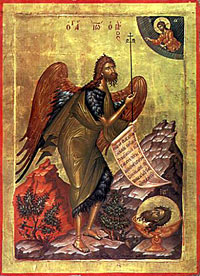
Icon of St. John the Baptist. 

Holy Scripture tells us that after St. John the Baptist was beheaded, the impious Herodias forbade the prophet’s head to be buried together with his body. Instead, she desecrated the honorable head and buried it near her palace. The saint’s disciples had secretly taken their teacher’s body and buried it. The wife of King Herod’s steward knew where Herodias had buried St. John’s head, and she decided to rebury it on the Mount of Olives, on one of Herod’s estates.[1]
When word reached the royal palace about Jesus’ preaching and miracles, Herod went with his wife Herodias to see if John the Baptist’s head was still in the place they had left it. When they did not find it there, they began to think that Jesus Christ was John the Baptist resurrected. The Gospels witness to this error of theirs (cf. Mt. 14:2). 

Jerusalem. The First Uncovering of the Head of St. John the Baptist.
May years later, during the reign of Equal-to-the-Apostles Emperor Constantine, his mother, St. Helen, began restoring the holy places of Jerusalem. Many pilgrims streamed into Jerusalem, amongst whom where two monks from the East, wishing to venerate the Lord’s Honorable Cross and Holy Sepulcher. St. John the Baptist entrusted these two pilgrims to discover his head. We only know that he appeared to them in a dream; and that after finding the head in the place he showed them, they decided to return to their native city. However, God’s will determined otherwise. Along the road, they met a poor potter from the Syrian town of Emesa (modern-day Homs), whose poverty had forced him to seek work in a neighboring country. Having found a co-traveler, the monks either out of laziness or carelessness entrusted him with carrying the sack containing the relic. As he was carrying it, St. John the Baptist appeared to him and told him to forget the careless monks and run away from them, taking the sack they had given him.
For the sake of the precious head of St. John the Baptist, the Lord blessed the potter’s house with an abundance of goods. The potter lived his whole life remembering his Benefactor, giving alms generously. Not long before his death he gave the precious head to his sister, commanding her to pass it on to other God-fearing, virtuous Christians.
The saint’s head was passed along from one person to the next, and came into the hands of one Hieromonk Eustacius, who sided with the Arian heresy. Sick people who came to him received healing, not knowing that it was due not to Eustacius’s false piety, but to the grace coming from the hidden head. Soon Eustacius’s ruse was exposed, and he was banished from Emesa. A monastery grew around the cave where the hieromonk had lived and in which the head of St. John the Baptist was buried. 

Emesa and Constantinople. The Second and Third Finding of the Precious Head.
After many years, the head of St. John the Baptist was uncovered a second time. We know about this from a description by Archimandrite Marcellus of the monastery in Emesa, as well as from the life of St. Matrona (†492, commemorated November 9/22), written by St. Simeon Metraphrastes. According to the first description, the head was discovered on February 18, 452. A week later, Bishop Uranius of Emesa established its veneration, and on February 26 of the same year, it was translated to the newly-built church dedicated to St. John. These events are celebrated on February 24/March 8, along with the commemoration of the First Finding of the Precious Head.
After some time, the head of St. John the Forerunner was translated to Constantinople, where it was located up to the time of the iconoclasts. Pious Christians who left Constantinople secretly took the head of St. John the Baptist with them, and then hid it in Comana (near Sukhumi, Abkhazia), the city where St. John Chrysostom died in exile (407). After the Seventh Ecumenical Council (787), which reestablished the veneration of icons, the head of St. John the Baptist was returned to the Byzantine capital in around the year 850. The Church commemorates this event on May 25/June 7 as the Third Finding of the Precious Head of St. John the Baptist. 

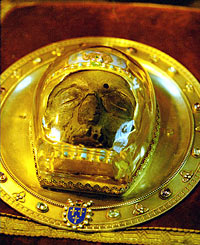
The face of St. John the Baptist, in the Cathedral of Our Lady in Amiens. / http://la-france-orthodoxe.net/ru/galer/jean
The face of St. John the Baptist, in the Cathedral of Our Lady in Amiens.

The Fourth Crusade and travel to the West.
Ordinarily, the Orthodox history of the finding of the head of St. John the Baptist ends with the Third Finding. This is due to the fact that its later history is bound up with the Catholic West. If we look at the Lives of the Saints written in the Menaon of St. Dimitry of Rostov, we find a citation in small print, often overlooked by readers, at the end of story of the Finding of the Forerunner’s Head. However, after unexpectedly discovering the head of St. John the Baptist in France and then returning home to Russia, this citation became a real revelation for us. It is this next “finding” of the head of St. John the Baptist that we would like to write about below. 

Thus, we read in this citation that after 850, part of the head of St. John the Baptist came to be located in the Podromos Monastery in Petra, and the other part in the Forerunner Monastery of the Studion. The upper part of the head was seen there by the pilgrim Antony in 1200. Nevertheless, in 1204 it was taken by crusaders to Amiens in northern France. Besides that, the citation shows three other locations of pieces of the head: the Athonite monastery Dionysiou, the Ugro-Wallachian monastery of Kalua, and the Church of Pope Sylvester in Rome, where a piece was taken from Amiens. 

The history of the Baptist’s head’s appearance in France differs little from the history of many other great Christian relics.
On April 13, 1204, during the Fourth Crusade, an army of knights from Western Europe seized the capital of the Roman Empire—Constantinople. The city was looted and decimated.
As Western tradition has it, Canon Wallon de Sarton from Picquigny found a case in one of the ruined palaces that contained a silver plate. On it, under a glass covering, were the hidden remains of a human face, missing only the lower jaw. Over the left brow could be seen a small perforation, most likely made by a knife strike.
On the plate the canon discovered an inscription in Greek confirming that it contained the relics of St. John the Forerunner. Furthermore, the perforation over the brow corresponded with the event recorded by St. Jerome. According to his testimony, Heriodias in a fit of rage struck a blow with a knife to the saint’s severed head. 

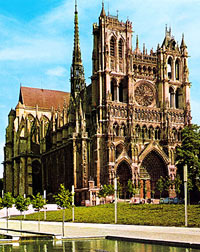
The Cathedral of Our Lady in Amiens (Notre Dame d’Amiens). Photo: S.P.A.D.E.M. – Editions d’art Yvon

Wallon de Sarton decided to take the head of the Holy Forerunner to Picardy, in northern France.
On December 17, 1206, on the third Sunday of the Nativity fast, the Catholic bishop of the town of Amiens, Richard de Gerberoy, solemnly met the relics of St. John the Baptist at the town gates. Probably the bishop was sure of the relic’s authenticity—something easier to ascertain in those days, as they say, “by fresh tracks”. The veneration of the head of St. John the Baptist in Amiens and all of Picardy begins from that time.
In 1220, the bishop of Amiens placed the cornerstone in the foundation of a new cathedral, which after many reconstructions would later become the most magnificent Gothic edifice in Europe. The facial section of the head of the St. John the Baptist, the city’s major holy shrine, was transferred to this new cathedral.
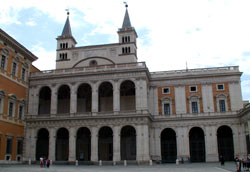
The Church of the Forerunner in Rome (Basilica di San Giovanni in Laterano). Photo: Alexander Starodubstev.
Eventually, Amiens became a place of pilgrimage not only for simple Christians, but also for French kings, princes and princesses. The first King to come and venerate the head in 1264 was Louis IX, called “the Holy”. After him came his son, Phillip III the Brave, then Charles VI, and Charles VII, who donated large sums for the relic’s adornment. In 1604, Pope Clement VIII of Rome, wishing to enrich the Church of the Forerunner in Rome (Basilica di San Giovanni in Laterano), requested a piece of St. John’s relics from the canon of Amiens.


Saving of the head from the outrages of the French revolution.
After the revolution in 1789, inventory was made of all Church property and relics were confiscated.
The reliquary containing the head of the Holy Forerunner remained in the cathedral until November, 1793, when it was demanded by representatives of the Convention. They stripped from it everything of material value, and ordered that the relics be taken to the cemetery. However, the revolutionary command was not fulfilled. After they left the city, the city’s mayor, Louis-Alexandre Lescouve, secretly and under fear of death returned to the reliquary and took the relics to his own home. Thus was the sacred shrine preserved. Several years later, the former mayor gave the relic to Abbot Lejeune. Once the revolutionary persecutions had ended, the head of St. John the Baptist was returned to the cathedral in Amiens in 1816, where it remains to this day.
At the end of the nineteenth century, historical science, not without the participation of ecclesiastical figures, determined that there had been many instances of false relics during the Middle Ages. In an atmosphere of general mistrust, veneration of the Amiens shrine eventually began to wane.

The head of St. John the Baptist today.
In the mid-twentieth century, specifically in 1958, there was a spark of renewed interest in the relics of St. John the Baptist. The rector of the Amiens cathedral reported to the ecclesiastical authorities that in eastern France, in Verdun, was what was presumed to be the lower jaw of St. John the Baptist. He wanted to rejoin the two parts. With the blessing of the bishop of Amiens, a commission of qualified medical experts was formed.
The relics were investigated for several months, in two stages—the first in Amiens, the second in Paris. After the work was completed, the commission’s findings were gathered into a document, signed by the members. In the first chapter of the document, which covers the research performed in Amiens, the following conclusions were made:
  • Comparison of the subject called “of Verdun” with the subject from Amiens disclosed their anatomical differences, confirming without a doubt that they are of differing origins.
  • From the chronological point of view, the subject called “of Verdun” is not as ancient as the Amiens subject. It is similar in form and weight to “bones of the Middle Ages”.
  • The facial part, called the head of St. John the Baptist from Amiens, is a very ancient object—more ancient than “bones of the Middle Ages”. On the other hand, it is younger than human bones of the Mesolithic era—which allows us to date it at between 500 BC and 1000 AD.
  • The man’s age could not be determined precisely due to the absence of teeth. But based upon the fact that the alveolar [tooth] sockets are fully developed and are slightly worn at the edges, it can be supposed that the man was an adult (between 25 and 40 years old).
  • General characteristics of the head in the form of inadequate elements can be determined, but with great permissible variation. The facial type is Caucasoid (that is, not Negroid or Mongoloid). The small measurements of the subject from Amiens and the development of the lower eye sockets lead to the supposition that it could correspond to a racial type called “Mediterranean” (a type to which modern Bedouins belong).
Here ends the modern chronicle of the head of St. John the Baptist. Unfortunately, few of the faithful have recourse to the help of such a lamp of grace as the precious head of St. John the Baptist, “the first among martyrs in grace”.[2] Many Orthodox Christians come to France, but not all of them know how many holy relics there are still on French soil despite the outrages committed against them during the French Revolution and subsequent forgetfulness of France’s Christian past.
Joyfully, during recent years more and more Orthodox pilgrims are travelling to Amiens. Now, with the help of the Pilgrimage Center of the diocese of Korsun (of the Moscow Patriarchate, based in Paris) Orthodox molebens and even Divine Liturgies are now being served before the head of St. John the Baptist. 


Category

1915 Armenian Genocide 21st-century Christian martyrs‎ Al Qaeda Apostles Arab Christian Arab-Orthodox Archimandrite Tikhon Shevkunov Asia Australia BBC Belarusian Orthodox Church Bethlehem Bible movies Bulgarian Orthodox Church Byzantine C.I.A. Cairo China Christian Armenians Christmas Traditions Christmas tree Conspiracy Constantinople Documentary Easter Ecumenical Patriarch Ecumenical Patriarch Bartholomew I Ecumenical Patriarchate of Constantinople Elder Ephraim of Vatopaidi Elder Porphyrios Epiphany FREE Greetings Cards FREE books Fr Seraphim Rose Georgian Orthodox Church Greek Orthodox Church Greek Orthodox Easter Holy Fathers Holy Scripture Holy Tradition Internet Interview Italy Jesus Christ Middle East Miraculous Icon Mount Sinai Movie Trailers Orthodox Church in America Palestine Prophecy Russia Russian Orthodox Church Saints Shroud of Turin Son of God St Nicholas of Myra The Mount Athos Food Evolution UK Ukraine Ukrainian Orthodox Church Vatican Watch FREE full movie africa al assad albania anti-Morsi protests army bank bible bible translations bulgaria byzantine music christianity christians christmas church coptic church copts cyprus daily news economy egypt egypt pope elder elder Paisios elder joseph of vatopaidi english subtitles europe food france fyrmacedonia germany greece greek greek food greek music greek orthodoxy health and medicine icon iran islam islamist israel jerusalem jews jihad killed libya mafia monastery money mother of god mount athos music muslim muslims news orthodox church pakistan patristic tradition photo photos picture politics pope protests quotes recipes religion romania romanian orthodox church saint science spy syria theotokos travel turkey tv usa vatopaidi video war world
Related Posts Plugin for WordPress, Blogger...