Search This Blog

Image and video hosting by TinyPic

Tuesday, November 29, 2011

NY Times reports on Obama's article about a "nuclear free world" as a Columbia College senior

Obama’s Youth Shaped His Nuclear-Free Vision

Chicago Tribune Photo, 2005
 
In college, Barack Obama wrote about nuclear arms. As a senator, he viewed a deactivated Russian nuclear missile.

Published: July 4, 2009 
 
In the depths of the cold war, in 1983, a senior at Columbia University wrote in a campus newsmagazine, Sundial, about the vision of “a nuclear free world.” He railed against discussions of “first- versus second-strike capabilities” that “suit the military-industrial interests” with their “billion-dollar erector sets,” and agitated for the elimination of global arsenals holding tens of thousands of deadly warheads.

The student was Barack Obama, and he was clearly trying to sort out his thoughts. In the conclusion, he denounced “the twisted logic of which we are a part today” and praised student efforts to realize “the possibility of a decent world.” But his article, “Breaking the War Mentality,” which only recently has been rediscovered, said little about how to achieve the utopian dream.
Twenty-six years later, the author, in his new job as president of the United States, has begun pushing for new global rules, treaties and alliances that he insists can establish a nuclear-free world.
“I’m not naïve,” President Obama told a cheering throng in Prague this spring. “This goal will not be reached quickly — perhaps not in my lifetime. It will take patience and persistence.”
Yet no previous American president has set out a step-by-step agenda for the eventual elimination of nuclear arms. Mr. Obama is starting relatively small, using a visit to Russia that starts Monday to advance an intense negotiation, with a treaty deadline of the year’s end, to reduce the arsenals of the nuclear superpowers to roughly 1,500 warheads each, from about 2,200. In an interview on Saturday, Mr. Obama, conscious of his critics, stressed that “I’ve made clear that we will retain our deterrent capacity as long as there is a country with nuclear weapons.”


But reducing arsenals, he insisted, would be the first step toward giving the United States and a growing body of allies the power to remake the nuclear world. Among the goals: halting weapons programs in North Korea and Iran, discouraging states from abandoning the Nuclear Nonproliferation Treaty and ending global production of fuel for nuclear arms, a step sure to upset Pakistan, India and Israel.
Even before those battles are joined, opposition is rising. “This is dangerous, wishful thinking,” Senator Jon Kyl, Republican of Arizona, and Richard Perle, an architect of the Reagan-era nuclear buildup that appalled Mr. Obama as an undergraduate, wrote last week in The Wall Street Journal. They contend that Mr. Obama is, indeed, a naïf for assuming that “the nuclear ambitions of Kim Jong-il or Mahmoud Ahmadinejad would be curtailed or abandoned in response to reductions in the American and Russian deterrent forces.”


In the interview, the president described his agenda as the best way to move forward in a turbulent world.
“It’s naïve for us to think,” he said, “that we can grow our nuclear stockpiles, the Russians continue to grow their nuclear stockpiles, and our allies grow their nuclear stockpiles, and that in that environment we’re going to be able to pressure countries like Iran and North Korea not to pursue nuclear weapons themselves.”
Realist or dreamer, Mr. Obama has an interest in global denuclearization that arises from what can best be described as a lost chapter of his life. Though he has written two memoirs, he has volunteered few details about his two years at Columbia.
“People assume he’s a novice,” said Michael L. Baron, who taught Mr. Obama in a Columbia seminar on international politics and American policy around the time he wrote the Sundial article. “He’s been thinking about these issues for a long time. It’s not like one of his advisers said, ‘Why don’t you throw this out?’ ”
In a paper for Dr. Baron, Mr. Obama analyzed how a president might go about negotiating nuclear arms reductions with the Russians — exactly what he is seeking to do this week.
At critical junctures of Mr. Obama’s career, the subject of nuclear disarmament has kept reappearing. Now both he and his agenda face the ultimate test: limiting nuclear arms at the very moment many experts fear the beginning of a second nuclear age and a rush of new weapons states — especially if Iran proves capable of making atomic warheads.
The Seminar
“I personally came of age,” Mr. Obama wrote in “The Audacity of Hope,” his second memoir, “during the Reagan presidency.”
It was a time when President Ronald Reagan began a trillion-dollar arms buildup, called the Soviet Union “an evil empire” and ordered scores of atomic detonations under the Nevada desert. Some Reagan aides talked of fighting and winning a nuclear war.
The popular response was the nuclear freeze movement. Dozens of books warned that Mr. Reagan’s policies threatened to end civilization and most life on Earth. In June 1982, a million protesters gathered in Central Park, their placards reading “Bread Not Bombs” and “Freeze or Burn.” The nation’s Roman Catholic bishops issued a pastoral letter denouncing nuclear war.
Many Columbia students campaigned for the freeze movement, which sought a halt to additional nuclear arms deployments. Mr. Obama explored going further. 
In the interview, Mr. Obama noted that he was too young to “remember having to do drills under the desk.” But as a student “interested broadly in foreign policy,” he recalled, he focused on “a central question: how would the United States and the Soviet Union effectively manage these nuclear arsenals, and were there ways to dial down the dangers that humanity faced?”
In his senior year, he began Dr. Baron’s seminar on presidential decision-making in American foreign policy. The first semester, starting in fall 1982, covered such cold-war flashpoints as the Cuban missile crisis — a dramatic study in the decision-making style of President John F. Kennedy. In the second semester, students focused on particular topics, and Mr. Obama wrote a lengthy paper about how to negotiate with the Soviets to cut nuclear arsenals. 


Photobucket 

“His focus was the nature of the strategic talks and what kind of negotiating positions might be put forward,” Dr. Baron said. “It was not a polemical paper — not arguing that the U.S. should have this or that position. It was how to get from here to there and avoid misperception and conflict.
“He got an A,” recalled Dr. Baron, who now runs a digital media business. Later, he wrote Mr. Obama a recommendation for Harvard Law School.
It was during that seminar that Mr. Obama wrote his Sundial article, profiling two campus groups, Arms Race Alternatives and Students Against Militarism. Photographs with the March 1983 article showed students at an antiwar rally in front of Butler Library.
The Article
Mr. Obama’s journalistic voice was edgy with disdain for what he called “the relentless, often silent spread of militarism in the country” amid “the growing threat of war.” The two groups, he wrote, “visualizing the possibilities of destruction and grasping the tendencies of distorted national priorities, are throwing their weight into shifting America off the dead-end track.”
Despite Mr. Obama’s sympathetic portrayal of the two groups, the article seemed to question the popular goal of freezing nuclear arsenals rather than reducing them, the topic of his seminar paper. Mr. Obama wondered if the freeze movement “stems from young people’s penchant for the latest ‘happenings.’ ”
What clearly excited him was the Comprehensive Nuclear-Test-Ban Treaty, which would have ended the testing and development of new weapons, and thus, in the minds of arms controllers, the nuclear arms race.
The Reagan administration vehemently opposed the treaty. One Columbia activist, Mr. Obama wrote, argued that the United States should initiate the ban “as a powerful first step towards a nuclear free world.”
That phrase — a “nuclear free world,” which was Mr. Obama’s paraphrase — would re-emerge decades later as the signature item of his nuclear agenda.
The article was lost for years — some of Mr. Obama’s campaign advisers said they had heard of its existence and went looking for it, presumably to see if it contained anything that might prove embarrassing. It came to light on the Internet just before the inauguration, and some conservative bloggers called it naïve, anti-American and blind to the Soviet threat.
Precisely how the article found its way onto the Internet is unclear. But late last year, a Columbia alumni publication said it had learned of it from an alumnus, Stephen M. Brockmann, who also had an article in the same Sundial issue. Dr. Brockmann, now a professor of German at Carnegie Mellon University, said he found the issue “while rummaging through some old stuff.” When he saw the Obama article, he recalled, “I could hardly believe my eyes.”
The Senator
After the Sundial article, Mr. Obama went silent on nuclear issues for the next two decades. In Chicago, where he worked as a community organizer, topics like remaking the schools, the welfare system and health care seemed a lot more urgent. The cold war ended. So did the protests.
But in 2003 Mr. Obama began his unlikely campaign for the United States Senate and answered a detailed questionnaire from the Council for a Livable World, an advocacy organization in Washington that evaluates candidates on arms control issues.
“He opposes building a new generation of nuclear weapons,” the organization said in a fund-raising letter supporting Mr. Obama’s candidacy. At the time, the Bush administration had proposed developing nuclear arms that could shatter deeply buried enemy bunkers.
“The United States has far more nuclear weapons than it needs,” the organization quoted Mr. Obama as saying, “and any attempt by the U.S. government to develop or produce new nuclear weapons only undermines U.S. nonproliferation efforts around the world.”
The organization said Mr. Obama also supported an American-financed effort to secure Russian nuclear arms, as well as ratification of the Comprehensive Nuclear-Test-Ban Treaty, still in limbo two decades after Mr. Obama wrote about it.
When he became a senator in January 2005, Mr. Obama zeroed in on arms control, an issue with little traction in the Republican-controlled Senate. Mark Lippert, now chief of staff of the National Security Council, recalled the senator’s seeking his nuclear views when he applied for a Senate staff job. 

http://i600.photobucket.com/albums/tt85/Pb43905/Obama%20article%20from%2083/BarackObama-BreakingtheWarMental4.jpg

Mr. Obama found a mentor in Senator Richard G. Lugar, Republican of Indiana, then chairman of the Senate Foreign Relations Committee and a longtime star of nuclear nonproliferation efforts. Later that year, Mr. Obama asked to accompany his Republican colleague on a trip to monitor Russian efforts to scrap nuclear arms and secure atomic materials from theft or diversion.
“When we got there, he was clearly all business — a very careful listener and note taker and a serious student,” Mr. Lugar recalled.
During the presidential campaign, Mr. Obama seized a new opportunity, and political cover, by aligning himself with four of the biggest names in national security. They had decided to campaign for the elimination of the nuclear arsenals they had built up and managed as cold warriors.
There were two Republicans, Henry A. Kissinger and George P. Shultz, secretary of state under Mr. Reagan, and two Democrats, William J. Perry, secretary of defense under President Bill Clinton, and former Senator Sam Nunn, who has made fighting proliferation his life’s work.
In a 2007 opinion article in The Wall Street Journal, the four men argued that the time was right to seek “A World Free of Nuclear Weapons,” as the headline put it. President George W. Bush never invited them to the White House to make their case.
But Mr. Obama embraced the four wholeheartedly, echoing their message in campaign speeches in places like Chicago and Denver and in Berlin, where he spoke in July 2008 as the presumptive Democratic nominee.
“This is the moment,” he told cheering Berliners, to seek “the peace of a world without nuclear weapons.”
The President
The nuclear world Mr. Obama studied and wrote about at Columbia bears little resemblance to the one he faces today.
Russia in many ways is the least of his challenges. Both Washington and Moscow want to renew the Strategic Arms Reduction Treaty, which expires late this year, and both say they want to shrink their arsenals.
More complex are problems posed by the rise of new nuclear states, chiefly North Korea, which has now conducted two nuclear tests, and Iran, which experts say will be able to build a warhead soon, if it cannot already. Pakistan has the fastest-growing arsenal, India’s is improving, and Israel’s nuclear capacity has never been publicly discussed, much less dealt with, by the United States.
The threat, Mr. Obama added in the interview, has “only been heightened with the emergence of extremist organizations such as Al Qaeda.”
Mr. Obama and his aides say they want to address all these issues — though they have only recently begun to discuss strategy.
“We tried the unilateral way, in the Bush years, and it didn’t work,” a senior administration official said recently. “What we are trying is a fundamental change, a different view that says our security can be enhanced by arms control. There was a view for the past few years that treaties only constrained the good actors and not the bad actors.”
Beyond the first step — deep cuts in American and Russian arsenals — is an agenda that has already provoked stirrings of discontent at home and abroad.
In January, in the journal Foreign Affairs, Defense Secretary Robert M. Gates, the lone holdover from the Bush cabinet, called for financing a new generation of longer-lasting and more dependable nuclear arms.
He was immediately overruled. Mr. Obama’s first budget declared that “development work on the Reliable Replacement Warhead will cease.”
Another focus of activity early this year was the Comprehensive Nuclear-Test-Ban Treaty. Its ratification faces a tough Senate fight. But his aides are already building a case that advanced technologies obviate the need to detonate weapons as tests of the American arsenal and can verify that other countries also refrain.
Critics argue that the North Koreas of the world will simply defy the ban — and that the international community will fail to punish offenders.
“If the implications were not so serious, the discrepancy between Mr. Obama’s plans and real-world conditions would be hilarious,” said Frank J. Gaffney Jr., a Reagan-era Pentagon official who directs the Center for Security Policy, a private group in Washington. “There is only one country on earth that Team Obama can absolutely, positively denuclearize: Ours.”
Even more ambitious, Mr. Obama wants a Fissile Material Cutoff Treaty, which would bar all nations that sign it from making fuel for their atom bombs. But when asked how Mr. Obama would sell the idea to America’s allies — primarily Pakistan, India and Israel — administration officials grow silent.
All this is supposed to culminate, next year, in an American effort to rewrite crucial provisions of the 1968 Nuclear Nonproliferation Treaty. Mr. Obama wants to strengthen inspection provisions and close the loophole that makes it easy for countries to drop out, as North Korea did in 2003.
Each of those steps would require building a global consensus. It would also mean persuading countries to give up the coveted freedom to make fuel for reactors — and instead, probably, buy it from an international fuel bank.
Most of all, Mr. Obama and like-minded leaders will have to establish a new global order that will truly restrain rogue states and terrorist groups from moving ahead with nuclear projects.
“I don’t think I was that unique at that time,” the president said of his Columbia days, “and I don’t think I’m that unique today in thinking that if we could put the genie back in the bottle, in some sense, that there would be less danger — not just to the United States but to people around the world.”

Monday, November 28, 2011

St. Moses the Black Hermit about discover God

But the contemplation of God is gained in a variety of ways. For we not only discover God by admiring His incomprehensible essence, a thing which still lies hid in the hope of the promise, but we see Him through the greatness of His creation, and the consideration of His justice, and the aid of His daily providence: when with pure minds we contemplate what He has done with His saints in every generation, when with trembling heart we admire His power with which He governs, directs, and rules all things, or the vastness of His knowledge, and that eye of His from which no secrets of the heart can lie hid, when we consider the sand of the sea, and the number of the waves measured by Him and known to Him, when in our wonder we think that the drops of rain, the days and hours of the ages, and all things past and future are present to His knowledge; when we gaze in unbounded admiration on that ineffable mercy of His, which with unwearied patience endures countless sins which are every moment being committed under His very eyes, or the call with which from no antecedent merits of ours, but by the free grace of His pity He receives us; or again the numberless opportunities of salvation which He grants to those whom He is going to adopt -- that He made us be born in such a way as that from our very cradles His grace and the knowledge of His law might be given to us, that He Himself, overcoming our enemy in us simply for the pleasure of His good will, rewards us with eternal bliss and everlasting rewards, when lastly He undertook the dispensation of His Incarnation for our salvation, and extended the marvels of His sacraments to all nations. But there are numberless other considerations of this sort, which arise in our minds according to the character of our life and the purity of our heart, by which God is either seen by pure eyes or embraced: which considerations certainly no one will preserve lastingly, if anything of carnal affections still survives in him, because "thou canst not," saith the Lord, "see My face: for no man shall see Me and live;" viz., to this world and to earthly affections.'

St. Moses the Black Hermit

Tuesday, November 22, 2011

THE WALL STREET JURNAL and prof Niall Ferguson - 2021: The New Europe

Niall Ferguson peers into Europe's future and sees Greek gardeners, German sunbathers—and a new fiscal union. Welcome to the other United States.


By NIALL FERGUSON

Welcome to Europe, 2021. Ten years have elapsed since the great crisis of 2010-11, which claimed the scalps of no fewer than 10 governments, including Spain and France. Some things have stayed the same, but a lot has changed.
The euro is still circulating, though banknotes are now seldom seen. (Indeed, the ease of electronic payments now makes some people wonder why creating a single European currency ever seemed worth the effort.) But Brussels has been abandoned as Europe's political headquarters. Vienna has been a great success.
"There is something about the Habsburg legacy," explains the dynamic new Austrian Chancellor Marsha Radetzky. "It just seems to make multinational politics so much more fun."


The U.S. has lost its position as the best place to do business, and China and the rest of the East have so mastered the ways of the West that they're charting a whole new economic paradigm, Harvard historian Niall Ferguson says in an interview with WSJ's John Bussey. Photo courtesy of Jeff Bush.
The Germans also like the new arrangements. "For some reason, we never felt very welcome in Belgium," recalls German Chancellor Reinhold Siegfried von Gotha-Dämmerung.
Life is still far from easy in the peripheral states of the United States of Europe (as the euro zone is now known). Unemployment in Greece, Italy, Portugal and Spain has soared to 20%. But the creation of a new system of fiscal federalism in 2012 has ensured a steady stream of funds from the north European core.
Like East Germans before them, South Europeans have grown accustomed to this trade-off. With a fifth of their region's population over 65 and a fifth unemployed, people have time to enjoy the good things in life. And there are plenty of euros to be made in this gray economy, working as maids or gardeners for the Germans, all of whom now have their second homes in the sunny south.
The U.S.E. has actually gained some members. Lithuania and Latvia stuck to their plan of joining the euro, following the example of their neighbor Estonia. Poland, under the dynamic leadership of former Foreign Minister Radek Sikorski, did the same. These new countries are the poster children of the new Europe, attracting German investment with their flat taxes and relatively low wages.
But other countries have left.
David Cameron—now beginning his fourth term as British prime minister—thanks his lucky stars that, reluctantly yielding to pressure from the Euroskeptics in his own party, he decided to risk a referendum on EU membership. His Liberal Democrat coalition partners committed political suicide by joining Labour's disastrous "Yeah to Europe" campaign.
Egged on by the pugnacious London tabloids, the public voted to leave by a margin of 59% to 41%, and then handed the Tories an absolute majority in the House of Commons. Freed from the red tape of Brussels, England is now the favored destination of Chinese foreign direct investment in Europe. And rich Chinese love their Chelsea apartments, not to mention their splendid Scottish shooting estates.
In some ways this federal Europe would gladden the hearts of the founding fathers of European integration. At its heart is the Franco-German partnership launched by Jean Monnet and Robert Schuman in the 1950s. But the U.S.E. of 2021 is a very different thing from the European Union that fell apart in 2011.
* * *
It was fitting that the disintegration of the EU should be centered on the two great cradles of Western civilization, Athens and Rome. But George Papandreou and Silvio Berlusconi were by no means the first European leaders to fall victim to what might be called the curse of the euro.
Since financial fear had started to spread through the euro zone in June 2010, no fewer than seven other governments had fallen: in the Netherlands, Slovakia, Belgium, Ireland, Finland, Portugal and Slovenia. The fact that nine governments fell in less than 18 months—with another soon to follow—was in itself remarkable.
But not only had the euro become a government-killing machine. It was also fostering a new generation of populist movements, like the Dutch Party for Freedom and the True Finns. Belgium was on the verge of splitting in two. The very structures of European politics were breaking down.
Who would be next? The answer was obvious. After the election of Nov. 20, 2011, the Spanish prime minister, José Luis Rodríguez Zapatero, stepped down. His defeat was such a foregone conclusion that he had decided the previous April not to bother seeking re-election.
And after him? The next leader in the crosshairs was the French president, Nicolas Sarkozy, who was up for re-election the following April.
The question on everyone's minds back in November 2011 was whether Europe's monetary union—so painstakingly created in the 1990s—was about to collapse. Many pundits thought so. Indeed, New York University's influential Nouriel Roubini argued that not only Greece but also Italy would have to leave—or be kicked out of—the euro zone.
But if that had happened, it is hard to see how the single currency could have survived. The speculators would immediately have turned their attention to the banks in the next weakest link (probably Spain). Meanwhile, the departing countries would have found themselves even worse off than before. Overnight all of their banks and half of their nonfinancial corporations would have been rendered insolvent, with euro-denominated liabilities but drachma or lira assets.
Restoring the old currencies also would have been ruinously expensive at a time of already chronic deficits. New borrowing would have been impossible to finance other than by printing money. These countries would quickly have found themselves in an inflationary tailspin that would have negated any benefits of devaluation.
 
EUROPEjump7
Some bumpy moments in recent EU history.

For all these reasons, I never seriously expected the euro zone to break up. To my mind, it seemed much more likely that the currency would survive—but that the European Union would disintegrate. After all, there was no legal mechanism for a country like Greece to leave the monetary union. But under the Lisbon Treaty's special article 50, a member state could leave the EU. And that is precisely what the British did.
* * *
Britain got lucky. Accidentally, because of a personal feud between Tony Blair and Gordon Brown, the United Kingdom didn't join the euro zone after Labour came to power in 1997. As a result, the U.K. was spared what would have been an economic calamity when the financial crisis struck.
With a fiscal position little better than most of the Mediterranean countries' and a far larger banking system than in any other European economy, Britain with the euro would have been Ireland to the power of eight. Instead, the Bank of England was able to pursue an aggressively expansionary policy. Zero rates, quantitative easing and devaluation greatly mitigated the pain and allowed the "Iron Chancellor" George Osborne to get ahead of the bond markets with pre-emptive austerity. A better advertisement for the benefits of national autonomy would have been hard to devise.
At the beginning of David Cameron's premiership in 2010, there had been fears that the United Kingdom might break up. But the financial crisis put the Scots off independence; small countries had fared abysmally. And in 2013, in a historical twist only a few die-hard Ulster Unionists had dreamt possible, the Republic of Ireland's voters opted to exchange the austerity of the U.S.E. for the prosperity of the U.K. Postsectarian Irishmen celebrated their citizenship in a Reunited Kingdom of Great Britain and Ireland with the slogan: "Better Brits Than Brussels."
Another thing no one had anticipated in 2011 was developments in Scandinavia. Inspired by the True Finns in Helsinki, the Swedes and Danes—who had never joined the euro—refused to accept the German proposal for a "transfer union" to bail out Southern Europe. When the energy-rich Norwegians suggested a five-country Norse League, bringing in Iceland, too, the proposal struck a chord.
The new arrangements are not especially popular in Germany, admittedly. But unlike in other countries, from the Netherlands to Hungary, any kind of populist politics continues to be verboten in Germany. The attempt to launch a "True Germans" party (Die wahren Deutschen) fizzled out amid the usual charges of neo-Nazism.
The defeat of Angela Merkel's coalition in 2013 came as no surprise following the German banking crisis of the previous year. Taxpayers were up in arms about Ms. Merkel's decision to bail out Deutsche Bank, despite the fact that Deutsche's loans to the ill-fated European Financial Stability Fund had been made at her government's behest. The German public was simply fed up with bailing out bankers. "Occupy Frankfurt" won.
Yet the opposition Social Democrats essentially pursued the same policies as before, only with more pro-European conviction. It was the SPD that pushed through the treaty revision that created the European Finance Funding Office (fondly referred to in the British press as "EffOff"), effectively a European Treasury Department to be based in Vienna.
It was the SPD that positively welcomed the departure of the awkward Brits and Scandinavians, persuading the remaining 21 countries to join Germany in a new federal United States of Europe under the Treaty of Potsdam in 2014. With the accession of the six remaining former Yugoslav states—Bosnia, Croatia, Kosovo, Macedonia, Montenegro and Serbia—total membership in the U.S.E. rose to 28, one more than in the precrisis EU. With the separation of Flanders and Wallonia, the total rose to 29.
Crucially, too, it was the SPD that whitewashed the actions of Mario Draghi, the Italian banker who had become president of the European Central Bank in early November 2011. Mr. Draghi went far beyond his mandate in the massive indirect buying of Italian and Spanish bonds that so dramatically ended the bond-market crisis just weeks after he took office. In effect, he turned the ECB into a lender of last resort for governments.
But Mr. Draghi's brand of quantitative easing had the great merit of working. Expanding the ECB balance sheet put a floor under asset prices and restored confidence in the entire European financial system, much as had happened in the U.S. in 2009. As Mr. Draghi said in an interview in December 2011, "The euro could only be saved by printing it."
So the European monetary union did not fall apart, despite the dire predictions of the pundits in late 2011. On the contrary, in 2021 the euro is being used by more countries than before the crisis.
As accession talks begin with Ukraine, German officials talk excitedly about a future Treaty of Yalta, dividing Eastern Europe anew into Russian and European spheres of influence. One source close to Chancellor Gotha-Dämmerung joked last week: "We don't mind the Russians having the pipelines, so long as we get to keep the Black Sea beaches."
***
On reflection, it was perhaps just as well that the euro was saved. A complete disintegration of the euro zone, with all the monetary chaos that it would have entailed, might have had some nasty unintended consequences. It was easy to forget, amid the febrile machinations that ousted Messrs. Papandreou and Berlusconi, that even more dramatic events were unfolding on the other side of the Mediterranean.
germanyitaly
Back then, in 2011, there were still those who believed that North Africa and the Middle East were entering a bright new era of democracy. But from the vantage point of 2021, such optimism seems almost incomprehensible.
The events of 2012 shook not just Europe but the whole world. The Israeli attack on Iran's nuclear facilities threw a lit match into the powder keg of the "Arab Spring." Iran counterattacked through its allies in Gaza and Lebanon.
Having failed to veto the Israeli action, the U.S. once again sat in the back seat, offering minimal assistance and trying vainly to keep the Straits of Hormuz open without firing a shot in anger. (When the entire crew of an American battleship was captured and held hostage by Iran's Revolutionary Guards, President Obama's slim chance of re-election evaporated.)
Turkey seized the moment to take the Iranian side, while at the same time repudiating Atatürk's separation of the Turkish state from Islam. Emboldened by election victory, the Muslim Brotherhood seized the reins of power in Egypt, repudiating its country's peace treaty with Israel. The king of Jordan had little option but to follow suit. The Saudis seethed but could hardly be seen to back Israel, devoutly though they wished to avoid a nuclear Iran.
Israel was entirely isolated. The U.S. was otherwise engaged as President Mitt Romney focused on his Bain Capital-style "restructuring" of the federal government's balance sheet.
It was in the nick of time that the United States of Europe intervened to prevent the scenario that Germans in particular dreaded: a desperate Israeli resort to nuclear arms. Speaking from the U.S.E. Foreign Ministry's handsome new headquarters in the Ringstrasse, the European President Karl von Habsburg explained on Al Jazeera: "First, we were worried about the effect of another oil price hike on our beloved euro. But above all we were afraid of having radioactive fallout on our favorite resorts."
Looking back on the previous 10 years, Mr. von Habsburg—still known to close associates by his royal title of Archduke Karl of Austria—could justly feel proud. Not only had the euro survived. Somehow, just a century after his grandfather's deposition, the Habsburg Empire had reconstituted itself as the United States of Europe.
Small wonder the British and the Scandinavians preferred to call it the Wholly German Empire.

—Mr. Ferguson is a professor of history at Harvard University and the author of "Civilization: The West and the Rest," published this month by Penguin Press.


St Nectarios - Holy Monastery of Aegina


Holy Monastery of Aegina 
Thank you a lot St Nectarios for the miracles that you have done in the name of Christ.

Writtings Of Saint Nectarios Of Aegina

DISCOVERING GOD
It is evident that unbelief is an evil offspring of an evil heart; for the guileless and pure heart everywhere discovers God, everywhere discerns Him, and always unhesitatingly believes in His existence. When the man of pure heart looks at the World of Nature, that is, at the sky, the earth, and the sea and at all things in them, and observes the systems constituting them, the infinite multitude of stars of heaven, the innumerable multitudes of birds and quadrupeds and every kind of animal of the earth, the variety of plants on it, the abundance of fish in the sea, he is immediately amazed and exclaims with the Prophet David: "How great are Thy works, O Lord! In wisdom Thou made them all." Such a man, impelled by his pure heart, discovers God also in the World of Grace of the Church, from which the evil man is far removed. The man of pure heart believes in the Church, admires her spiritual system, discovers God in the Mysteria, in the heights of the theology, in the light of the Divine revelations, in the truths of the teachings, in the commandments of the Law, in the achievements of the Saints, in the very good deed, in every perfect gift, and in general in the whole of the creation. Justly then did the Lord say in His Beatitudes of those possessing purity of the heart: "Blessed are the pure in heart, for they shall see God."

SELF-KNOWLEDGE
He who does not know himself does not know God, either. And he who does not know God does not know the truth and the nature of things in general... He who does not know himself continually sins against God and continually moves farther away from Him. He who does not know the nature of things and what they truly are in themselves is powerless to evaluate them according to their worth and to discriminate between the mean and the precious, the worthless and the valuable. Wherefore, such a person wears himself out in the pursuit of vain and trivial things, and is unconcerned about and indifferent to the things that are eternal and most precious. Man ought to will to know himself, to know God, and to understand the nature of things as they are in themselves, and this becomes an image and likeness of God.

MAN
Man is a composite being, made up of an earthly body and celestial soul... The soul is closely united with the body, yet wholly independent of it. Man is not only reason but also heart. The powers of these two centers, mutually assisting one another, render man perfect and teach him what he could never learn through reason alone. If reason teaches about the natural world, the heart teaches us about the supernatural world... Man is perfect when he has developed both his heart and his intellect. Now the heart is developed through revealed religion.


IMMORTALITY OF THE SOUL

The rational soul of man has supernatural, infinite aspirations. If the rational soul were dependent upon the body and died together with the body, it should necessarily submit to the body and follow it in all its appetites. Independence would have been contrary both to the laws of nature and to reason, because it disturbs the harmony between the body and the soul. As dependent upon the body it should submit to the body and follow in all its appetites and desires, whereas, on the contrary, the soul masters the body, imposes its will upon the body. The soul subjugates and curbs the appetites and passions of the body, and directs them as it (the soul) wills. This phenomenon comes to the attention of every rational man; and whoever is conscious of his own rational soul is conscious of the souls's mastery over the body. The mastery of the soul over the body is proved by the obedience of the body when it is being led with self-denial to sacrifice for the sake of the abstract ideas of the soul. The domination by the soul for prevalence of its principles, ideas, and views would have been entirely incomprehensible if the soul died together with the body. But a mortal soul would never have risen to such a height, would never have condemned itself to death along with the body for the prevalence of abstract ideas that lacked meaning, since no noble idea, no noble and courageous thought has any meaning for a mortal soul.
A soul, therefore, which is capable of such things,must be immortal.

LIFE AFTER DEATH
The Teachers of the Eastern Orthodox Church, having Holy Scripture as their foundation, teach that those who die in the Lord go to a place of rest, according to the statement in the Apocalypse: "Blessed are the dead who die in the Lord from henceforth. Yea, saith the Spirit, that they may rest from their labors; and their works do follow them" (Revelation 14:13). This place of rest is viewed as spiritual Paradise, where the souls of those who have died in the Lord, the souls of the righteous, enjoy the blessings of rest, while awaiting the day of rewarding and the prize of the high calling of God in Christ Jesus...About the sinners, they teach that their souls go down to Hades, where there is suffering, sorrow, and groaning, awaiting the dreadful day of the Judgment. The Fathers of the Orthodox Church do not admit the existence of another place, intermediate between Paradise and Hades, as such a place is not mentioned in Holy Scripture. After the end of the General Judgment, the Righteous Judge (God) will declare the decision both to the righteous and to the sinners. To the righteous He will say: "Come, ye blessed of my Father, inherit the Kingdom prepared for you from the foundation of the world;" while to the sinners He will say: "Depart from me, ye cursed, into everlasting fire, prepared for the devil and his angels." And these will go away to enternal hades, while the righteous will go to enternal life. This retribution after the General Judgment will be complete, final, and definitive. It will complete, because it is not the soul alone, as the Partial Judgment of man after death, but the soul together with the body, that will receive what is deserved. It will be final, because it will be enduring and not temporary like that at Partial Judgment. And it will be definitive, because both for the righteous and for the sinners it will be unalterable and eternal.

SAINTS
Our Church honors saints not as gods, but as faithful servants, as holy men and friends of God. It extols the struggles they engaged in and the deeds they performed for the glory of God with the action of His grace, in such a way that all the honor that the Church gives them refers to the Supreme Being, Who has viewed their life on earth with gratification. The Church honors them by commemorating them annually through public celebrations and through the erection of Churches in honor of their name.
The holy men of God, who were magnified on earth by the Lord, have been honored by God's holy Church from the very time it was founded by the Savior Christ. 


Quote of the day - St. Poemen

"A man who teaches without doing what he teaches is like a spring which cleanses and gives drink to everyone, but it is not able to purify itself."
St. Poemen
 

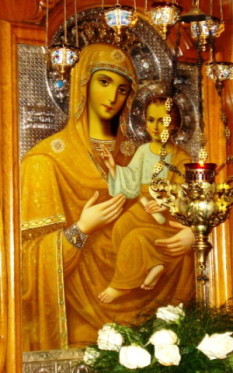
Icon of the Most Holy Mother of God "Quick to Hear"


The Icon of the Mother of God, “Quick to Hear,” is an ancient wonderworking icon, and is located on Holy Mt. Athos at the Docheiariou Monastery. The monastery’s tradition suggests that the icon was written during the tenth century, in the time of St. Neophytus. In 1664, the cook, Nilus, came into the kitchen at night with a burning torch. He heard a voice from the Icon of the Mother of God which hung over the door, warning him in the future not to walk with a torch and not to darken the icon with soot. The monk thought that it was a prank by one of his monastic brothers, so he disregarded the warning and continued to walk into the kitchen with the sooty torch.

Miraculous Icon of the Mother of God, She Who is Quick to HearSuddenly he fell blind. With fervent repentance, Nilus prayed before the Icon of the Mother of God, begging forgiveness. When the brethren heard what had happened, they placed a lamp before the icon, and censed it each night. Again, Nilus heard the wondrous voice saying that he had been forgiven, and that his sight would return. The All-Pure One commanded him to announce to all his brothers that She was the protector and guardian of the monastery. ”Let them and all Orthodox Christians come to Me in their necessities, and I shall not forsake them. All their petitions will be granted by My Son, because of My intercession with Him. My icon shall be called ‘She who is Quick to Hear,’ for I shall speedily fulfill the petitions of those who hasten to it.” The Most Holy Theotokos then fulfilled and continues to fulfill Her promise of quick help and consolation for all those who come to Her with faith.

In Russia, copies of the wonderworking Athonite image “She who is Quick to Hear” were always venerated with great love and fervent prayer. Many of them were glorified by miracles. In particular, there were cases of healing from the plague and from demonic possession.

In 1938, the Docheiariou Monastery presented a copy of the wonderworking Icon of the Mother of God “Quick to Hear” to the Russian Spiritual Mission at Jerusalem.


Monday, November 21, 2011

Marios Frangoulis: Kemal (song about Kemal Ataturk)

Mustafa Kemal Ataturk is the Nero of the 20th century. He was a Turkish army officer and revolutionist statesman who made the genocide of the Greek and Armenian Orthodox Christians. Also, he was the founder and first President of the Republic of Turkey; known most of his life as Mustafa Kemal, he was given the name Ataturk (which means Father of the Nation) by the Grand National Assembly of Turkey in 1934. This is a song about him.


KEMAL


Listen to the story of Kemal
a young prince of the East
descendant of Sinbad the Sailor
who thought he could change the world.
But bitter is the will of Allah
and dark the souls of men.
In the lands of the East once upon a time
the purse was empty and the water stale.
In Mosul and Bushehr on the old coconut tree
the children of the desert now cry bitter tears.
And a young man of an old and royal line
hears the lament and grows near.
the Bedouins look at him sadly
and he gives them an oath in Allah's name, that times will change.
When the lords heard of the lad's fearlessness
they set out with wolf's teeth and lion's skin
from Tigris to Euphrates, from the earth to the heavens
they hunt for the deserter, to capture him alive.
The horde descends upon him like rabid dogs
and takes him to the Caliph to place the noose [on his neck]
black honey and black milk he drank that morning
before he breathed his last on the gallows.
The Prophet awaits before the Gates of Heaven
with two elderly camels and a red horse.
They now go hand in hand and it's cloudy
but the star of Damascus kept them company.
In a month and a year they see Allah before them
and from his high throne he says to the simple Sinbad:
"my beaten smart-aleck, times do not change,
the world always moves on by fire and blades"
Goodnight Kemal, this world will never change.
Goodnight...

Quote by Day

"Finally, be ye all of one mind, having compassion one of another, love as brethren, be pitiful, be courteous. Do not repay evil with. "
I Peter 3:8. 

Apostle Peter being kept in prison bound with chains (Acts 12:5,6).


Category

1915 Armenian Genocide 21st-century Christian martyrs‎ Al Qaeda Apostles Arab Christian Arab-Orthodox Archimandrite Tikhon Shevkunov Asia Australia BBC Belarusian Orthodox Church Bethlehem Bible movies Bulgarian Orthodox Church Byzantine C.I.A. Cairo China Christian Armenians Christmas Traditions Christmas tree Conspiracy Constantinople Documentary Easter Ecumenical Patriarch Ecumenical Patriarch Bartholomew I Ecumenical Patriarchate of Constantinople Elder Ephraim of Vatopaidi Elder Porphyrios Epiphany FREE Greetings Cards FREE books Fr Seraphim Rose Georgian Orthodox Church Greek Orthodox Church Greek Orthodox Easter Holy Fathers Holy Scripture Holy Tradition Internet Interview Italy Jesus Christ Middle East Miraculous Icon Mount Sinai Movie Trailers Orthodox Church in America Palestine Prophecy Russia Russian Orthodox Church Saints Shroud of Turin Son of God St Nicholas of Myra The Mount Athos Food Evolution UK Ukraine Ukrainian Orthodox Church Vatican Watch FREE full movie africa al assad albania anti-Morsi protests army bank bible bible translations bulgaria byzantine music christianity christians christmas church coptic church copts cyprus daily news economy egypt egypt pope elder elder Paisios elder joseph of vatopaidi english subtitles europe food france fyrmacedonia germany greece greek greek food greek music greek orthodoxy health and medicine icon iran islam islamist israel jerusalem jews jihad killed libya mafia monastery money mother of god mount athos music muslim muslims news orthodox church pakistan patristic tradition photo photos picture politics pope protests quotes recipes religion romania romanian orthodox church saint science spy syria theotokos travel turkey tv usa vatopaidi video war world
Related Posts Plugin for WordPress, Blogger...