Search This Blog

Image and video hosting by TinyPic

Sunday, December 30, 2012

RUSSIA: The Russian town full of fallen dictators that could be Bashar Al-Assad's next home


BARVIKHA, Russia — A few years back, before he settled in this bucolic town in a pine forest near Moscow, Askar Akayev, then the president of Kyrgyzstan, had a very stressful day.


Outside his presidential palace, an angry mob had gathered. An overturned car was on fire. Protesters had shinned over a wrought-iron fence and were breaking ground-floor windows and prying open doors.
Then came word from a security adviser: The time had come.
“I left in the suit I was standing up in,” Mr. Akayev told a journalist soon after his downfall in March 2005. Within days he was here, staying in a government-owned sanitarium — and in good company.
This improbable small town of villas and luxury boutiques, built around the sanitarium where Mr. Akayev stayed, is home to half a dozen or so deposed leaders and members of their families.
And in its snowy tranquillity, it offers one strange, possible future for the embattled president of Syria, Bashar al-Assad, as Western governments have been pressuring Russia since summer to smooth his departure with an offer of asylum.
For now, even with rebel fighters closing in on Damascus, diplomats in Russia, Mr. Assad’s most important ally, have denied they are considering granting him safe haven as a step toward resolution of the conflict. But the Russians have come through with 11-hour rescues of their allies before.
“The Russians have experience with getting heads of state out in the nick of time,” said Mark N. Katz, a professor of government and politics at George Mason University in Virginia. “They could be trying to signal to Assad there is an offer, but the window of opportunity is not going to remain open for a long time.”
Leaders’ hurried packing and just-in-time flight to this place from angry street crowds or the nearing sound of gunfire brought measures of resolution to conflicts in the former Yugoslavia, Georgia, Kyrgyzstan and elsewhere.
Russia has been inching closer to agreeing to a settlement that would include Mr. Assad’s departure, if that is even possible at this juncture, with rebels occupying parts of the capital and firing mortar rounds at the presidential palace in the Muhajireen neighborhood of Damascus.
On Thursday, the United Nations envoy to Syria, Lakhdar Brahimi, and Russian diplomats agreed to revive a peace initiative that stalled last summer after the Russians insisted it refrain from specifically excluding a role for Mr. Assad in any transition government. It was unclear whether Russia would accede to such a demand in any new agreement, and if so, whether the Syrian leader would land here.
Not all political exiles live in the districts of spacious country homes that lie here, along the Ryublyovsky Highway, but many do.
By many accounts, once here, these people enjoy the quiet and privileged afterlife of former elites of Soviet or Russian client states that have folded. In a snowy shopping center, the Barvikha Luxury Village, Gucci, Ralph Lauren and Dolce & Gabbana shops were open on a recent visit, of possible interest to Mr. Assad’s wife, Asma al-Assad, who is known to dress fashionably.

Harvard Scientist Proposes Refreezing Arctic to Prevent Global-Warming Disaster (VIDEO)


Harvard University geoengineer and environmental scientist David Keith has a "plan B" in case of an environmental emergency.
Keith's unusual proposal is this: Force reflective particles into the Earth's upper atmosphere -- the stratosphere -- to reverse global warming.
"One approach is to disperse particulates at high altitude to reduce the effective solar flux entering the atmosphere," Keith and his fellow researchers report in the Nature Climate Change journal and Environmental Research Letters.
The idea comes from nature, Keith said in a TED talk. In 1991, Mount Pinatubo in the Philippines erupted and cooled the Earth. About 15 millions tons of sulfur dioxide rose into the upper atmosphere, creating an "hazy layer" of aerosol particles, according to NASA. The plume of particles in the atmosphere shaded the Earth's surface, creating a cooling effect for almost two years.
Keith is proposing something similar to save the Arctic sea ice, which is at an all-time low. The large-scale geoengineering solution could reduce the penetration of the sun by at least 0.5%, according to his papers.
For now, the $8 billion geoengineering plan remains a radical option. The solar geoengineering investigators hope their ongoing research sparks a global conversation about the environment.
"If one is optimistic, one might hope that the injection of this new technology into climate policy will energize the topic, breaking the static trench warfare that now characterizes much of the debate about climate and perhaps producing a better outcome. But, that is a wish, not a prediction," Keith said in a recent Q&A with the Belfer Center Newsletter.
The scientist believes there are solutions for global warming, including enforcing global conversation, reducing carbon-dioxide emissions and increasing wind power. What we currently lack, according to Keith, is urgency, attention to the problem and action.
Do you think we're doing enough to conserve the environment, and reduce greenhouse gas emissions?

Lawrence of Arabia (1962) - Watch FREE Full Movie


Image and video hosting by TinyPic


St. John Moschos: The Incredible Story of a Baptism with Sand


Abba Palladios told us he had heard one of the fathers whose name was Andrew (whom we also met) say:
 

When we were in Alexandria, Abba Andrew at the eighteenth mile post told us saying:
As a young man I was very undisciplined. A war broke out and confusion reigned so, together with nine others, I fled to Palestine. One of the nine was a fellow with iniative (Grk. philoponos, strictly, one who likes hard work, an industrious fellow) and another was a Hebrew. When we came into the wilderness, the Hebrew became mortally sick, so we were in great distress, for we did not know what to do for him. But we did not abandon him. Each of us carried him as far as he was able. We wanted to get him to a city or to a market town so that he should not die in the wilderness. 
But when the young man was completely worn out and was brought to the point of death by hunger and a burning fever, by utter exhaustion and a raging thirst from the heat (in fact he was about to expire), he could no longer bear to be carried. With many tears, we decided to abandon him in the wilderness and go our way. We could see death from thirst lying in store for us. We were in tears when we set him down in the sand. When he saw that we were going to leave him, he began to adjure us, saying: ‘By the God who is going to judge both the quick and the dead, leave me not to die as a Jew, but as a Christian. Have mercy on me and baptise me so that I too may depart this life as a Christian and go to the Lord.’ We said to him: ‘Truly brother, it is impossible for us to do anything of the sort. 
We are laymen and baptizing is bishops’ work and priests.’ Besides, there is no water here.’ But he continued to adjure us in the same terms and with tears, saying: ‘Oh, Christians, please do not deprive me of this benefit.’ While we were most unsure of what to do next, the fellow with initiative among us, inspired by God, said to us: ‘Stand him up and take off his clothes.’ We got him to his feet and with great difficulty and stripped him. The one with initiative filled both his hands with sand and poured it three times over the sick man’s head saying: ‘Theodore is baptised in the name of the Father and of the Son and of the Holy Spirit’, and we all answered amen to each one of the names of the holy, consubstantial and worshipful Trinity. 
The Lord is my witness, brethren, that Christ, the Son of the living God, thus cured and reinvigorated him so that not a trace of illness remained in him. In health and vigour he ran before us for the rest of our journey through the wilderness. When we observed so great and so sudden a transformation, we all praised and glorified the ineffable majesty and lovingkindness of Christ our God. When we arrived at Ascalon, we took this matter to the blessed and saintly Dionysios, who was bishop there, and told him what had happened to the brother on the journey. When the truly holy Dionysios heard of these things, he was stupefied by so extraordinary a miracle. 
He assembled all the clergy and put to them the question of whether he should recognize the effusion of sand as a baptism or not. Some said that, in view of the extraordinary miracle, he should allow it as a valid baptism; others said he should not. Gregory the Theologian enumerates all the kinds of baptism. He speaks of the Mosaic baptism, baptism in water, that is, but before that of baptism in a cloud and in the sea. ‘The baptism of John was no longer Judaic baptism, for it was not only a baptism in water, but also unto repentance. Jesus also baptised, but in the Spirit, and this is perfection. 
I know also a fourth baptism: that of martyrdom and of blood. And I know a fifth: the baptism of tears.’ ‘Which of these baptisms did he undergo?’, asked some, ‘so that we might pronounce on its validity? For indeed the Lord said to Nicodemus: Except a man be born again of water and of the Spirit, he shall not enter into the Kingdom of heaven (Jn. 3:5).’ To this, others replied: ‘But indeed they were baptised, as Clement, the author of the Stromates, testifies in the fifth book of Hypotyposes. 
In commenting on the saying of the Apostle Paul, he opines: I thank God that I baptised none of you (1 Cor. 1:14) that Jesus is said to have baptised none but Peter; Peter to have baptised Andrew; Andrew, James and John, and they the others.’ When they had said all this and much more beside, it seemed good to the blessed Bishop Dionysios to send the brother to the Holy Jordan and for him to be baptised there. The fellow with iniative he ordained a deacon. 

RUSSIA: By the waters of Babylon - Moscow Sretensky choir (VIDEO)


Psalm 136[137], sung by the Moscow Sretensky Choir.
A miniature St Cuthbert's Cross
By the rivers of Babylon..." (Septuagint: "By the waters of Babylon...") 
Psalm 136

BY the waters of Babylon there we sat down and wept when we remembered thee, O Sion. Alleluia.

As for our harps, we hanged them up upon the willows that are therein.Alleluia.
For they that carried us away captive required of us the words of a song, and they that led us away asked for melody, in our heaviness, ‘Sing us one of the songs of Sion’. Alleluia.
How shall we sing the Lord’s song in a strange land? Alleluia.
A miniature St Cuthbert's Cross
If I forget thee, O Jerusalem let my right hand forget her cunning. Alleluia.
If I do not remember thee, let my tongue cleave to the roof of my mouth, yea if I prefer not Jerusalem above my chief joy. Alleluia.
Remember the children of Edom, O Lord, in the day of Jerusalem, how they said, Down with it, down with it, even to the ground. Alleluia.
O daughter of Babylon, wasted with misery: yea, happy shall he be that rewardeth thee, as thou hast served us. Alleluia.
Blessed shall he be that taketh thy children, and throweth them against the stones.1 Alleluia.

1 St Augustine of Hippo wrote: “What are the little ones of Babylon? Evil desires at their birth. For there are, who have to fight with inveterate lusts. When lust is born, before evil habit giveth it strength against thee, when lust is little, by no means let it gain the strength of evil habit; when it is little, dash it. But thou fearest, lest though dashed it die not; ‘Dash it against the Rock; and that Rock is Christ.’” (Expositions on the Psalms, Ps 136[137].)


source

BBC: Athens Is Only EU Capital Without a Muslim Ctr.


At Friday prayers and across Athens, Muslims gather in underground, cramped prayer rooms.

The makeshift facilities are illegal but this huge community faces no other option. Athens, a metropolis on the edge of the Muslim world, is one of the few EU capitals without a mosque.
Since Greece gained independence from the Ottoman Empire in 1832, no government has allowed a mosque to be built in the city. It was seen by many as "un-Greek" - out of place in a country in which much more than 90% of the population are Orthodox Christians.
But as Greece has become the main entry point for migrants to the EU, its Muslim population has swelled.
Some estimates place the number of Muslims in Athens alone at around 300,000, in a city with a population of around five million, and the clamour for an official place of prayer is growing.
"It is a very big tragedy for us Muslims that there is no mosque here," says Syed Mohammad Jamil from the Pakistan-Hellenic Society.
"Greece produced democracy and civilisation and the respect of religion - but they don't respect our Muslims to provide us with a regular, legal mosque."
One of the Friday worshippers, Ashifaq Ahmad, says: "I feel somehow cut off from society.
"When we have a celebration, there is nowhere proper for us to get together. Society is not accepting us."
Barracks plan
Pressure on the government to provide a secure, protected mosque has grown as the neo-fascist Golden Dawn party continues to rise.


The party's deputy, Ilias Panagiotaros, told me earlier in the year that landmines should be placed on Greece's border with Turkey, saying: "If immigrants die trying to jump into our country, that's their problem."Its members stand accused of beating immigrants and vandalising some of the underground prayer rooms.

Now perhaps the call for a place of worship may be answered.
A disused army barracks near the city centre has been chosen as a site for the capital's first mosque.
Behind heavy gates lie old buildings, broken glass and rubble strewn across the floors. The crumbling shells currently there would be torn down, making space for a mosque that could accommodate 500 people.
If it is built, Muslims entering would catch sight of a small church next door, the two religions finally operating officially shoulder to shoulder.
The government insists the project will go ahead, but similar plans have been promised in the past - only to fall foul of political infighting.
And the financial crisis could still blow the idea off course. A government struggling to afford schoolbooks or healthcare may find it hard to announce 1m euros (£814,000; $1.3m) for a state-funded mosque.
"In the past, there was a fear in some segments of Greek society about constructing a mosque but we must overcome that fear," says Stratos Simopoulos, the secretary general of the ministry for development.
"The financial crisis is a problem. The government has other priorities for now, but this mosque must be constructed and we may be in a position to start the process in a few months."
I ask whether he is committed to the plan.
"Of course", he replies, "because it's not my commitment - it's a commitment of the Greek state."
And yet there is still resistance within the country.
'Islamic tyranny'
 
The Greek Church has warmed to the mosque idea but some senior ecclesiastical figures remain opposed.
In a packed service in St Nicolas's Church in Piraeus, just outside Athens, the strength of religious devotion is clear.
Members of the congregation kiss the icons and repeatedly cross themselves. Orthodox Christianity goes to the heart of what it means to be Greek and the Bishop here, Seraphim, says his nation must preserve its identity.
"Greece suffered five centuries of Islamic tyranny under Turkish rule and building a mosque would offend the martyrs who freed us," he says.
Greece, he adds, "does not hate anyone" but he believes that "most Muslims have come here illegally" to, as he puts it, "Islamise Europe".
I put it to him that his position appears Islamophobic, out of touch with a multicultural European Union, and his response may betray other prejudices too.
"We are not a multicultural country," the Greek bishop says. "We are one Greek nation and everything else is an invention of the 'new order' and of Zionism. They are trying to corrupt our character."

Elder Joseph of Vatopaidi intervenes through the Radio and during the Holy Liturgy


The following incident refers to a friendly family of mine, and it took place on the 2nd of July 2009, a day after the blessed repose of Elder Joseph of Vatopaidi.
            A. and her husband were going through some very tough times for the last few years and particularly since last May. It has to do with how her parents in law view her and how they behave towards their own son. In effect they are trying to separate the couple, who already have four kids, one newly-born- through quarrels, slurs, and malicious behaviour with appalling letters full of vile and slurs. They even managed to turn other relatives against the couple. However, being the spiritual children of Elder Efrem of Vatopaidi, the couple does not return the fire but shows patience and perseverance in trying to protect their family.
            Nevertheless, being human, they are suffering. The wife reached the point where she thought that it is all her fault since everybody had turned against her and was desperate. Elder Efrem told her to forget about it and that it is not her fault. However, she cannot get rid of this thought.
            The day after Elder Joseph reposed to the Lord, while she was driving her children to school with her husband’s car, she heard on the radio a faint, husky voice saying quickly: ‘Do not allow Satan enter your house. You must get rid of him. He particularly likes to dissolve marriages and families. What is happening is not your fault. It is Satan who makes you believe it is your fault and gives you a hard time unnecessarily’.  When she returned home she told her husband that she had listened to a wonderful speech by an elder with a faint, husky voice, talking about their specific problem. When the husband got into the car, he listened to an interview which Elder Joseph of Vatopaidi gave to the reporter of the Metropolis of Limassol Radio, Mr Louka Louka. It was a very good interview but it was referring to irrelevant to their problem issues. 
He thought to ask for the CD to listen to it with his wife. They made a copy of Elder Joseph’s interview, broadcasted on the 2nd of July 2009.  The following night he drove to the Machaira monastery to attend an all night vigil. He turned the CD on but at no time did the Elder talk about Satan and the need to drive him out of our homes. The husband thought it was weird. Then he remembered that the radio station broadcasts the Holy Liturgy live from the Holy Monastery of Asomaton Petraki at 7.30am everyday. He confirmed this with those working at the radio station. Indeed, the previous day the radio was broadcasting the Holy Liturgy at 7.30 and not anything with Elder Joseph speaking. What had happened was inconceivable in our logic. Elder Joseph spoke to his wife during the Holy Liturgy!
            This proved without any doubt that Elder Joseph, having found favour in the face of our Lord, intervened miraculously to calm down a devout soul which was unjustly suffering from slanders and slurs.
            This event astounded us very much and proved that not only Elder Joseph had gained favour in the face of the Lord but also the fact that there is life after death and that Our Lord is a Living God. Our Lord is neither a theory nor some man-made fiction. However, we, His creations, doubt Him.
            I mentioned this event to the Abbot of Vatopaidi, Elder Efrem. He was not surprised since he knew very well how his elder lived. The Metropolitan of Limassol Athanasios was also informed and confirmed again that at 7.30 every morning the station broadcasts the Holy Liturgy.
I have received the permission of the couple to reveal this astonishing ‘intervention through the radio waves’ by Elder Joseph, without mentioning their names.
NEARCHOS PANAGI
Dentist


Saturday, December 29, 2012

The New Middle East: Hidden US-Israeli Military Agenda


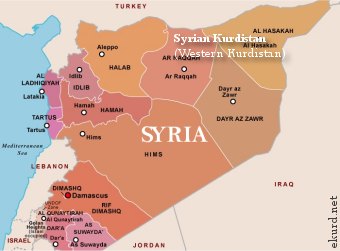
A timely article in the Jerusalem Post in June brings to the forefront the unspoken objective of US foreign policy, namely the breaking up of Syria as a sovereign nation state –along ethnic and religious lines– into several separate and “independent” political entities. The article also confirms the role of Israel in the process of political destabilization of  Syria.  The JP article is titled:“Veteran Kurdish politician calls on Israel to support the break-up of Syria‘ (by Jonathan Spyer)
The objective of the US sponsored armed insurgency is –with the help of Israel– to “Break Syria into Pieces”
One possible ”break-up scenario” pertaining to Syria, which constitutes a secular multi-ethnic society, would be the formation of separate and  “independent” Sunni, Alawite-Shiite, Kurdish and Druze states:   “We need to break Syria into pieces,” Abbas said. (Quoted in JP, op. cit., emphasis added).
“The Syrian Kurdish dissident argued that a federal Syria, separated into four or five regions on an ethnic basis, would also serve as a natural “buffer” for Israel against both Sunni and Shi’ite Islamist forces.” (Ibid.).
Ironically, while Islamist forces are said to constitute the main threat to the Jewish State, Tel Aviv is providing covert support to the Islamist Free Syrian Army (FSA).
Map 1
Meeting behind Closed Doors at the US State Department
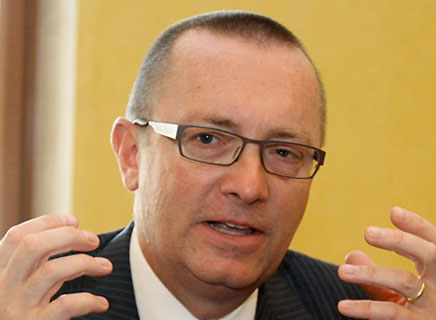
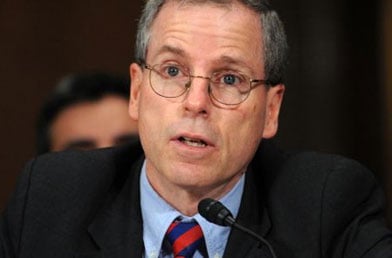
A top level US State Department meeting was held in May with members of the Syrian Kurdish opposition. In attendance were representatives of the Kurdish National Council (KNC),  Robert Stephen Ford, the outgoing US ambassador to Syria (who has played a key role in channelling support to the rebels) as well as Frederic C. Hof, a former business partner of Richard Armitage, who currently serves as the administration’s “special coordinator on Syria”. (Ibid). The delegation also met with Assistant Secretary of State for Near Eastern Affairs Jeffrey Feltman.
Frederic C. Hof, Robert Stephen Ford and Jeffrey Feltman are the State Department’s key Syria policy-makers, with close links to the Syrian Free Army (SFA) and the Syrian National Council (SNC).


Assistant Secretary of State for Near Eastern Affairs Jeffrey Feltman

Frederic C. Hof, The Administration’s “special coordinator on Syria”

Robert S. Ford, outgoing US Ambassador to Syria
The public statements of KNA leader Sherkoh Abbas in the wake of the State Department meeting suggest that the political fracturing of the Syrian Arab Republic along ethnic and religious lines as well as the creation of an “independent Kurdistan” were discussed. “State Department Deputy Spokesman Mark Toner described [the meeting's] purpose as part of ‘ongoing efforts… to help the Syrian [Kurdish] opposition build a more cohesive opposition to Assad.’”  (Ibid).
The KNA leader called upon Washington to support the creation of a separate Kurdish State consisting of  “an autonomous region in Syria; joining the Kurdistan Regional Government in Iraq – which borders the Kurdish region in Syria; or perhaps an even larger Kurdish state” [Greater Kurdistan].
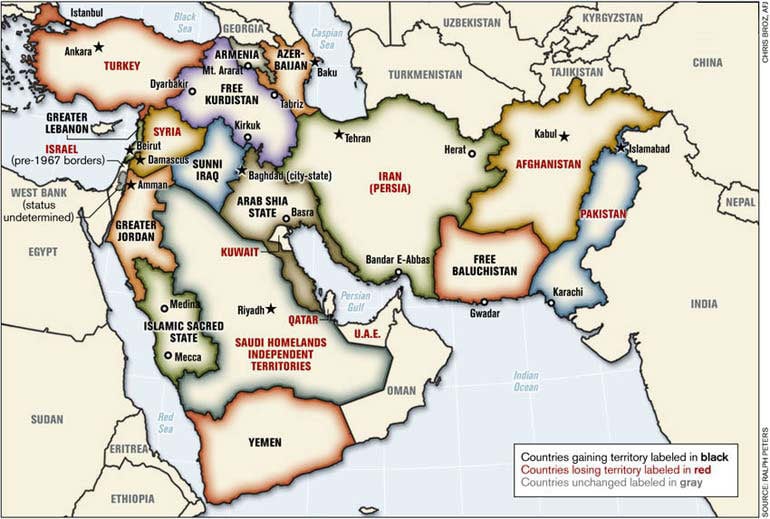
It is worth noting, in this regard, that the creation of a “Greater Kurdistan” has been envisaged for several years by the Pentagon as part of a broader “Plan for Redrawing the Middle East”.(See map 2 below)
This option, which appears unlikely in the near future, would go against the interests of Turkey, a staunch ally of both the US and Israel. Another scenario, which is contemplated by Ankara would consist in the annexation to Turkey of parts of Syrian Kurdistan. (See map above).
Map 2. The New Middle East
The following map was prepared by Lieutenant-Colonel Ralph Peters. 
Although the map does not officially reflect Pentagon doctrine, it has been used in a training program at NATO’s Defense College for senior military officers.
This map, as well as other similar maps, has most probably been used at the National War Academy as well as in military planning circles.


source

Belgium: Belgian Church of Scientology should be charged with extortion, fraud, organized crime, illegal medical practice

 Grand place, Brussels - Belgium 

After a long lasting legal battle Belgium prosecutors demand to label the Church of Scientology as a criminal organization and charge it and its leaders with extortion, fraud, privacy breaches, and the illegal practice of medicine.
The subpoenas have been sent to the scientologists, the local financial newspaper De Tijd reported.
The charges against the Church of Scientology stem from employment contracts issued to recruit volunteers and members allegedly breaching the country's strict employment laws. In Belgium as in some other countries Scientology is not recognized as a faith.
In 2008 the Belgium Labor Mediation Service complained about number of labor contracts, prompting an investigation.
A judge then ordered raids on Scientology premises where police allegedly “managed to seize a wealth of evidence,” that the organization had spied on and extorted money from its members, the Flanders News reported.
Belgian authorities have been legally battling Scientologists since 2007, when the country tried to label the movement as a cult. Around the same time Belgian prosecutors ruled that the Belgian Church of Scientology, plus Scientology's Office of Human Rights and their 12 members, should be charged with extortion, fraud, organized crime, illegal medical practice.
They were accused of practicing medicine without a license and violating privacy laws.
The church described the case as a "witch hunt", with vocal supporters in the US condemning the move.
An estimated 500 people belong to the church of Scientology in Belgium, where the government denied Scientology the status of religion in 1997.  The organization's European headquarters are located in Brussels.
In 2009 the organization was convicted in France on fraud charges.
That conviction was upheld in a French appeals court in February 2012.

US - Russia: Two nations into a new Cold War


Tit-for-tat moves between Russia and the US are plunging the two nations into a new Cold War, says Russia expert Stephen Cohen. Washington’s longtime policy towards Moscow is to blame for the growing tensions.
The ‘reset’ in relations between the United States and Russia is dead, as the Obama administration has never truly cooperated with Moscow, instead pushing the same policy Washington has been imposing on Russia for the past 20 years.
“That policy is advancing NATO toward Russia’s borders, building missile defense on Russia’s borders, interfering in Russia’s internal politics,” Stephen F. Cohen – professor of Russian Studies and History at New York University and Princeton University told RT.
RT: After the US Senate passed the controversial [Magnitsky] bill, Russia accused Washington of engaging in 'Cold War tactics'. Now that Moscow has retaliated, how would you describe the two countries' relations?
Stephen Cohen: Increasingly we are plunging into a new Cold War. But it’s not a surprise. The story of the orphans doesn’t begin with the Magnitsky Bill. Number of us in the United States have been warning since the 1990s – nearly 20 years – that unless Washington changed its policy, its kind of winner-take-all policy after the Cold War policy toward Moscow, that we would drift toward Cold War, not toward the partnership we all hoped for 20 years ago. This is just the last stage I wouldn’t say it’s inevitable. But even though the tragedy of those orphans already adopted in effect who now will not be able to join their families in America is foremost in our minds – especially on the Christmas Eve and the eve of the New Year.
A real honest, analytical approach by an American patriot – as I am – is that Washington bears a large part of responsibly because of the policies it pursued toward Moscow. And what we saw in the Russian Duma and in the Russian Higher House – the Federal Assembly – when virtually every deputy voted in favor of the ban on American adoption, which was just signed by Putin, is an outburst of pent-up of anti-American feeling in Moscow which has been caused not only, but in large measure by American policy.
RT: How much is this dispute actually just political saber-rattling and how will it actually impact the children?
SC: There is an old Russian saying – “Words are also deeds.” A lot of people in Moscow and in Washington- when they passed the Magnitsky Act and now the ban on adoption in Moscow – may have though that they werejust talking, showing off, playing grandstanding. But these words have consequences. They have backed, they have fueled this new Cold War atmosphere which is enveloping the relationship between our two countries. Each going to affect American relations with Russia regarding Afghanistan, regarding missile defense, regarding Syria, regarding Iran – these are very serious matters. The angrier people get, the more resentment people have on both sides, the worse is the situation.
For example, anti-Putin feeling in America is irrational, completely irrational. There has been a kind of demonization of Putin in America. Some of us tried to counter it by beginning a rational discourse about Putin as a leader. We are not pro-Putin, we just see him as a national leader who needs to be understood. But these events – the Magnitsky and the orphan act are going to make it impossible to have a discourse in America about Putin’s leadership in a way that would lead to any cooperation between Obama and Putin.
RT: With the US and Russia exchanging tit-for-tat actions, what possible further moves can we expect?
SC: There was some surprise in America because our legislature does not think about the consequences of what it does. Many people thought that the Russian reaction to the Magnitsky Bill would be for Moscow to start selling its dollars, for example, and try to harm the American economy or perhaps that Moscow would reduce its cooperation with the United States in supplying NATO troops fighting in Afghanistan. So many people were surprised that the orphan issue became the retaliation.
But there are two issues here that are interesting: In the beginning President Putin did not seem to favor the ban on American adoptions, but he signed the bill after it turned out that almost every member of this parliament favored it. It is also said that President Obama did not favor the Magnitsky Bill, but he signed it when it turned out that almost every member of Congress favored it. So it may be that we are exaggerating the power both of Putin and Obama.
RT: The reset button was pressed in 2009 – but how much has really changed in ties between Washington and Moscow?
SC: I see Obama’s reset is what we – the older generation – used to call when we were in a Cold War a ‘detente’ – meaning an attempt to reduce Cold War conflict by replacing it with cooperation. I think there was a lost opportunity. When Obama and then President Medvedev entered into the reset, Moscow wanted certain things from Washington and Washington wanted certain things from Moscow. Without going into the detail Washington got everything from Moscow it wanted and Moscow got nothing. So the reset has been dead for several months, maybe a year.
RT: During the US Presidential elections, Barack Obama had been accused by his Republican counterpart of being soft on Russia. Could the latest decision mean he's changing his stance?
SC: The Republicans said that because they were prepared to say anything negative they could think about Obama in order to defeat him. But he reality is that Obama has continued the policy toward Moscow begun by President Clinton, a Democrat, and continued by PresidentBush, a Republican. That policy is advancing NATO toward Russia’s borders, building missile defense on Russia’s borders, interfering in Russia’s internal politics, most recently the street demonstrations. This is the same policy that began 20 year ago with the Soviet Union.
The fundamental American policy toward Russia has not changed. So it’s ridiculous to call Obama ‘soft’ on Moscow. Just because two leaders get together as they always do and say ‘we are friends’ – it doesn’t mean anything. The reality is that the partnership we need between Washington and Moscow to make the world safer for all of us has not existed since the Soviet Union ended. And we may be farther from it today as a result partially of this orphan act than we have been in 20 years.

Blessed Fr. Daniel Sysoyev: Life After Death


When a person dies he is met by angels. The angels of God help a person while demons attack him and intimidate him. Two weeks ago I was with a person as they were dying and I saw how demons were attacking him. This is not a joke, it is truly so. Only the Orthodox faith, the power of the cross, and, especially, Holy Communion can protect such a person. Therefore, if after death demons attack you, cross yourself and say “Lord Jesus, help!” and particularly ask the Most Holy Mother of God. 

She quickly protects from the demons. And then, after death, rise up to heaven, not concerning yourself with the earth, and run quickly to God, then the demons cannot attack you. The demons detain those at the toll houses who are attached to the earth, those who think too much about the earthly. If a person has striven for God his whole life then he will not even notice their attack. But remember that the demons will trick you with the help of the sin of vanity. To Macarius the Great, when he was rising up, the demons said, “you have conquered us! you have conquered us!” But he answered, “Not quite yet,” and only when he had entered the gates of paradise did he say, “now I have conquered you with the power of Jesus Christ.” Just the same do we need to prepare early and get in the disposition not to boast and be captured there. When you get into paradise, and I want all our listeners to end up in paradise, go to your beloved saints. 

Therefore, while still on the earth make friends with them, with St. Savva, St. Paraskeva, St. Nicholas, and, in this case, they may even approach you after death. And then, when you bow down to God, He sends you to look at hell, because often we think that sin is sweet and pleasant, but the Lord says, “Look at how it ends.” Therefore, the Church fervently prays for people during the 40 days following their death, because at that time is the final trial for the soul. Close ones can help during this time with both the giving of alms and reading of the Psalter-I think that all our listeners know this but to repeat it is never superfluous. 

Some of our close ones act incorrectly: they spend too much money on funeral feasts when it would be better to give that money to the poor who would then pray for the reposed. Those whom we have brought to Orthodoxy will, of course, especially pray for us. For example, those former Muslims, Roman Catholics, and Protestants who became Orthodox thanks to us. And angels will carry us to heaven on their wings. Remember that life is a school and paradise is a university. And true life begins after the Final Judgment. Therefore, I hope that we will prepare well to be able to live eternally in joy.

Turkey: Ahmet and Dezla - We are 100% Turks and Christians


Ahmet and Dezla Ozgiunes, who have become Orthodox Christian in the last couple of years, speak to Alexandros Massavetas of ‘Kathimerini’ newspaper.
We kept meeting every year in one of the Greek parishes at Nichori of Vosporos during the Easter Service as if we had been keeping an appointment. I thought they were just like the many other Turks who come to the Service out of curiosity to experience the Greek traditional Easter or to celebrate among Christian friends and be part of a multinational and mixed religious congregation.
tourkoi_xristianoi_1
The couple, elegant, educated and well travelled, is among the thousands of Turks who have recently decided to change their religion and among the very few who do not keep their decision secret. They have decided to share with the readers of ‘Kathimerini’ their internal quest which led them to espouse Orthodoxy, as well as to explain to us what it means to be a Turk and a Christian. The interview took place a few months before they were due to emigrate abroad.

- Several articles in the newspapers on the recent baptisms of Muslims insisted that these involved Turks who were of Greek or Armenian origin and thus they were just ‘returning to their roots’. Was such an origin the reason which led you to espouse Christianity?
(Ahmet) Indeed some people did return to their origins by becoming Christians, but this did not apply to us. I was born in Cappadocia and my ancestors hailed from Caucasus. As far as I know there were no Christians in our family. I acceded to Orthodoxy out of personal interest.
(Dezla) My mother hails from Kavala and my father from Pontos. Some relatives do speak romeika -the local Greek dialect spoken by those who had been Islamized. Nevertheless, abandoning Islam and espousing Orthodoxy was a personal choice and had nothing to do with my origins.
- The Turkish identity has historically been so closely connected to Islam that many Turks cannot accept that a Turk may not be a Muslim. How do you feel about this?
(A) It is true that many people do not view one as a ‘Turk” if he belongs to a different religion, especially if one is a Christian or a Jew. They believe that such a person does not just have a different religion but belongs to a different nation.
(D) This perception is mainly due to historical reasons. It is an ottoman tradition to divide people into different nationalities because of their religion. For example all orthodox people belonged to the Orthodox nation and the ottoman administration did not distinguish them as Bulgarians, Serbs or Greeks because of their identity. In Cappadocia, the inhabitants were distinguished between Romioi and Turks because of their religion. The Orthodox people at my home region, Talas, were native Turkish speakers and they even held their church services in Turkish. Their Orthodox religion was the element which distinguished them as ‘Romioi’. Turkish history gives other different examples. Throughout history, Turkish tribes espoused Christianity throughout the Turkish regions. There are Turkish Christians in Central Asia, in Romania and thousands of Turks in Turkey have espoused Christianity. Nevertheless, being Christian does not exclude them from being Turks. I am also a Christian and 100% Turk, while my native language is Turkish. Besides, to distinguish nations on religious grounds is outdated. People are usually baffled by the fact that a Turk could also be a Christian, but this is slowly changing.
- What’s your profession?
(D) I’m a dietician and also do volunteer work.
(A) I was a director at various governmental organizations and have lived in the US for some years. Later on I did business in Belgium.
- Ahmet, does your decision to espouse Christianity date back to the times you have lived in Christian countries?
No, the ground was laid long before that. Unfortunately, Christianity is presented as something which comes to Turkey from abroad. This is a mistake since Christianity is an important part of the history of the region. This is verified by the privileges that Mohammed the Conqueror gave to the Patriarchate. We see Christianity through the lens of Islam even as children. Many Muslims feel great reverence for Christians, since the Koran insists on this, as it sees Jesus as a prophet. Muslims also hold The Most Holy Lady to a great esteem. 
You have certainly seen the masses of Muslims gathering at various Christian churches in Constantinople worshiping the Saints and asking for their assistance or their mediation. In Turkey, we have been preparing from an early age to receive the Christian ideas. The various problems which arise are due to the education that both sides receive as well as to ignorance. For example many Muslims are not able to comprehend the idea of the Triune God and think that Christianity is a polytheistic religion because it worships three Gods. I am not being critical here. I am just mentioning this as an indication of how misinformation works. It is not right to criticize Islam, a religion which I have abandoned.
- What about your quest Dezla. Has it also begun in Turkey?
(D)Yes, it all started at University. My family was more or less religious, without adhering to everything that Islam demanded. They identified themselves as Muslims and so did I until I started studying in Ankara. Our parents had allowed us reasonable freedom on the matter of religion. When I abandoned Islam, I felt a vacuum which I had to fill. I started reading. I was doing my own research. This is how my own journey began which led me to Orthodoxy.
- Therefore, your course towards Orthodoxy was the result of ‘local’ experiences, without external influences…
(A) Any influence that I might have had from the States and Europe could have only been negative. I could not feel at ease with the Christians there. They repelled me because they have turned Christianity into psychotherapy. They go to Church on Sunday to relax, whereas religion aims to fill a vacuum. In Europe Christianity has been turned into a festival away from any religious references. Let’s take Christmas. Many people do not wish one another ‘Merry Christmas’ but ‘happy holidays’. In Europe, people harbor a very superficial relationship with Christianity. They have no idea about its message neither its spirituality.
- How do Christians here differ from their European counterparts?
(D) We are much nearer to the essence and tradition of Christianity.
(A) We are much more faithful.
(D) At least we adhere to the commands of our religion. We go to Church every Sunday and read the Scriptures together every night for some time. And we pray.
- Do you have any connection with the Greek community here?
(A) We are closely connected since we meet every Sunday at Church. The Greek community has some very nice people and we have become friends. Each one has something to give us. The Services are held alternatively at some church. We often visit the churches at Nichori. Lakis Vingas, who is the president of the community, asks Dezla to read ‘Our Father who art in Heaven’ in Turkish.
(D) Indeed, I read it for the Turkish speaking congregation (Laughs).
- You must find it difficult when the liturgy is all in Greek.
(A) We prepare ourselves for each service at home so that we can follow it when we are there. We have a bilingual version of the Scriptures so that we can follow the Turkish text. It is significant for someone to be able to understand, to participate…
- Fr Euthym’s abdication from the Patriarchate and the creation of the ‘Turkish Orthodox Church’ in 1920 was a traumatic experience. Perhaps it still complicates the acceptability of the Turkish language in the Greek parishes of Constantinople, something already accomplished by other dogmas…
(A) Yes, of course… I hope that in time there will be a liturgical service in Turkish in the Orthodox Church. Today only the Creed of Faith is being read in Turkish. The issue with Fr Euthym must also be settled. It is not right that churches hold a grudge with each other… All Orthodox ought to come under the Ecumenical Patriarchate.
- Did you ever experience any negative reactions from your social circle because of the change of religion? Are you concerned about it at all?
(A) I didn’t meet with any negative reaction; neither do I have any concern.
(D) I didn’t have any adverse reaction. My family was surprised but accepted my choice.
- Do you think that other Turks will follow your example and espouse Christianity?
(A and D) Yes, many will do.
Few have been baptized to date…
- It is true that those who have been baptized are more numerous than those who admit it. They are scared of the reaction from their social circle. They are crypto-Christians.
(A) Yes, there is some fear. But this must change. Society must also change its stance against those who change their religion. Needless to say the Orthodox Church here does not proselytize people. On the contrary, it puts those who want to change through their paces. One must go through a long catechesis and one’s honest intention is tested.
- Was it therefore difficult to be admitted into the ranks of the Orthodox Church?
(A) It took a long time, but it was something we really wanted.
- Do you believe that the government’s recognition of the ecumenical character of the Patriarchate would benefit Turkey?
(A) Of course. In my opinion the Patriarchate is an institution through which the Turks and the Orthodox could come together and this will be crucial for Turkey. Since Turkey wants to become a member of the EE, the Patriarchate could assist in bringing the country nearer to Europe and this role is very significant. Moreover, the Orthodox Church plays the most suitable role in the dialogue between different religions since its congregation has coexisted with the Muslims for centuries. I cannot say that such coexistence was always friendly or peaceful but it has at least created ways of communication. I cannot understand why some people in my country would like to downgrade the Ecumenical Patriarchate. I am both surprised and saddened. This recognition is more crucial for Turkey than it is for example for Greece or Russia. If our government had actively promoted the role of the Patriarchate as the centre of Orthodoxy, Turkey’s spiritual role would have been promoted worldwide. Some nationalist circles in Greece do not wish to have the Patriarchate’s role advanced because it is situated in Turkey. Russia, for its part, wishes Moscow to be recognized as the centre of Orthodoxy rather than the Patriarchate. Unfortunately many people undermine the Patriarchate.
- Have you been alarmed by the attacks against Christians like the murder of Fr Santorio in Trapezounta and the massacre of Christians in Malatia? Who do you think was behind these atrocities?
(A) I don’t think that similar events could take place here in Constantinople. In view of the negotiations with the EE, Turkey is changing dramatically. Turks become more tolerant and open. It is normal that some extremists would object to such changes. Such paranoid resistance to progress is found everywhere amongst extremists circles. These are dark forces which have nothing to do with the state. They are outcasts.


Category

1915 Armenian Genocide 21st-century Christian martyrs‎ Al Qaeda Apostles Arab Christian Arab-Orthodox Archimandrite Tikhon Shevkunov Asia Australia BBC Belarusian Orthodox Church Bethlehem Bible movies Bulgarian Orthodox Church Byzantine C.I.A. Cairo China Christian Armenians Christmas Traditions Christmas tree Conspiracy Constantinople Documentary Easter Ecumenical Patriarch Ecumenical Patriarch Bartholomew I Ecumenical Patriarchate of Constantinople Elder Ephraim of Vatopaidi Elder Porphyrios Epiphany FREE Greetings Cards FREE books Fr Seraphim Rose Georgian Orthodox Church Greek Orthodox Church Greek Orthodox Easter Holy Fathers Holy Scripture Holy Tradition Internet Interview Italy Jesus Christ Middle East Miraculous Icon Mount Sinai Movie Trailers Orthodox Church in America Palestine Prophecy Russia Russian Orthodox Church Saints Shroud of Turin Son of God St Nicholas of Myra The Mount Athos Food Evolution UK Ukraine Ukrainian Orthodox Church Vatican Watch FREE full movie africa al assad albania anti-Morsi protests army bank bible bible translations bulgaria byzantine music christianity christians christmas church coptic church copts cyprus daily news economy egypt egypt pope elder elder Paisios elder joseph of vatopaidi english subtitles europe food france fyrmacedonia germany greece greek greek food greek music greek orthodoxy health and medicine icon iran islam islamist israel jerusalem jews jihad killed libya mafia monastery money mother of god mount athos music muslim muslims news orthodox church pakistan patristic tradition photo photos picture politics pope protests quotes recipes religion romania romanian orthodox church saint science spy syria theotokos travel turkey tv usa vatopaidi video war world
Related Posts Plugin for WordPress, Blogger...