Search This Blog

Image and video hosting by TinyPic

Tuesday, May 29, 2012

Elder Paisios: Do not forget Christ, so that He also remembers you


The basis of everything is to keep our minds on God by offering Him our heart, which He desires. When our mind is on God and the heart distances itself from the body, then man does not live on earth anymore, but in Heaven. He does not worry about death or Paradise because he experiences it from this life. “The kingdom of Heaven is inside us”. 


Maybe you will ask me: “ You are correct is saying these , father, but how does one accomplish this?” I think it is easy, if we strive to achieve two simplifications: Firstly, to simplify our life from a materialistic point of view and secondly to direct our attention to our spiritual existence rather than to our materialistic side. For example: If someone swears at us, instead of getting upset because the ‘old’ self inside us has been offended , we must examine whether we had offended him in any way and to change our ways. Try to develop an ascetic conscience. Live spiritually like nuns and do not forget Christ so that He also remembers you.


(from a letter to nuns)

Monday, May 28, 2012

Aramaic: Efforts To Revive Jesus' Language In Christian Community In Holy Land

Aramaic Jesus 

JISH, Israel -- Two villages in the Holy Land's tiny Christian community are teaching Aramaic in an ambitious effort to revive the language that Jesus spoke, centuries after it all but disappeared from the Middle East.
The new focus on the region's dominant language 2,000 years ago comes with a little help from modern technology: an Aramaic-speaking television channel from Sweden, of all places, where a vibrant immigrant community has kept the ancient tongue alive.
In the Palestinian village of Beit Jala, an older generation of Aramaic speakers is trying to share the language with their grandchildren. Beit Jala lies next to Bethlehem, where the New Testament says Jesus was born.
And in the Arab-Israeli village of Jish, nestled in the Galilean hills where Jesus lived and preached, elementary school children are now being instructed in Aramaic. The children belong mostly to the Maronite Christian community. Maronites still chant their liturgy in Aramaic but few understand the prayers.
"We want to speak the language that Jesus spoke," said Carla Hadad, a 10-year-old Jish girl who frequently waved her arms to answer questions in Aramaic from school teacher Mona Issa during a recent lesson.
"We used to speak it a long time ago," she added, referring to her ancestors.
During the lesson, a dozen children lisped out a Christian prayer in Aramaic. They learned the words for "elephant," "how are you?" and "mountain." Some children carefully drew sharp-angled Aramaic letters. Others fiddled with their pencil cases, which sported images of popular soccer teams.
The dialect taught in Jish and Beit Jala is "Syriac," which was spoken by their Christian forefathers and resembles the Galilean dialect that Jesus would have used, according to Steven Fassberg, an Aramaic expert at the Hebrew University in Jerusalem.
"They probably would have understood each other," Fassberg said.
In Jish, about 80 children in grades one through five study Aramaic as a voluntary subject for two hours a week. Israel's education ministry provided funds to add classes until the eighth grade, said principal Reem Khatieb-Zuabi.
Several Jish residents lobbied for Aramaic studies several years ago, said Khatieb-Zuabi, but the idea faced resistance: Jish's Muslims worried it was a covert attempt to entice their children to Christianity. Some Christians objected, saying the emphasis on their ancestral language was being used to strip them of their Arab identity. The issue is sensitive to many Arab Muslims and Christians in Israel, who prefer to be identified by their ethnicity, not their faith.
Ultimately, Khatieb-Zuabi, a secular Muslim from an outside village, overruled them.
"This is our collective heritage and culture. We should celebrate and study it," the principal said. And so the Jish Elementary School become the only Israeli public school teaching Aramaic, according to the education ministry.
Their efforts are mirrored in Beit Jala's Mar Afram school run by the Syrian Orthodox church and located just a few miles (kilometers) from Bethlehem's Manger Square.
There, priests have taught the language to their 320 students for the past five years.
Some 360 families in the area descend from Aramaic-speaking refugees who in the 1920s fled the Tur Abdin region of what is now Turkey.
Priest Butros Nimeh said elders still speak the language but that it vanished among younger generations. Nimeh said they hoped teaching the language would help the children appreciate their roots.
Although both the Syrian Orthodox and Maronite church worship in Aramaic, they are distinctly different sects.
The Maronites are the dominant Christian church in neighboring Lebanon but make up only a few thousand of the Holy Land's 210,000 Christians. Likewise, Syrian Orthodox Christians number no more than 2,000 in the Holy Land, said Nimeh. Overall, some 150,000 Christians live in Israel and another 60,000 live in the West Bank.
Both schools found inspiration and assistance in an unlikely place: Sweden. There, Aramaic-speaking communities who descended from the Middle East have sought to keep their language alive.
They publish a newspaper, "Bahro Suryoyo," pamphlets and children's books, including "The Little Prince," and maintain a satellite television station, "Soryoyosat," said Arzu Alan, chairwoman of the Syriac Aramaic Federation of Sweden.
There's also an Aramaic soccer team, "Syrianska FC" in the Swedish top division from the town of Sodertalje. Officials estimate the Aramaic-speaking population at anywhere from 30,000 to 80,000 people.
For many Maronites and Syrian Orthodox Christians in the Holy Land, the television station, in particular, was the first time they heard the language outside church in decades. Hearing it in a modern context inspired them to try revive the language among their communities.
"When you hear (the language), you can speak it," said Issa, the teacher.
Aramaic dialects were the region's vernacular from 2,500 years ago until the sixth century, when Arabic, the language of conquering Muslims from the Arabian Peninsula, became dominant, according to Fassberg.
Linguistic islands survived: Maronites clung to Aramaic liturgy and so did the Syrian Orthodox church. Kurdish Jews on the river island of Zakho spoke an Aramaic dialect called "Targum" until fleeing to Israel in the 1950s. Three Christian villages in Syria still speak an Aramaic dialect, Fassberg said.
With few opportunities to practice the ancient tongue, teachers in Jish have tempered expectations. They hope they can at least revive an understanding of the language.
The steep challenges are seen in the Jish school, where the fourth-grade Aramaic class has just a dozen students. The number used to be twice that until they introduced an art class during the same time slot – and lost half their students.


Jesus' Crucifixion Date Possibly Friday April 3, 33 A.D.


A new study suggests that the Biblical date of Jesus' crucifixion is, in fact, possible to confirm.
The International Geology Review investigated an earthquake that was said to have occurred the same date as Jesus' crucifixion; which was most likely Friday April 3, 33 A.D.
In Gospel of of Matthew, Chapter 27 says: 
“And when Jesus had cried out again in a loud voice, he gave up his spirit. At that moment the curtain of the temple was torn in two from top to bottom. The earth shook, the rocks split and the tombs broke open.”
According to Discovery News, geologist Jefferson Williams of Supersonic Geophysical and colleagues Markus Schwab and Achim Brauer of the German Research Center for Geosciences, analyzed earthquake activity in the area by studying three cores from the Ein Gedi Spa beach.
The research confirmed that two major earthquakes have hit the area specified, one during the period between 26 BCE and 36 CE, and could be the one referred to in the Gospel of Matthew.

Sunday, May 27, 2012

Peter Frankopan: The men of the Fourth Crusade - Bankers at the Gates


FEW Greeks have a good word to say about the European banking system these days. They believe it’s the real reason for their current crisis, having pushed easy money on their politicians and now demanding a pound of financial flesh.
It was the same story 800 years ago. The men of the Fourth Crusade, who had originally set off to fight for Christianity in the Holy Land, found themselves instead ransacking Constantinople, the capital of the Greek-speaking Byzantine Empire, because of enormous debts that had been racked up in the West.
The way Europe has behaved over the current Greek crisis is scarcely less shameful than the way those crusaders behaved all those centuries ago. If nothing else, that dark spot on the West’s historical record should be a warning to the bankers and politicians who would rather watch Greece fall apart than take responsibility for their own profligacy.
Greece may be on Europe’s periphery today, but in the 12th century Constantinople was the gateway to a lucrative trade in spices, silks and luxury goods coming from the east. This trade had made fortunes for men across Europe — as the economies of Greece, Spain, Portugal and Italy have done over the last two decades.
Traders from places like Venice, Genoa and Pisa in the late 12th century managed to win for themselves the sort of advantages and loopholes in Constantinople that bright young fund managers would kill for today: they negotiated positions that allowed them to undercut local traders, alongside smart commercial treaties that let them minimize or even sidestep their taxes. As with modern Greece, this led to a flow of cheap foreign capital into the markets.
Around 1200, though, things went sour. A sharp contraction of trade in the Byzantine Empire was exacerbated by wild overspending by Venice, the medieval equivalent of a European central bank.
Almost overnight there was a switch from the easy money, where everyone was a winner, to the dark arts of debt collecting. As with Athens since the financial crisis took hold, it became clear that no one would take responsibility for lending too much, for basing forecasts on only best-case scenarios.
Someone would have to cover the losses, and Venetian merchants were adamant that it would not be them. Constantinople and the Greek-speaking empire, riven by internal divisions, was the obvious mark.
Eventually, one of the rival factions in Constantinople offered a deal with Venice: in exchange for covering the Most Serene Republic’s losses, the faction would receive Venetian military muscle to secure its claim on the Byzantine throne. Venice jumped at the deal.
But Constantinople had vastly underestimated the size of its new debt obligations — and overestimated the stabilizing effect of Venetian arms. Financial obligations mounted abroad, while political paralysis deepened at home.
Everyone from the pope to the kings of Europe knew about the pressure building against Constantinople. One Western delegation after another told the Greeks to get their act together — or, to put it more bluntly, to pay up. The crusaders, under the sway of Venice, lay siege to the city.
Eventually, the Westerners had enough of the procrastination. Seizing their chance, the knights stormed Constantinople. What happened next was a disgrace: the prize assets of the empire were looted at will, seized as collateral by a mob that behaved with no concern for the city’s inhabitants, its culture or its history.
According to one account, prostitutes danced on the altar of St. Sophia, the most beautiful church in the whole of Christendom. Palaces, gardens and holy places were ransacked, with treasures taken off by the cartload. The great collections of relics held in the imperial capital were seized by the Westerners to adorn cathedrals and churches across Western Europe; to this day four bronze horses, stolen from the hippodrome of Constantinople, stand atop the Cathedral of St. Mark in Venice.
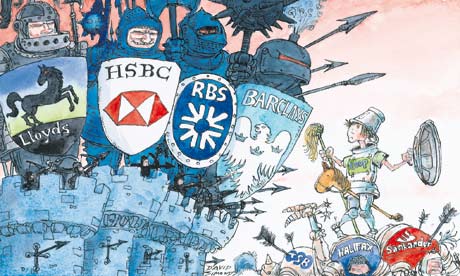
Dave Simonds cartoon Co-op bid for LLoyds branches

Judging the Greeks fiscally and politically incompetent, the conquerors appointed a regent. Baldwin of Flanders, crowned emperor of Constantinople in 1204, was a classic I.M.F.-style appointee: a safe pair of hands, someone with whom other Western leaders could do business.
Meanwhile, the noblemen leading the Crusade, many of whom had brought ruin in the first place with their reckless promises, took control of whole areas of the city and empire for themselves — a classic case of getting in at rock bottom. (So keep an eye on those bankers and their villas in the Aegean; you don’t need to be a historian to know it is a buyers’ market.) The new Latin Empire of Constantinople lasted just 50 years before the Greeks returned to power.
The story is the same as then: cheap money brings handsome rewards but guarantees crisis, while the pain falls solely on the Greeks. Constantinople and Athens may have become addicted to easy money, but the West was their dealer.


*Peter Frankopan is the director of the Center for Byzantine Research at Oxford and the author of “The First Crusade: The Call From the East.”


Miracles of St. John the Russian


One of the most popular saints among Greeks today is St. John the Russian whose incorrupt relics are the boast of the island of Euboia. The multitudes who visit his shrine are such that there is daily bus service to the shrine from Athens. Countless miracles flow from his relics and icons, and even now-when the spirit of the world is having such an oppressive effect on traditional Greek piety–icons of the Saint are often found in buses and in nearly all Orthodox homes. St. John was neither a celebrated hierarch, nor an eloquent theologian, but a simple young man who spent the better part of his life in a stable.

The Saint performed many wonders even after his blessed repose. A descendent of the Agha told many of the following miracle: 
“My children would not live except for a short time, and would die while yet infants. Their unfortunate mother, after she had lost hope in the wisdom of medicine, fled without my knowledge to the relics of the slave John, so that be might grant her a little child which would not die while yet young, so that we also might rejoice to see it as a young man or even a young girl …. In truth the righteous John heard the supplication of my wife. God granted us a strong little boy whom we called, as you know, Kole Guvan Oglu (that is, “Son of the Slave John”), and he lives through the power of God and the prayers of John even until today.”
Several times St. John has appeared in dreams and visions warning of impending dangers. Once he warned some Greek school children that the roof was about to fall; they had time enough to jump underneath their desks and when the roof fell, its beams came down upon the desks without striking even one of the children.
More recently we have heard about the miraculous healings of two severe cases of meningitis – one a 19 year old shepherd boy in southern Greece and the other a 3-year old boy in London.
Today a part of the right hand of St. John is enshrined in a special silver reliquary in the Holy Transfiguration Monastery, Boston, where many people come to venerate it and to ask the prayers of this simple Confessor of the Christian faith, knowing that the Lord – Who resisteth the proud – hears speedily the prayers of the meek.
(Based on a Life by Photios Kontoglou. The Orthodox Word, June-July, 1967)

BBC: Buranovskiye Babushki (Buranovo Grannies) - Russia in Eurovision Song Contest 2012.


This is the Russian singing group Buranovskiye Babushki (Buranovo Grannies) that is representing Russia in Eurovision Song Contest 2012.

The six grannies from Buranovo in Russia wanted to take part in the contest to raise enough money for an Orthodox Church to be built in their village. There has not been a church in the village since the former Church was demolished during the Soviet era, they currently worship in a shop that has been converted into a prayer room.

So, if you plan to vote someone tonight, it would be nice to vote for them, if you want, to help them raise money to build a Church at their village!


Vatican In Chaos After Pope's Butler Arrested For Leaks


Vatican Butler
VATICAN CITY -- The Vatican's inquisition into the source of leaked documents has yielded its first target with the arrest of the pope's butler, but the investigation is continuing into a scandal that has embarrassed the Holy See by revealing evidence of internal power struggles, intrigue and corruption in the highest levels of the Catholic Church governance.
The detention of butler Paolo Gabriele, one of the few members of the papal household, capped one of the most convulsive weeks in recent Vatican history and threw the Holy See into chaos as it enters a critical phase in its efforts to show the world it's serious about complying with international norms on financial transparency.
The tumult began with the publication last weekend of a book of leaked Vatican documents including correspondence, notes and memos to the pope and his private secretary. It peaked with the inglorious ouster on Thursday of the president of the Vatican bank. And it concluded with confirmation Saturday that Pope Benedict XVI's own butler was the alleged mole feeding documents to Italian journalists in an apparent bid to discredit the pontiff's No. 2.
"If you wrote this in fiction you wouldn't believe it," said Carl Anderson, a member of the board of the Vatican bank which contributed to the whirlwind with its no-confidence vote in its president, Ettore Gotti Tedeschi. "No editor would let you put it in a novel."
The bank, known as the Institute for Religious Works, issued a scathing denunciation of Gotti Tedeschi in a memorandum obtained Saturday by The Associated Press. In it the bank, or IOR by its Italian initials, explained its reasons for ousting Gotti Tedeschi: he routinely missed board meetings, failed to do his job, failed to defend the bank, polarized its personnel and displayed "progressively erratic personal behavior."
Gabriele, the pope's personal butler since 2006, has often been seen by Benedict's side in public, riding in the front seat of the pope's open-air jeep during Wednesday general audiences or shielding the pontiff from the rain. In private, he is a member of the small papal household that also includes the pontiff's private secretaries and four consecrated women who care for the papal apartment.
Lombardi said Gabriele's detention marked a sad development for all Vatican staff. "Everyone knows him in the Vatican, and there's certainly surprise and pain, and great affection for his beloved family," the spokesman said.
The "Vatileaks" scandal has seriously embarrassed the Vatican at a time when it is trying to show the world financial community that it has turned a page and shed its reputation as a scandal plagued tax haven.
Vatican documents leaked to the media in recent months have undermined that effort, alleging corruption in Vatican finance as well as internal bickering over the Holy See's efforts to comply with international norms to fight money laundering and terror financing.
The Vatican in July will learn if it has complied with the financial transparency criteria of a Council of Europe committee, Moneyval – a key step in its efforts to get on the so-called "white list" of countries that share financial information to fight tax evasion.
Anderson acknowleged that the events of the last week certainly haven't cast the Holy See in the best light. And he said the bank's board appreciated that the ouster of its president just weeks before the expected Moneyval decision could give the committee pause.
"The board considered that concern and decided that all things considered it was best to take the action at this time," Anderson said. "These steps were taken to increase the IOR's position vis-a-vis Moneyval."
The Vatileaks scandal began in January when Italian journalist Gianluigi Nuzzi broadcast letters from the former No. 2 Vatican administrator to the pope in which he begged not to be transferred for having exposed alleged corruption that cost the Holy See millions of euros in higher contract prices. The prelate, Monsignor Carlo Maria Vigano, is now the Vatican's U.S. ambassador.
Nuzzi, author of "Vatican SpA," a 2009 volume laying out shady dealings of the Vatican bank based on leaked documents, last weekend published "His Holiness," which presented a trove of other documents including personal correspondence to the pope and his secretary – many of them painting Benedict’s No. 2, Cardinal Tarcisio Bertone, in a negative light.
Nuzzi has said he was offered the documents by multiple Vatican sources and insisted he didn't pay a cent (EURO) to any of them.
Gabriele was in Vatican custody and unavailable for comment. No known motive has come to light as to why Gabriele, if he is found to be the key mole, might have passed on the documents. Nuzzi declined to comment Saturday on whether Gabriele was among his sources.
Bertone, 77, has been blamed for a series of gaffes and management problems that have plagued Benedict's papacy and, according to the leaked documents, generated a not inconsiderable amount of ill will directed at him from other Vatican officials.
"For some time and in various parts of the church, criticism even by the faithful has been growing about the lack of coordination and confusion that reign at its center," Cardinal Paolo Sardi, the former No. 2 official in the Vatican secretariat of state, wrote to the pope in 2009, according to the letter cited in "His Holiness."
Anderson, who heads the Knights of Columbus, a major U.S. lay Catholic organization, said he was certain the Holy See would weather the storm and that the Vatican bank, at least, could move forward under a new leader with solid banking credentials as well as a desire to show off the bank's transparency.
"I hope this will be the beginning of a new chapter for the IOR and part of that chapter will be restoring the public image of the IOR," he told AP. "I think we have a good story to tell."

Gotti Tedeschi was also accused by the board of leaking documents himself: The IOR memorandum said he "failed to provide any formal explanation for the dissemination of documents last known" to be in his possession.
In an interview with the AP, Anderson said the latter accusation was independent of the broader "Vatileaks" scandal that has rocked the Vatican for months. But he stressed: "It is not an insignificant issue."
Gotti Tedeschi hasn't commented publicly about his ouster or the reasons behind it, saying he has too much admiration for the pope to do so. He also hasn't been arrested, avoiding the fate that befell Gabriele.
The 46-year-old father of three has been in Vatican detention since Wednesday after Vatican investigators discovered Holy See documents in his apartment. The Vatican spokesman, the Rev. Federico Lombardi, said Gabriele had met with his lawyers and that the investigation was taking its course through the Vatican's judicial system.

Rock And Roll Hall Of Famer Chris Hillman (The Byrds) To Perform At International Orthodox Christian Charities 20th Anniversary Gala


The Byrds - "Turn, Turn, Turn"


In celebration of International Orthodox Christian Charities (IOCC) two decades of faith-based humanitarian work, Rock and Roll Hall of Famer and Orthodox Christian, Chris Hillman, will perform at the organization's 20th Anniversary Gala on May 8, 2012, at the Capital Hilton in Washington, D.C. 

Hillman, whose multi-faceted musical career spans five decades, gained popular recognition as a founding member of The Byrds, one of the most influential American rock bands of the 1960s. Their biggest hit song, "Turn, Turn, Turn," carries a message of peace and tolerance inspired by Biblical verses taken from the Book of Ecclesiastes. The song remains a rock classic and one of a few examples of scripture set to popular music. 

Hillman's appearance at the Gala underscores his strong support of the philanthropic arm of the Orthodox Church. An evangelical Christian who came to know the Orthodox faith through his wife Connie, a Greek Orthodox Christian, he converted after a strong calling to explore Orthodoxy prompted him to speak to a priest and complete the holy sacrament of chrismation. Fifteen years later, he devotes much of his time and talent to supporting his church in Santa Barbara, California, and performing for Orthodox-based benefits like the IOCC 20th Anniversary Gala. "I feel as an Orthodox Christian that the talent God has given me now should be used to help the church and whatever I can do to generate interest to directly benefit those in need." 
The IOCC Gala will mark 20 years as the global humanitarian relief organization of the Assembly of Canonical Orthodox Bishops of North and Central America. Joining Hillman will be a gathering of "who's who" from IOCC's past, present and future. The gala festivities will begin with an afternoon congressional reception hosted by Orthodox Christian members of Congress at the U.S. Capitol building, followed by a VIP cocktail reception and banquet dinner at the Capital Hilton Hotel. The inaugural Compassion at Work award will also be introduced at the 20th Anniversary Gala dinner. The humanitarian award recognizes extraordinary support for IOCC's mission. 


Since 1992, IOCC has worked throughout the world to deliver more than $400 million in emergency aid and development assistance to families in 50 countries. IOCC enjoys an exceptional record of stewardship, with 92% of all resources directly reaching those in need. 
IOCC is a member of InterAction, a coalition of U.S. based non-governmental organizations that carry out humanitarian assistance programs overseas, and the ACT Alliance, a global coalition of churches and relief agencies engaged in development, humanitarian assistance and advocacy. 


Christian Jordanian woman sues her Muslim employer


AMMAN, Jordan — A Christian Jordanian woman said Sunday she is suing her Gulf Arab employer for arbitrary dismissal after she refused a new dress code forcing her to cover her head.
The incident is rare and could stir religious tensions in Jordan, a predominantly conservative Muslim nation whose Western-educated ruler – King Abdullah II – is perceived as a staunch supporter of moderate Islam and tolerance of other religions.
"We are not in Iran, we are in Jordan, and we must continue to enjoy personal and religious freedoms as stipulated by our constitution," said Vivian Salameh, 45, an assistant manager of corporate operations at the Jordan Dubai Islamic Bank since March 2010 until she was fired a week ago.
"I'm Christian. Why should I wear something not dictated by my religion?" she said in an interview.
Christians make up nearly 4 percent of the country's 6 million population.
Bank spokeswoman Eman Affaneh confirmed that Salameh was fired because "she refused to comply with the terms of her contract, which stipulates that all employees must respect management regulations and bank bylaws."
"We are an Islamic establishment and the dress code is a reflection of our conservative Muslim traditions and values," she said.
Salameh says she had worked for Jordan's Industrial Development Bank for 25 years until it was acquired in 2010 by the Jordan Dubai Islamic Bank – an offshoot of the Dubai Islamic Bank based in the United Arab Emirates. In January 2011, the new management issued a new regulation stipulating a unified dress code for its workers, including waist-to-heel skirts and head covers for female employees.
Salameh accepted the uniform, but refused to wear the head cover on grounds that it violated her religious beliefs and since the contract she signed when she was hired did not oblige her to a dress code.
Affaneh, the spokeswoman, said the headcover "is a fashionable piece of white cloth that shows the hair line – like what women wear in the Gulf Arab countries."
"It's not a headscarf, covering all the hair," she added.
She and Salameh said that five other Christian women employees at the bank accepted wearing the headcover.
When Salameh refused the head cover, "no action was taken against me for nearly 17 months until two weeks ago, when I was suddenly given two notices, five days apart, warning me that I will lose my job if I don't wear the head cover," she said.
"When I stuck by my decision, I was verbally fired last Sunday," she said, adding that she filed a lawsuit against the bank.
The next legal step would be for the court to decide when it would hear the case.
Affaneh, the spokeswoman, says the bank has not been notified of the lawsuit.
"Her contract allows her to do what she wants," she said. She declined to discuss the matter further.

Saturday, May 26, 2012

The Vatican investigation: "Vatileaks" scandal - Pope butler, Paolo Gabriele arrested


VATICAN CITY (AP) — The Vatican confirmed on Saturday that the pope's butler has been arrested in its embarrassing leaks scandal, adding a Hollywood twist to a sordid tale of power struggles, intrigue and corruption in the highest levels of Catholic Church governance.
Paolo Gabriele, a layman and member of the papal household, was arrested Wednesday after secret documents were found in his Vatican City apartment and was continuing to be held Saturday, Vatican spokesman the Rev. Federico Lombardi said in a statement.
Gabriele is often seen by Pope Benedict XVI's side in public, riding in the front seat of his open-air jeep during Wednesday general audiences or shielding the pontiff from the rain. He has been the pope's personal butler since 2006, one of the few members of the small papal household that also includes the pontiff's private secretaries and four consecrated women who care for the papal apartment.
His arrest followed another stunning development at the Vatican this week, the ouster of the president of the Vatican bank, Ettore Gotti Tedeschi, by his board. Sources close to the investigation said he, too, was found to have leaked documents, though the official reason for his ouster was that he simply failed to do his job.
The "Vatileaks" scandal has seriously embarrassed the Vatican at a time during which it is trying to show the world financial community that it has turned a page and shed its reputation as a scandal plagued tax haven.
Vatican documents leaked to the press in recent months have undermined that effort, alleging corruption in Vatican finance as well as internal bickering over the Holy See's efforts to show more transparency in its financial operations. But perhaps most critically, the leaks have seemed aimed at one main goal: to discredit Pope Benedict XVI's No. 2, Cardinal Tarcisio Bertone, the Vatican secretary of state.
The scandal took on even greater weight last week with the publication of "His Holiness," a book which reproduced confidential letters and memos to and from Benedict and his personal secretary. The Vatican called the book "criminal" and vowed to take legal action against the author, publisher, and whoever leaked the documents.
The Vatican had already warned of legal action against the author, Italian journalist Gianluigi Nuzzi, after he broadcast letters in January from the former No. 2 Vatican administrator to the pope in which he begged not to be transferred for having exposed alleged corruption that cost the Holy See millions of euros in higher contract prices. The prelate, Monsignor Carlo Maria Vigano, is now the Vatican's U.S. ambassador.
Nuzzi, author of "Vatican SpA," a 2009 volume laying out shady dealings of the Vatican bank based on leaked documents, said he was approached by sources inside the Vatican with the trove of new documents, most of them of fairly recent vintage and many of them painting Bertone in a negative light.
Bertone, 77, had no diplomatic experience when, after Benedict's election, he took over the high-profile job as the main administrator of the Vatican and its external relations. He had long been Benedict's loyal deputy as a canon lawyer at the Vatican's orthodoxy office.
But he has been blamed for a series of gaffes that have plagued Benedict's papacy and, according to the leaked documents, generated a not inconsiderable amount of ill will directed at him from other Vatican officials.
"For some time and in various parts of the church, criticism even by the faithful has been growing about the lack of coordination and confusion that reign at its center," Cardinal Paolo Sardi, the former No. 2 official in the Vatican secretariat of state, wrote to the pope in 2009, according to the letter reproduced in "His Holiness."
At a news conference this week, Nuzzi defended the publication of the book and said he wasn't afraid of Vatican retaliation. In fact, he even taunted Vatican prosecutors to seek help from Italian magistrates to investigate the case, charging that it would be a remarkable turnaround, given that the Vatican has been less than helpful in the past when Italian prosecutors came asking for information for their investigations.
He praised his sources — and said there were several — in his acknowledgments, writing: "They risked their jobs, loves, lives to entrust their big and little secrets."
Nuzzi had no comment Saturday about the arrest.
Lombardi said Saturday the arrest of Gabriele was a sad development for all Vatican staff. "Everyone knows him in the Vatican, and there's certainly surprise and pain, and great affection for his beloved family," Lombardi said.
Lombardi said Gabriele had met with his two lawyers and that the Vatican judicial system was taking its investigative course. He hasn't been indicted.
The Vatican has taken the leaks very seriously, with Benedict appointing a commission of cardinals to investigate. Vatican gendarmes as well as prosecutors are also investigating the sources of the leaks.

Greek Archbishop Ieronymos Meets With Russian Patriarch Kirill and President Putin


The Archbishop of Athens and All Greece Ieronymos is paying an official visit to Russia on the invitation of the Patriarch of Moscow and All Russia Kirill. The Greek Orthodox primate also met with Russian President Vladimir Putin yesterday at the Cathedral of Christ the Savior in Moscow.
Putin thanked the Greek primate for visiting the country on the day marking the Name Day of Patriarch Kirill of Moscow and All Russia and the Day of Slavic Writing and Culture, noting that the sermon of Saints Kirill and Methodius has a strong cultural tie between Greece and Russia.
“On this day, the spiritual roots that unite us are particularly vivid. I am certain that you will like Russia. We are very happy to see you,” said Putin as he welcomed the Greek Orthodox primate during his first official visit to the Russian Orthodox Church, according to the official website of Kremlin.
Among others, the Greek Archbishop referred to the Name Day of the Russian primate, while he also congratulated Vladimir Putin for his recent re-election and swearing-in as the new president of Russia.
According to the official transcription of the dialogue by the Kremlin, his Beatitude Hieronymos also commented on the historic ties connecting the people of the two countries through the centuries.
“As you already said, our people are linked by many centuries of history – these ties span over many centuries, even before the advent of Christianity in Russia, the colonization that Greek settlers brought to the territory of your nation. But most of all, we are united by the Orthodox faith. We would like to specifically emphasize this today, to ensure great relations between all our Orthodox people,” 

Thursday, May 24, 2012

Europe is driving full-tilt, foot on the pedal, into a brick wall


It’s unbelievable that we should be urging our neighbours to adopt a tighter fiscal union, argues Boris Johnson.

Message understood: graffiti depicting the Euro symbol as a grenade about to be thrown by a soldier, sits on a wall in Athens - Europe finally awakes from its utopian dream
Message understood: graffiti depicting the euro symbol as a grenade about to be thrown, on a wall in Athens 


I see the G8 has a brilliant solution to the problems of the eurozone. President Obama says it’s time for “growth and jobs”. Jolly good. That’s the stuff. Let me show you how to create employment – the Brussels way.
Come with me through the streets of Athens, not far from Syntagma Square, and your mind will reel with the horrified realisation that history is not a one-way ratchet, that human progress is not guaranteed, and that a proud country can be reduced – by years of torture and bullying – to a state verging on total political, economic and moral collapse.
You will see businesses boarded up and windows smashed because no one has the money or the energy to fix them, and on almost every wall a riot of graffiti full of poisonous hatred for politicians. You will see people sitting on cardboard, heads down, hands out, or pushing trolleys full of scrap metal.
Not far from the town hall, I saw a man using the pavement as an operating theatre to eviscerate a mattress for its springs. In the eyes of every politician there is a glassy humiliation, a sense that the fate of the nation is no longer in their hands. Even worse than the humiliation is the dread that things will deteriorate further still. Thousands are now being fed by soup kitchens.
Unemployment is rising by the day, and among young people it now stands at a shameful 54 per cent. Yup, folks – those are the results of an EU plan to produce “growth and jobs”. It was called the euro, and it has been a catastrophe for Greece and pretty bad (with one notable exception) for the rest of the continent.
As far as I can understand the “strategy” of the EU, it is now to prepare for Greece to leave the single currency. Not that the Greeks themselves are anything like psychologically ready to quit: the politicians are punch-drunk, exhausted, and appalled at the loss of face and loss of security that would go with a sundering from “Europe”. Most voters choose pro-euro parties. But money is being withdrawn from banks; events are gathering momentum; and it is clear from their remarks that other EU leaders are getting ready for an outcome which until recently was held to be impolite to mention: the Grexit.
And then what? And then the strategy would appear to be to cauterise the amputation; to circle the wagons; to issue the most ringing and convincing proclamation to the markets that no more depredations will be tolerated; and to get the Germans to stump up, big time, to protect Spain and Portugal. We are told that the only solution now is a Fiscal Union (or FU). We must have “more Europe”, say our leaders, not less Europe – even though more Europe means more suffering, and a refusal to recognise what has gone wrong in Greece.
The euro has turned out to be a doomsday machine, a destroyer of jobs, a killer of growth, because it entrenches and exacerbates the fundamental and historic inability of some countries to compete with Germany in making high-quality goods with low-unit labour costs. Unable to devalue their way back into the game, these countries are forced to watch industry wilt under German imports, as the euro serves as a giant trebuchet to fire swish German saloon cars and machine tools across the rest of Europe.
Germany is almost alone in recording economic growth in the first part of 2012; Germany is doing well from the euro; and so the theory is that Germany should pay to keep the whole racket going by bailing out the improvident and the uncompetitive, just as London and the South East subsidise the rest of the UK.
Alas, it is not a strategy that is likely to work. As Angela Merkel has made clear, there is little political support – let alone popular support – in Germany. EU leaders may want a fiscal union, but it is deeply anti-democratic. We accept large fiscal transfers in this country because Britain has a single language and a single political consciousness in a way that Europe never will. Rather than creating an “economic government of Europe”, the project will lead to endless bitterness between the resentful donors and the humiliated recipients, as these diminished satrapies will be instructed to accept cuts and “reforms” – designed in Berlin and announced in Brussels – as the price of their dosh.
And it is not as if the markets will believe in these “firewalls”, or not for very long. If they can prise away Greece, they will know they can prise away others. As long as the euro can break up, there is always a risk that it will break up. So it is frankly unbelievable that we should now be urging our neighbours to go for fiscal union. It is like seeing a driver heading full-tilt for a brick wall, and then telling them to hit the accelerator rather than the brake.
Europe now has the lowest growth of any region in the world. We have already wasted years in trying to control this sickness in the euro, and we are saving the cancer and killing the patient. We have blighted countless lives and lost countless jobs by kidding ourselves that the answer to the crisis might be “more Europe”. And all for what? To salvage the prestige of the European Project, and to spare the egos of those who were wrong and muddle-headed enough to campaign for the euro.
Surely it is now time to accept that the short-term pain of a managed euro rupture – a wholesale realignment, possibly a north/south bisection – would be better than continuing to immiserate so many people around the continent.
At the end of a day in Athens, I was so sad at what I had seen that I went to a kafeneion and ordered a metaxa. And then another. At length, I fished into my wallet and found a rather handsome banknote, with an image of Apollo from Olympia. “Not today,” said the owner, politely declining my drachmas. “In a month, yes.” It will be awful for Greece, and turbulent for Britain, but at present I can think of no better solution.

Top food was olives in time of the ancient mariner


A huge quantity of olive stones on an ancient shipwreck more than 2,000 years old has provided valuable insight into the diet of sailors in the ancient world, researchers in Cyprus said Thursday.
The shipwreck, dating from around 400 B.C. and laden mainly with wine amphorae from the Aegean island of Chios and other north Aegean islands, was discovered deep under the sea off Cyprus’s southern coast.
Excavation on the site, which started in November 2007, has determined that the ship was a merchant vessel of the late classical period.
“An interesting piece of evidence that gives us information on the conditions under which the sailors of antiquity lived, are the large numbers of olive pips that were found during excavation, since these pips must have been part of the crew’s food supply,” Cyprus’s antiquities department said in a news release Thursday.
The excavation is shedding light on seafaring in Cyprus in antiquity, commerce between the island and the Aegean and the sizes of the period’s cargo ships, it said.
Olives and olive oil are a staple of the Mediterranean diet and their consumption over hundreds of years has been well documented.
Italian archaeologists discovered that some of the world’s oldest perfumes, made in Cyprus, were olive oil based. The commodity was also used to fire copper furnaces.
Apart from the amphorae, or large clay wine jars, two lead rods with remains of wood were found.
“This especially rare find enhances the importance of the shipwreck and strengthens the possibilities of finding preserved wood from the ship’s keel,” the department said.

Wednesday, May 23, 2012

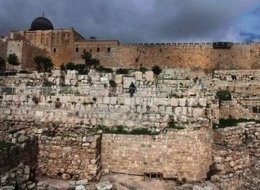
Ancient Jerusalem Wall Provides Proof For Bible Stories, Archaeologist Says


Ancient Wall

JERUSALEM — An Israeli archaeologist said Monday that ancient fortifications recently excavated in Jerusalem date back 3,000 years to the time of King Solomon and support the biblical narrative about the era.
If the age of the wall is correct, the finding would be an indication that Jerusalem was home to a strong central government that had the resources and manpower needed to build massive fortifications in the 10th century B.C.
That's a key point of dispute among scholars, because it would match the Bible's account that the Hebrew kings David and Solomon ruled from Jerusalem around that time.
While some Holy Land archaeologists support that version of history – including the archaeologist behind the dig, Eilat Mazar – others posit that David's monarchy was largely mythical and that there was no strong government to speak of in that era.
Speaking to reporters at the site Monday, Mazar, from the Hebrew University of Jerusalem, called her find "the most significant construction we have from First Temple days in Israel."
"It means that at that time, the 10th century, in Jerusalem there was a regime capable of carrying out such construction," she said.
Based on what she believes to be the age of the fortifications and their location, she suggested it was built by Solomon, David's son, and mentioned in the Book of Kings.
The fortifications, including a monumental gatehouse and a 77-yard (70-meter) long section of an ancient wall, are located just outside the present-day walls of Jerusalem's Old City, next to the holy compound known to Jews as the Temple Mount and to Muslims as the Noble Sanctuary. According to the Old Testament, it was Solomon who built the first Jewish Temple on the site.
That temple was destroyed by Babylonians, rebuilt, renovated by King Herod 2,000 years ago and then destroyed again by Roman legions in 70 A.D. The compound now houses two important Islamic buildings, the golden-capped Dome of the Rock and the Al-Aqsa mosque.
Archaeologists have excavated the fortifications in the past, first in the 1860s and most recently in the 1980s. But Mazar claimed her dig was the first complete excavation and the first to turn up strong evidence for the wall's age: a large number of pottery shards, which archaeologists often use to figure out the age of findings.
Aren Maeir, an archaeology professor at Bar Ilan University near Tel Aviv, said he has yet to see evidence that the fortifications are as old as Mazar claims. There are remains from the 10th century in Jerusalem, he said, but proof of a strong, centralized kingdom at that time remains "tenuous."
While some see the biblical account of the kingdom of David and Solomon as accurate and others reject it entirely, Maeir said the truth was likely somewhere in the middle.
"There's a kernel of historicity in the story of the kingdom of David," he said.


Category

1915 Armenian Genocide 21st-century Christian martyrs‎ Al Qaeda Apostles Arab Christian Arab-Orthodox Archimandrite Tikhon Shevkunov Asia Australia BBC Belarusian Orthodox Church Bethlehem Bible movies Bulgarian Orthodox Church Byzantine C.I.A. Cairo China Christian Armenians Christmas Traditions Christmas tree Conspiracy Constantinople Documentary Easter Ecumenical Patriarch Ecumenical Patriarch Bartholomew I Ecumenical Patriarchate of Constantinople Elder Ephraim of Vatopaidi Elder Porphyrios Epiphany FREE Greetings Cards FREE books Fr Seraphim Rose Georgian Orthodox Church Greek Orthodox Church Greek Orthodox Easter Holy Fathers Holy Scripture Holy Tradition Internet Interview Italy Jesus Christ Middle East Miraculous Icon Mount Sinai Movie Trailers Orthodox Church in America Palestine Prophecy Russia Russian Orthodox Church Saints Shroud of Turin Son of God St Nicholas of Myra The Mount Athos Food Evolution UK Ukraine Ukrainian Orthodox Church Vatican Watch FREE full movie africa al assad albania anti-Morsi protests army bank bible bible translations bulgaria byzantine music christianity christians christmas church coptic church copts cyprus daily news economy egypt egypt pope elder elder Paisios elder joseph of vatopaidi english subtitles europe food france fyrmacedonia germany greece greek greek food greek music greek orthodoxy health and medicine icon iran islam islamist israel jerusalem jews jihad killed libya mafia monastery money mother of god mount athos music muslim muslims news orthodox church pakistan patristic tradition photo photos picture politics pope protests quotes recipes religion romania romanian orthodox church saint science spy syria theotokos travel turkey tv usa vatopaidi video war world
Related Posts Plugin for WordPress, Blogger...