Search This Blog

Image and video hosting by TinyPic
Showing posts with label ecology. Show all posts

Friday, January 25, 2013

Exclusive: Billionaires secretly fund attacks on climate science


A secretive funding organisation in the United States that guarantees anonymity for its billionaire donors has emerged as a major operator in the climate "counter movement" to undermine the science of global warming, The Independent has learnt.


The Donors Trust, along with its sister group Donors Capital Fund, based in Alexandria, Virginia, is funnelling millions of dollars into the effort to cast doubt on climate change without revealing the identities of its wealthy backers or that they have links to the fossil fuel industry.

However, an audit trail reveals that Donors is being indirectly supported by the American billionaire Charles Koch who, with his brother David, jointly owns a majority stake in Koch Industries, a large oil, gas and chemicals conglomerate based in Kansas.

Millions of dollars has been paid to Donors through a third-party organisation, called the Knowledge and Progress Fund, with is operated by the Koch family but does not advertise its Koch connections.

Some commentators believe that such convoluted arrangements are becoming increasingly common to shield the identity and backgrounds of the wealthy supporters of climate scepticism – some of whom have vested interests in the fossil-fuel industry.
The Knowledge and Progress Fund, whose directors include Charles Koch and his wife Liz, gave $1.25m to Donors in 2007, a further $1.25m in 2008 and $2m in 2010. It does not appear to have given money to any other group and there is no mention of the fund on the websites of Koch Industries or the Charles Koch Foundation.

The Donors Trust is a "donor advised fund", meaning that it has special status under the US tax system. People who give money receive generous tax relief and can retain greater anonymity than if they had used their own charitable foundations because, technically, they do not control how Donors spends the cash.

Thursday, January 3, 2013

Climate change threatens French wine


PARIS, France — From rising shorelines to devastating hurricanes, the visible effects scientists say climate change is wreaking on daily life no longer surprise many people around the world.
The French have their own take on just how radically life may change.
Vineyard 12 28 2012“In 20 years, the English will be making Grenache from Chateauneuf-du-Pape,” says Herve Lethielleux, co-owner of L’Etiquette, a wine boutique in central Paris, about a wine variety from subtropical southeastern France.
That’s because the changing climate is affecting the delicate balance of weather, soil and other factors that are central to the production one of their main commodities, something that’s already had a visible effect elsewhere around the globe.
“If you look at Tasmania, it was too cool to grow grapes 25 to 40 years ago,” says Gregory Jones, a research climatologist at Southern Oregon University, about the wine-producing region of Australia. “Today, it’s clearly much more suitable.”
For French winemakers already keenly feeling the effects of growing competition from other countries, higher temperatures in recent years have meant grapes with lower acidity and higher sugar content. That makes for higher alcohol and fruitier — some say cloying — wines.
“As you get older you don’t want those hugely alcoholic fruit bombs,” says Juan Sanchez, owner of Le Derniere Goutte, a wine shop on Paris’s storied Left Bank.
In France, where wine is an important part of social culture, “alcoholic fruit bombs” are also counterintuitive to the typical palate. Usually paired with food, wine is generally intended to enhance rather than overpower. “You almost don’t want to eat with those kinds of wines, they’re like a meal in themselves,” Sanchez explains.
Lethielleux says many of the winemakers with whom he works have been documenting gradual but persistent changes in climate over the past decades — and noting increasingly earlier harvest dates with growing alarm. “The grapes just aren’t ripening properly,” he adds.
Such concerns raise an increasingly common question: “Will people have to change what they’re planting to adapt?” Sanchez says.
That’s easier said than done, thanks to the strict French system for categorizing wines. They can be classified as AOC — appellation d'origine controlee, or controlled designation of origin — only if they conform to certain varietal constraints in each region.
Drastic changes to grape varieties — even in response to potentially ruinous climate change — can be a risky business for growers. “You can do it but you lose the appellation,” Lethielleux says. “If you’re not a great winemaker, having your wine declassified means you can’t sell it at the same price anymore.”
The changing environment is starting to shake a system that’s been central to European wine for centuries. “Europe has historically been about regional identities based on varieties of wines and particular styles,” says Jones, a specialist in the study of climate structure and suitability for viticulture.
“Those that have adaptive capacity in the face of climate change are going to be much more able to adapt across a range of different climate futures,” he adds.
However, climate change is nothing new in the earth’s history, he points out. “Today the issue is that our agricultural systems are much more fixed,” he says, “and our investments in our agricultural systems are much more fixed.”
Despite the rising concern, Jean-Pascal Goutouly, a researcher at the Institut des Sciences de la Vigne et du Vin, part of the National Institute for Agricultural Research in Bordeaux, says full-on crisis mode hasn’t yet arrived. “Things are okay for the moment,” he says. “We still have the possibility to adapt to the conditions.”
As this year showed, it’s not only warmer temperatures and earlier harvests that are affecting wine, but more volatile weather in general.
“This is a bad year — a lot of disease, a lot of rain, a late spring and a summer that never arrived — and it was dreadful with hail,” Lethielleux says. “The grapes are all stressed: They’re full of sugar, but they’re not ripe.”
Weather fluctuation of more than “two or three times more than what you’re used to” may jeopardize the entire French viniculture system, Jones says, adding that the main threat is the combination of factors.
“France has a long, rich history of growing grapes and making wine,” he says. “Production has varied, there are good years and bad years, and French wine growers have always dealt with that.”
“The issue today,” he adds, “is that it appears climates are both changing and varying more than they have historically and our potential to adapt across those climates is more challenged.”
Even if future adaptation is possible, that may be little consolation to winemakers who lost significant portions of their crop this year. The harvest was the smallest in at least 40 years, according to the Agriculture Ministry, which estimates overall production to be down by 20 percent thanks to lousy weather across France.
That’s already a source of consternation around French tables and wine bars. And it’s starting to resonate around the world, as lovers of French wine begin to worry about what climate change may mean for the availability — and price — of their favorite Bordeaux or Bourgogne at their local wine shops. 

Wednesday, January 2, 2013

UK: What is going on with our weather?


Scientists are trying to fathom what is causing extreme variations in British weather

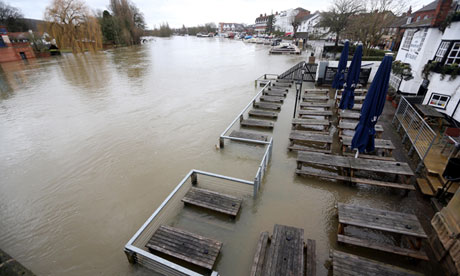
flooding river thames
The River Thames


The transformation of the British landscape over the last 12 months has been dramatic.
At the end of 2011, the nation was caught in the grip of one of the severest droughts on record. Low rainfall over the previous year had reduced water levels in rivers and reservoirs to exceptional levels. The year ahead promised to be one of parched landscapes, hosepipe bans and streams turned to trickles. There could have been widespread consequences for farmers, food production, tourism, industry and domestic life, warned officers from the Environment Agency.
Today, the country is in a very different state. Villages across much of the UK have been flooded and cut off; railway lines have been closed; hundreds of flood alerts have been issued by the Environment Agency; homes have been evacuated and commuters and travellers have been forced to abandon plans for the festive season as sections of the transport network have ground to a halt. Today, the UK is on the brink of having had its wettest year since records began in 1910.
It is an astonishing change of fortunes. Last year was the driest on record in England and Wales for 90 years. This year will be one of the wettest. The question is: what has brought about this remarkable transformation?
According to experts, the key changes in Britain's weather occurred in early summer. The past couple of weeks may have seen momentous downpours across much of the country, with south-west England bearing the brunt of the grim weather, but it was record falls over the months between April and June that brought UK figures to their highs for 2012 and have raised river and reservoir levels to brimming point.
"The early summer months were the ones that turned drought to deluge in the UK," said Helen Roberts, a forecaster at the Met Office.
"As to the cause, the jetstreams that sweep high over the country were largely to blame. Jetstreams carry ribbons of air at high speeds and altitudes and normally trap regions of high pressure over Britain in summer," she said. "But this year the jetstreams trapped a region of low pressure over the country for several months in summer and that, in turn, brought all that rain to the country."
As to the reason for the change in jetstream behaviour, several suggestions have been put forward. These include the proposal that rising temperatures in the Arctic – triggered by increasing levels of manmade greenhouse gases in the atmosphere – could be destabilising jetstream patterns. However, scientists stress that more research is needed.

Thursday, December 27, 2012

Man-made tornadoes may produce green energy (PHOTOS)

A tornado forms in the sky above Aken some 150 kilometers.(Reuters / Holger Otto) 

Massive man-made twisters reaching to the skies from cyclopean structures on the ground may be the future of suburban landscape. A Canadian firm is developing the technology to use the tornadoes to produce electricity – and assures it would be safe.
The company, AVEtec Energy Corporation, is working on a proof-of-concept device after winning this month a grant from The Thiel Foundation, a non-profit organization created by PayPal co-founder Peter Thiel. The machine is meant to make a rotating column of air that sucks air from its base like a natural twister.
The company already built a four-meter diameter prototype and will now use the grant money to construct a version twice as big, which it hopes will produce a 40-meter tall vortex with a diameter of 30 centimeters.
A concept engine. (Image from AVEtec website) 
“Power output increases geometrically with size, so commercialization will become economically viable when we build a 40-meter diameter prototype in 2015” said Louis Michaud, AVEtec president.
The proposed design is not unlike a conventional solar updraft tower, in which the sun heats up air in a large greenhouse-like structure and goes up through a tall chimney in the center. The air convection moves turbines to produce electricity.
The LM-6 prototype. (Photo by AVEtec)
The proposed Atmospheric Vortex Engine (AVE) takes a similar approach, but the air goes inside the tower through tangential inlets and forms a tornado. Thanks to the rotation of the air column it remains stable long after rising past the top of the chimney rather than mixing with the cooler ambient air. It can potentially go up as far as 20 kilometers for a vortex with the base diameter of 100 meters generated in a 200-eter diameter 80-meter high tower, the company’s website explains.
The height of this “virtual chimney” and the low temperature at its “outtake” in the troposphere means that the process can be sustained with a much smaller temperature difference that what is required for an updraft tower power plant to operate. In fact it does not require a solar collector farm, instead pre-heating the air on the intakes to start the process, the company says.
The device in action. (Photo by AVEtec)
The initial heat input may come from industrial waste heat (the company says one of the applications of the technology may be simply replacing cooling towers at plants with cheaper twister generators) or from a natural source like the tropical ocean waters – the same that give energy to the natural tornadoes and hurricanes.
The big ‘if’ in the technology is whether the man-made twister is able to survive a horizontal wind. This question can be answered only after a larger-scale test, the company says. If the concept proves reliable, it may become one of the cheapest sources of energy costing as low as 3 cents per kilowatt hour, which would also not produce additional emission.
Side effects of the technology, if it goes industrial scale, may include producing clouds and rains in a power plant vicinity and making the environment there somewhat cooler. AVEtec assures that an artificial tornado cannot run amok, destroying the plant that produced it and the neighborhood.
The device in action. (Photo by AVEtec)


Category

1915 Armenian Genocide 21st-century Christian martyrs‎ Al Qaeda Apostles Arab Christian Arab-Orthodox Archimandrite Tikhon Shevkunov Asia Australia BBC Belarusian Orthodox Church Bethlehem Bible movies Bulgarian Orthodox Church Byzantine C.I.A. Cairo China Christian Armenians Christmas Traditions Christmas tree Conspiracy Constantinople Documentary Easter Ecumenical Patriarch Ecumenical Patriarch Bartholomew I Ecumenical Patriarchate of Constantinople Elder Ephraim of Vatopaidi Elder Porphyrios Epiphany FREE Greetings Cards FREE books Fr Seraphim Rose Georgian Orthodox Church Greek Orthodox Church Greek Orthodox Easter Holy Fathers Holy Scripture Holy Tradition Internet Interview Italy Jesus Christ Middle East Miraculous Icon Mount Sinai Movie Trailers Orthodox Church in America Palestine Prophecy Russia Russian Orthodox Church Saints Shroud of Turin Son of God St Nicholas of Myra The Mount Athos Food Evolution UK Ukraine Ukrainian Orthodox Church Vatican Watch FREE full movie africa al assad albania anti-Morsi protests army bank bible bible translations bulgaria byzantine music christianity christians christmas church coptic church copts cyprus daily news economy egypt egypt pope elder elder Paisios elder joseph of vatopaidi english subtitles europe food france fyrmacedonia germany greece greek greek food greek music greek orthodoxy health and medicine icon iran islam islamist israel jerusalem jews jihad killed libya mafia monastery money mother of god mount athos music muslim muslims news orthodox church pakistan patristic tradition photo photos picture politics pope protests quotes recipes religion romania romanian orthodox church saint science spy syria theotokos travel turkey tv usa vatopaidi video war world
Related Posts Plugin for WordPress, Blogger...